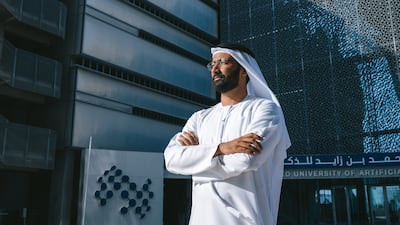

A new fellowship programme for Emirati postdoctoral researchers and academic leaders who incorporate artificial intelligence into their research has selected its first recipient.
Dr Mohamed Almarei has been selected as the inaugural recipient of the Ruwwad AI Scholars (RAIS) Fellowship from Mohamed bin Zayed University of Artificial Intelligence (MBZUAI).
He will take up a two-year research placement at the University of Oxford to continue applying AI to synthetic biology. Fellows are fully funded and sent to leading international institutions to build on their talents.

“AI is becoming increasingly important to how we approach scientific research, particularly in fields such as biology, where complexity has long limited our ability to predict outcomes,” Dr Almarei told The National.
Turning point
Dr Almarei received his doctorate in bioengineering from Imperial College London, where he researched the engineering of biological systems for more sustainable bioproduction.
The researcher came across the work of Prof Jean-Baptiste Lugagne, who works at the University of Oxford, at a conference earlier this year, which he described as a “turning point”.
He found the methodology valuable in answering questions his own research had brought up and chose Prof Lugagne's lab for his fellowship placement.
Dr Almarei said: “His research demonstrated how machine-learning could help predict cellular behaviour without requiring a complete understanding of every underlying process. I am now building on my experimental bioengineering background to investigate how data-driven AI models can help us better predict and control living systems.”
His research at Oxford will harness AI to explore biological systems. “The aim is to develop accurate models that help us decrease our reliance on costly wet-lab experiments and design better biological systems for more reliable and sustainable biological production,” he said.
Making a difference
Meanwhile, the UAE has been investing heavily in AI technology and infrastructure.
Last week, Abu Dhabi's Artificial Intelligence and Advanced Technology Council met to review AI progress. A joint UAE-US AI Campus is planned for Abu Dhabi, while the Abu Dhabi government plans to become fully AI-native by 2027, which would be a world first.
Dr Almarei hopes to be part of this future and play a role in his country's development in the AI sphere. Fellows are considered for faculty positions at MBZUAI on their return.
“The UAE has made AI a national priority, investing in research, education and the development of specialised talent,” he said. “Contributing to the UAE's future has always been part of my ambition. For me, success means gaining expertise that advances my research and strengthens the knowledge and capabilities I can bring back to the UAE.”
The Emirati researcher wants his work to continue beyond Oxford to make a difference domestically and globally.
“I see myself conducting research with both economic and societal impact, contributing to high-impact publications in world-class journals that reach the wider scientific community and mentoring the next generation of researchers on scientific rigour and integrity for the betterment of humanity,” he said.