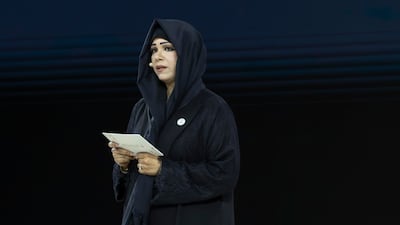

Residents who posted positive comments about feeling safe during Iran's spate of missile and drone attacks on the UAE were doing so out of love for the country, Sheikha Latifa bint Mohammed has said.
The Dubai Culture and Arts Authority chairwoman was speaking on Wednesday at the Arab Media Summit, where she explored the connection between the country's leadership and its population.
A prime example was when residents rallied behind the UAE in the wake of the Iranian attacks on the country, which began on February 28, said Sheikha Latifa in her address at the summit.

She said some observers questioned why people were defending the UAE, even going as far to suggest they were being paid for positive content.
Media outlets in the UK had criticised Dubai-based influencers for painting a positive picture of their experiences at the height of the conflict, speculating that they may have been paid for their positive posts.
“People who defended and supported the UAE didn't do it for payment but because of their love of the UAE,” said Sheikha Fatima, daughter of Sheikh Mohammed bin Rashid, Vice President and Ruler of Dubai.
“People were proud of their country and its path,” she said, adding that such loyalty was not surprising in a country where people had developed a strong relationship with its leaders.
“Anyone working in Dubai's government sector understands that the emirate's leadership has set a clear objective, ensuring the happiness, comfort and security of everyone living in the city. When all entities and systems work to serve the human, it makes the human trust the country, the leaders and the government.”
That trust, she added, had grown through time and experience. Sheikha Latifa also spoke about Dubai's evolving global identity and the role of its residents in shaping the city's story. “We can write 1,000 stories about the city, but the one that has an impact is the one people of the city write about the city,” she said.
Keeping trust
Dubai had built trust through difficult periods and challenges, she said, adding that the emirate was guided by a leadership that did not believe in the concept of the impossible.
The UAE had consistently placed its faith in its people and their capabilities, she said, helping Dubai establish itself as a global city capable of attracting visitors, investors and talent. “People here feel they have a role to play in building the future of the city,” she said.
Sheikha Latifa said the rapid development of artificial intelligence was transforming the media landscape, making it easier than ever for people to create and distribute content, making it more of a challenge to ensure the correct information was finding its audience.
“Anyone can create content or publish news,” she said. “Reaching information and the audience is easier.”
Technology allows people to produce content within seconds, but trust cannot be built in seconds, she said.
Sheikha Latifa said younger generations were particularly aware of the challenges posed by misinformation, noting that 55 per cent of people under the age of 30 in the Arab world are exposed to a rapidly changing information environment.
The challenge for cities and institutions, she suggested, is to build genuine relationships with their communities that can withstand an era in which technology can rapidly amplify both accurate information and false narratives.
“Great cities can attract people by making them genuine partners in building their future. In Dubai, we learnt to work with good intentions, and trust will make the achievement last,” she said.

