A multimillion-dollar UAE award fund recognising efforts to address climate change, expand access to healthcare services and strengthen food and water security around the world has received a record number of submissions.
The Zayed Sustainability Prize, now in its 18th year, attracted 10,233 entries from 177 countries, which marks a 32 cent increase on the previous awards cycle. The prize honours organisations focused on projects in six categories – climate action, health, food, energy, water and global high schools.
The prize, which celebrates the legacy of UAE Founding Father, the late Sheikh Zayed bin Sultan Al Nahyan, empowers small to medium-sized enterprises, non-profit organisations and high schools to deliver sustainable solutions to pressing global challenges. The finalists are to be announced in September, with the awards ceremony held on January 12 next year.

The winners of the climate, health, water, food and energy categories will secure $1 million to support their projects, while each finalist will receive $150,000.
The six high school award winners – selected from entrants around the world – will receive $150,000, with finalists each handed $25,000.
-
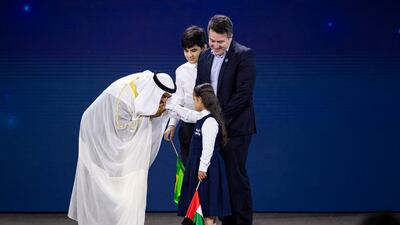
President Sheikh Mohamed presents the 2026 Zayed Sustainability Prize for Health to representatives from Jade, during the opening ceremony of Abu Dhabi Sustainability Week at Abu Dhabi National Exhibition Centre on January 13. All photos: UAE Presidential Court -

President Sheikh Mohamed attends the opening ceremony of Abu Dhabi Sustainability Week. Seen with Aleksandar Vucic, President of Serbia, Faustin Archange Touadera, President of the Central African Republic, Patrick Herminie, President of Seychelles and Ferdinand Marcos Jr, President of the Philippines -

President Sheikh Mohamed applauds during the opening ceremony at Abu Dhabi National Exhibition Centre -
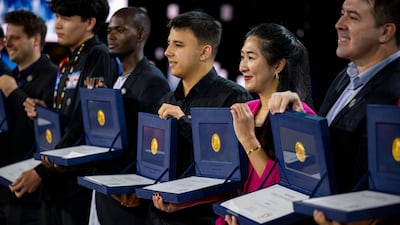
Winners of 2026 Zayed Sustainability Prize -

Performers during the prize ceremony -

Celebrations at the Abu Dhabi National Exhibition Centre -

The UAE flag is displayed on screen during the award ceremony


Dr Sultan Al Jaber, Minister of Industry and Advanced Technology and director general of the Zayed Sustainability Prize, said the surge in applications underlined the need for meaningful action to support communities in need.
“This historic level of participation reflects the growing global demand for practical solutions that build resilience, strengthen essential systems and deliver lasting impact," Dr Al Jaber said. "This year’s applicants have shown how AI, adaptability, innovation and local leadership can come together to address urgent challenges in communities where access, affordability and reliability remain limited.
"Guided by the legacy of the late Sheikh Zayed bin Sultan Al Nahyan, the prize will continue to support pioneers whose solutions are practical in purpose, grounded in service and measured by the positive difference they make in people’s lives.”
Developing solutions
There was strong participation from the UAE, Bangladesh, Brazil, China and Kenya. More than two thirds of submissions originated from developing and emerging economies.
The climate action category received the highest number of submissions (2,505), followed by food (2,261), health (1,807), global high schools (1,710), energy (994) and water (956).
Among the thousands of applications this year, key trends emerged, with a sharp focus on ways to harness advanced technology as a force for good. In the health category, projects centred on efforts to ensure underserved and vulnerable communities were given critical access to health care.
There was strong representation from AI-powered diagnostics and low-cost medical devices to health financing initiatives. In the food category, submissions explored how to bolster support networks for farmers, embrace agricultural technology and strengthen supply chains.
Energy solutions looked at improving efficiency and storage and boosting affordability and reliability, while in the water category there was an emphasis on enhancing access and conservation in communities facing water security challenges.
Climate action applications focused on adaptation and community adoption, as well as waste reduction and circular economy models. The school category, meanwhile, emphasises a push to protect the environment, spanning renewable energy, food production and biodiversity.
All entries are now set to undergo an independent review and due diligence process, followed by assessment from a committee of international experts.
Making a difference
The prize has selected 139 winners over the years, whose projects and initiatives have helped more than 400 million people around the world. In the latest award ceremony in January, Brazilian company Jade won the health category for its AI-powered game that provides early detection and personalised intervention in conditions such as autism and ADHD.
In the climate action category, Build up Nepal triumphed for manufacturing low-carbon, earthquake-resilient eco bricks to replace coal-fired materials and help cut emissions for affordable housing.
President Sheikh Mohamed and several high-level guests attended the event at the Abu Dhabi National Exhibition Centre to recognise 11 organisations and high schools.