
Dubai has set out plans to champion its rich cultural heritage under a drive to protect archaeological sites and artefacts, and highlight their crucial role as "national assets of the emirate".
Sheikh Mohammed bin Rashid, Vice President and Ruler of Dubai, issued a law that will seek to identify and preserve ancient sites and antiquities.
The legislation will apply to long-established and newly-found sites and objects across all land, marine and mountainous areas – including special development zones and free zones, among them the Dubai International Financial Centre (DIFC).

The law aims to raise awareness of areas of historical, cultural, and architectural significance, while strengthening their protection and supporting the regulation of archaeological activities.
The Dubai Culture and Arts Authority (Dubai Culture) has been made responsible for overseeing antiquities and archaeological sites in the emirate.
"The Law aims to identify, register, classify, and preserve Dubai’s antiquities and archaeological sites, recognising them as key national assets of the emirate,' Dubai Media Office said.
What are the rules and regulations?
Under the law, antiquities and archaeological sites are deemed the property of the emirate, except for privately owned movable or immovable artefacts and sites proven through possession, official documentation, or registration in the official register.
Land ownership does not include rights over any antiquities found on or beneath the land, nor does it authorise excavation or related works.
Artefacts owned by Dubai cannot be gifted, except with the approval of the Dubai Culture and Arts Authority, and may only be temporarily moved abroad for exhibition, restoration, or study with its permission.
The law requires anyone who discovers an artefact that meets the legal definition of an antiquity, whether intentionally or by chance, to leave it undisturbed and immediately stop any work, including construction, that could affect it or any surrounding remains.
The finder must also notify Dubai Culture or Dubai Police within 48 hours of the discovery.
The law establishes a dedicated register at the Dubai Culture and Arts Authority for all antiquities and archaeological sites, including privately owned ones that meet the legal criteria.
Penalties in place
The law prohibits damaging, altering, relocating, or defacing any antiquity or archaeological site, including its surroundings, and bans dumping waste or placing signs except for approved guidance.
It also prohibits entering closed sites without approval from the Dubai Culture and Arts Authority or using sites and surrounding areas for activities that might be damaging in any way, such as dumping, storage, quarrying, or industrial, military, or hazardous uses.
Any excavation, construction, landscaping, or similar work requires approval from the Dubai Culture and Arts Authority in coordination with relevant authorities.
Under the law, no person may carry out archaeological activities in Dubai without a permit from the Dubai Culture and Arts Authority.
Uncovering the past
-
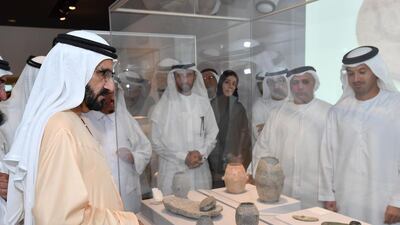
-
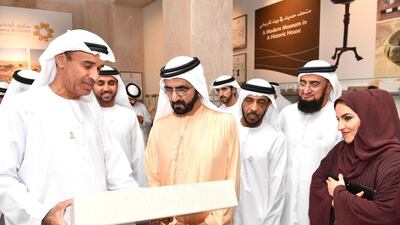
Sheikh Mohammed bin Rashid, Vice President of the UAE and Ruler of Dubai, inaugurates the Saruq Al Hadid Museum. Wam -

The museum contains artefacts unearthed at an ancient site in Dubai that dates back to the Iron Age. Wam -
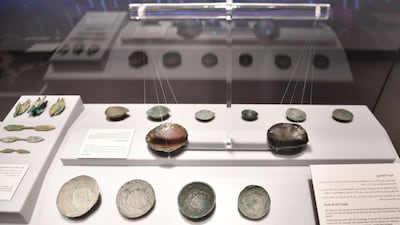
Some of the items on display at the Saruq Al Hadid Museum at Al Shindagha, in Bur Dubai. Wam -

Tools on display at the museum. Wam -
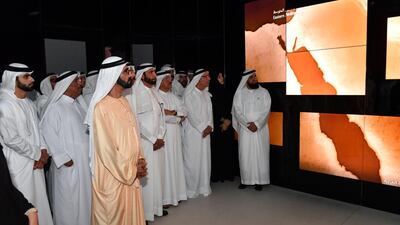
Sheikh Mohammed watches a short film about the discovery of the Saruq Al Hadid site. Wam


In February, a historic area deep in the Dubai desert was recognised in the Islamic World Heritage List, overseen by the Islamic World Educational, Scientific and Cultural Organisation (Icesco).
Saruq Al Hadid, the name of which roughly translates as “Way of Iron”, is viewed as one of the most significant archaeological sites in the UAE.
It was occupied from the Umm An Nar period, which began around 2600 BCE, through to about 1000 BCE in the Iron Age, when copper and bronze were smelted. Smelting also occurred during the subsequent Islamic period.

