
Winning the Zayed Award for Human Fraternity sends a signal to the world of the “moral imperative” of humanitarian work in Palestine, Taawon's director general said.
Speaking to The National after being awarded the annual $1 million humanitarian prize, Tareq Emtairah, director general of the non-profit organisation, said the scale of the humanitarian situation in Gaza had reached unprecedented levels.
For Taawon in particular, he said the recognition carries significance well beyond symbolism.
“It sends a signal to the world that humanitarian work in Palestine is a moral imperative,” Mr Emtairah said. “It reflects shared values of human solidarity and fraternity, and it gives us both recognition and responsibility to do more.”
Taawon was one of three winners of the award, which will be presented at a private ceremony on Wednesday. It was selected in recognition of its humanitarian and developmental work, which touches the lives of more than one million people annually across Palestine.
“Historically, it goes back to the legacy of the late Sheikh Zayed,” Mr Emtairah said. “Palestine and the Palestinian people were very close to his heart. He consistently supported the rights of Palestinians and their right to self-determination.
“That legacy translated into the people of the UAE supporting Palestinians – not only as Arab solidarity, but as a broader humanitarian solidarity.”
What does Taawon do?
Over the years, Taawon has worked closely with UAE partners, including the Big Heart Foundation, particularly on orphan care and, more recently, on support for war amputees.
Founded in 1983, Taawon has invested more than $1 billion across various initiatives including education, youth empowerment, orphan care, cultural projects, rehabilitation of historic towns and community development, as well as health, agriculture and emergency humanitarian assistance.
Today, Taawon operates across the occupied West Bank, Jerusalem and Gaza, as well as in Palestinian refugee camps in Lebanon.
“We are a multi-sector development partner, working across all areas that affect Palestinian life,” Mr Emtairah said. “This includes education, access to universities, improving school quality in Lebanon, and investing in early childhood learning and development.”
Over the past two years, Taawon’s focus has shifted heavily towards Gaza. A central pillar of that effort is the Noor Programme, launched to support children orphaned during the war. Initiatives have since been launched to support war amputees and to help restore the enclave's shattered rehabilitation system.
Taawon has about 120 active members globally and employs between 80 and 85 full-time staff, including about 20 in Gaza, with others based in the West Bank and Amman. The organisation also works with about 200 local partner organisations across Palestine.
Who were the winners?
Alongside Taawon, the other winners were Afghan girls’ education advocate Zarqa Yaftali, and the architects of the historic peace agreement between Azerbaijan and Armenia.
Ms Yaftali was honoured for her crucial work to provide educational resources, psychological support and other community services to more than 100,000 people in Afghanistan against the backdrop of Taliban rule.
The leaders of Armenia and Azerbaijan were awarded jointly. The countries had previously participated in peace talks in Abu Dhabi in July, setting the stage for a milestone peace agreement in Washington in August.
For more than three decades, Armenia and Azerbaijan had wrestled over the fate of Nagorno-Karabakh, a mountainous region with a mainly ethnic Armenian population. They fought two wars – in the 1990s and in 2020 – over the region.
On Monday, President Sheikh Mohamed met Ilham Aliyev, President of Azerbaijan, at Qasr Al Shati in Abu Dhabi where they discussed the award.
The two men hailed the historic peace agreement between Azerbaijan and Armenia as “a global model for reconciliation and a landmark step towards conflict resolution”.
-
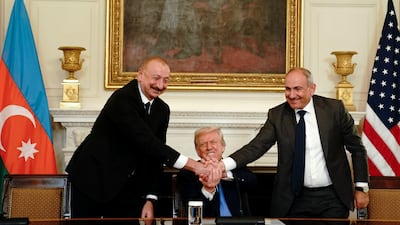
From left, Azerbaijan's President Ilham Aliyev, US President Donald Trump and Armenia's Prime Minister Nikol Pashinyan join hands at the White House in August 2025, after successful peace talks. EPA -
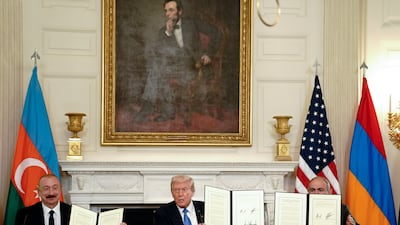
For more than three decades, Armenia and Azerbaijan had wrestled over the fate of Nagorno-Karabakh, a mountainous region with a mainly ethnic Armenian population. EPA -
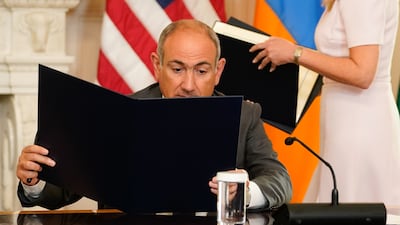
Mr Pashinyan, pictured, and Mr Aliyev have landed a Zayed Human Fraternity award for their roles in orchestrating the historic peace deal, an accolade Azerbaijan's President described as 'a great honour'. EPA -
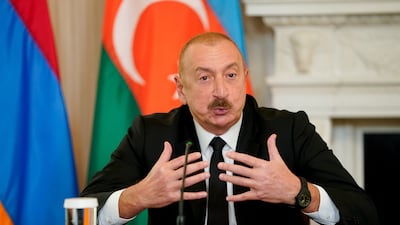
Mr Aliyev at the White House. Both he and Mr Pashinyan will receive their Zayed Human Fraternity awards at a ceremony in Abu Dhabi in February. EPA -
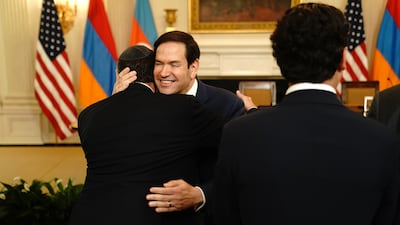
US Secretary of State Marco Rubio is all smiles after the leaders of Azerbaijan and Armenia signed the peace deal. EPA -

The end of the trilateral signing event at the White House, for which the Armenian and Azerbaijani leaders will receive a Zayed Human Fraternity award in Abu Dhabi. Reuters


What is the award?
The global prize was established after the late Pope Francis's historic visit to the UAE in 2019.
The 2026 winners were selected by an independent global judging committee comprising: Charles Michel, former president of the European Council and previous prime minister of Belgium; Moussa Faki Mahamat, former chairman of the African Union Commission and former prime minister of Chad; Unicef executive director Catherine Russell; Saida Mirziyoyeva, head of the administration of the President of Uzbekistan; Jose Tolentino de Mendonca, Prefect of the Dicastery for Culture and Education at the Holy See, and Judge Mohamed Abdelsalam, Secretary General of the Zayed Award for Human Fraternity.
The 2026 recipients will be honoured on February 4 – coinciding with the UN-recognised International Day of Human Fraternity – at the annual awards ceremony to be held at Founder’s Memorial in Abu Dhabi.
Since 2019, the awards committee has honoured 19 recipients from 19 countries, including honorary winners Pope Francis and Dr Ahmed Al Tayeb, The Grand Imam of Al Azhar, UN Secretary General Antonio Guterres, Egyptian cardiac surgeon Prof Sir Magdi Yacoub and American food relief organisation World Central Kitchen.

