


The UAE's landmark Etihad Rail network is moving full steam ahead, with the launch of a long-awaited passenger line fast approaching and major expansion of its freight services taking shape.
Etihad Rail, the developer and operator of the large-scale public transport scheme, offered a glimpse into the future at the recent Global Rail conference held in Abu Dhabi.
Key deals were signed to help fast-track development goals - including the appointment of a company to operate passenger services and an agreement with a leading ride-hailing company to enhance connectivity.

Etihad Rail also unveiled a large topographic map showing 10 passenger stations on an expanded route for the network, which will eventually run for 900 kilometres across the UAE, from the border with Saudi Arabia to Fujairah.
The map showed several additional potential passenger stations across the UAE at places such as Sila, Mirfa, Madinat Zayed in the Al Dhafra Region and Al Dhaid.
Azza Al Suwaidi, deputy chief executive at Etihad Rail Mobility (passenger services division), would not comment on the map at the event but said Etihad Rail was “working really hard in delivering the project”.
“We are connecting 11 cities and areas within the UAE,” she said. “That is how we are going to service the UAE in terms of passenger [stations].”
When will passenger line launch?
Etihad Rail's passenger service remains on track to launch in 2026.
Ms Al Suwaidi said Etihad Rail is working to ensure the stations are linked with existing and future transport from Dubai Metro to buses and more, in what is known as the “last mile”.
It is planned for the passenger service to not only transform transport in the UAE but also eventually connect to Oman and potentially across the Gulf. When it is launched, passengers can expect travel times of 57 minutes from Abu Dhabi to Dubai and 105 minutes from Abu Dhabi to Fujairah.
The rail operator also said the travel time between Abu Dhabi and Al Ruwais, about 240km west of the capital, will be 70 minutes.
Mapping out the potential route
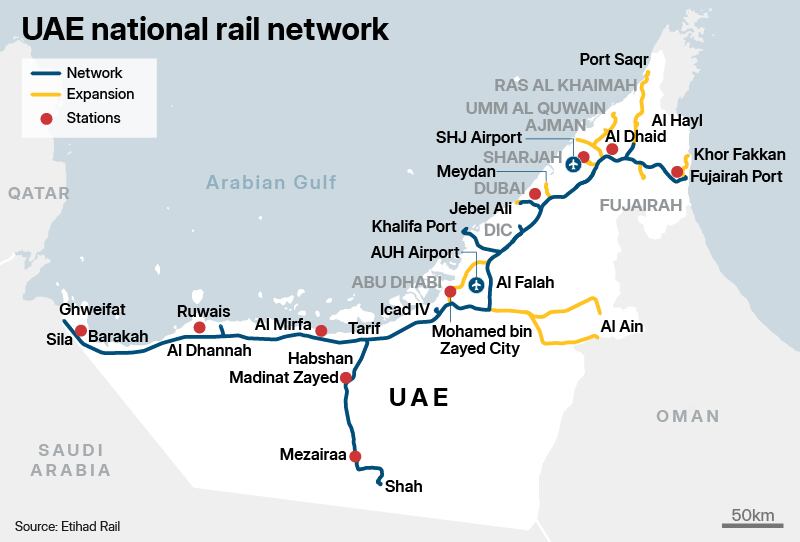
According to the map on show at Global Rail, the passenger service will run from the Fujairah station in Sakamkam, to Al Dhaid Station, which will be north-east of the city. From there, it will branch off to the Sharjah Station, situated near University City.
The train will then return to the main line to cut through the desert, heading towards the Dubai station. This station is situated just behind the Jumeirah Golf Estates Metro Station.
Next, the 57-minute non-stop journey to the capital leads to Abu Dhabi Station, in Mohamed bin Zayed City, opposite Dalma Mall.
Heading west into the Al Dhafra region, the train will branch into two directions. Towards the border with Saudi Arabia, it will stop at Mirfa Station, south-west of the city. Continuing onward, it will stop at Al Dhannah Station before terminating at Sila Station, just south of the Western region city.
Taking a right towards Liwa, there will be a stop at Madinat Zayed Station. It will terminate at the Mezairaa Station, north of Liwa.
Etihad Rail declined to comment further on the rail map, but said further announcements were expected in the near future.
A passenger station model was also on display at the conference, showing a modern long building with cream coloured panels and Arabic motifs.

Four stations have previously been announced, in Fujairah, Sharjah, Dubai, and Abu Dhabi.
Who will run the passenger network?
Etihad Rail this month announced a venture with Keolis International, a French company that already manages the Dubai Metro, to operate passenger trains.
Passenger numbers across the Etihad Rail network are expected to reach 36 million by 2030, to boost connectivity between the emirates and take cars off the roads to further environmental goals.
Keolis, often through joint ventures, is involved in operating and maintaining metro and regional rail networks globally such as Dubai Metro, the Valleilijn regional service in the Netherlands, and the Docklands Light Railway in London.
Plans to boost connectivity
Etihad Rail announced an agreement with taxi company Yango Group at Global Rail, which is being seen as a step towards bolstering access to passenger stations once the train service begins.
It sets out how Etihad Rail could harness Yango’s ride-hailing service around stations. It aims to support passenger pick-up and drop-off points, streamline vehicle entry and exit procedures, and help reduce congestion.
Keeping trade moving
Efforts are under way to expand the capacity of Etihad Rail’s freight network as business grows, a senior official has said.
Omar Al Sebeyi, acting chief executive of Etihad Rail's freight section, said the network is operating at full capacity when it comes to transporting aggregates, the crushed stones that are crucial for construction projects in the UAE.
The aggregates are transported from quarries in the Northern Emirates on wagons on the freight line to stations in Dubai and Abu Dhabi.
The freight network stretches from the border with Saudi Arabia to Fujairah. Aside from aggregates, freight trains carry loads such as petrochemicals, polymers and general cargo in shipping containers.
It has other benefits. It was previously announced that every train could take up to 300 lorries off the UAE’s roads, and the network aims to reduce CO2 emissions in the country's road transport sector by 21 per cent annually by 2050.
Dubai to Abu Dhabi to 30 minutes
-
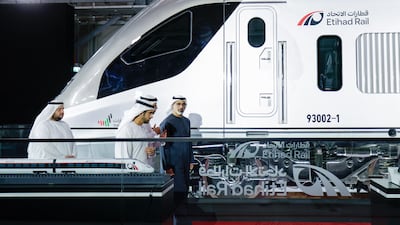
Sheikh Khaled bin Mohamed, Crown Prince of Abu Dhabi, and Sheikh Hamdan bin Mohammed, Crown Prince of Dubai, Deputy Prime Minister and Minister of Defence, inspect the UAE’s first passenger train fleet. Photo: Abu Dhabi Media Office -

Etihad Rail has announced plans for a high-speed passenger rail service between Abu Dhabi and Dubai. Photo: Abu Dhabi Media Office -
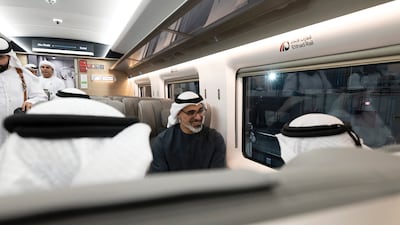
Sheikh Khaled on one of the trains. The service will cut the journey time between the emirates to 30 minutes. Photo: Abu Dhabi Media Office -
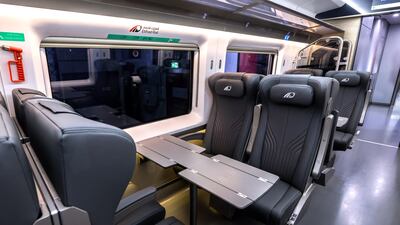
Inside one of the carriages. The trains will travel at up to 350kph. Victor Besa / The National -

Sebastien Mangeant, executive director of high-speed rail at Etihad Rail, ha said the service will support tourism. Victor Besa / The National -

Inside one of the passenger train carriages. The high-speed trains will help to reduce traffic between Abu Dhabi and Dubai. Victor Besa / The National -
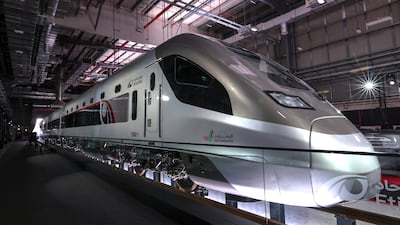
Plans are also in place for a railway connecting the UAE with Oman. Victor Besa / The National


A high-speed passenger rail service between Abu Dhabi and Dubai is also in the works, separate to the main Etihad Rail network.
The new line from Etihad Rail - first announced in January - would cut the journey time between the two emirates to 30 minutes.
Trains will run at up to 350kph on a route that will pass through key destinations and tourist attractions.
The new high-speed electrified line will feature six stations at Reem Island, Yas Island, Saadiyat Island, Zayed Airport, close to Al Maktoum Airport in Dubai and Jaddaf, near Dubai Creek, Etihad Rail said.
Construction has yet to start and a date for the launch of services was not revealed but tenders for contracts have been issued and network designs approved, Etihad Rail said previously.

