
A high-speed railway created to connect Abu Dhabi to Dubai in 30 minutes has the potential to transform the UAE, analysts believe.
Etihad Rail unveiled the plan on Thursday and, while no launch date was revealed, experts say the project could revolutionise the UAE's economy, its environment and where its people will live.
Six stations will be built in the first phase passing through Abu Dhabi’s islands, connecting the airports and then up to Dubai Creek.
“It changes the landscape tremendously,” said Monica Menendez, professor of civil and urban engineering at New York University Abu Dhabi. “And brings the cities very close together.”
-
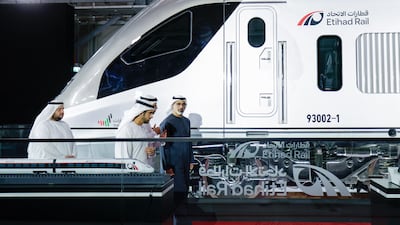
Sheikh Khaled bin Mohamed, Crown Prince of Abu Dhabi, and Sheikh Hamdan bin Mohammed, Crown Prince of Dubai, Deputy Prime Minister and Minister of Defence, inspect the UAE’s first passenger train fleet. Photo: Abu Dhabi Media Office -

Etihad Rail has announced plans for a high-speed passenger rail service between Abu Dhabi and Dubai. Photo: Abu Dhabi Media Office -
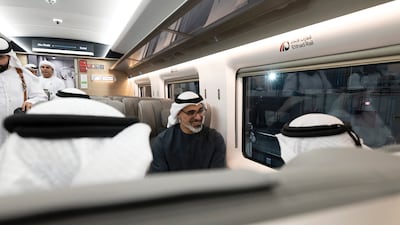
Sheikh Khaled on one of the trains. The service will cut the journey time between the emirates to 30 minutes. Photo: Abu Dhabi Media Office -
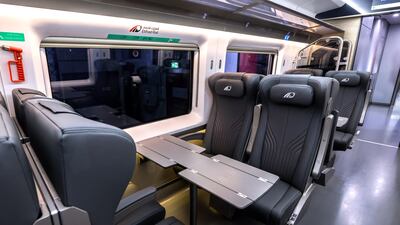
Inside one of the carriages. The trains will travel at up to 350kph. Victor Besa / The National -
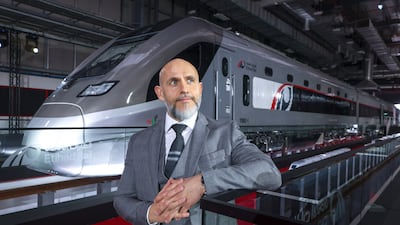
Sebastien Mangeant, executive director of high-speed rail at Etihad Rail, ha said the service will support tourism. Victor Besa / The National -

Inside one of the passenger train carriages. The high-speed trains will help to reduce traffic between Abu Dhabi and Dubai. Victor Besa / The National -
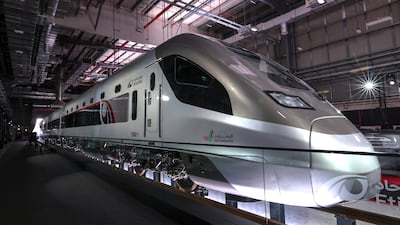
Etihad Rail's plans have been hailed as ambitious and transformative. Victor Besa / The National


A world of change for weary commuters
If a 30-minute travel time at speeds of up to 350 kph replaces a fraught drive along the busy Sheikh Zayed Road, more people could have more choice about where to live and work.
Paulo Anciaes, senior researcher in transport at University College London, said he expected “a considerable shift”.
“The new rail lines will be very competitive, in terms of travel time, comfort and convenience, comparing with private car use. So, we can expect a considerable modal shift from car to rail for intercity travel within the UAE, which will reduce congestion and pollution,” said Mr Anciaes.
“The project will increase happiness, as travel will be faster and less stressful, so people can more easily travel to see family and friends in other cities and make more leisure trips.”
Faster travel could allow workers more time to take part in more productive activities.
“Reduced commuting times also makes it easier for workers to find a job that best matches their skills and opens up opportunities to access education and training.”
Marcus Enoch, a professor of transport strategy at Loughborough University in the UK, said he thought that the new service may increase the amount of travel between Abu Dhabi and Dubai. Currently car and bus are the only ways to travel between the two cities.
“You might get a lot of extra trips generated that you didn’t get before, which I suspect is part of the point,” he said.
It will connect areas of high density and typically has fewer stops so the trains can reach their top speed.
“Think of tourism,” said Prof Menendez. “Now you can be there in 30 minutes.
“The trip is less costly in terms of time and that is a valuable asset.”
A Dh145 billion GDP boost
Like most megaprojects, such a network does not come cheap.
Parts of the UK’s HS2 rail were cancelled due to several factors including the soaring costs, although Prof Enoch said that high-speed rail was more difficult to build in densely populated countries such as the UK which have a long-established rail heritage, as new lines inevitably encounter planning obstacles such as long-established villages and towns.
“I never thought HS2 made any sense because there's nowhere to put it,” he said.
Etihad Rail did not disclose a cost but, according to the International Railway Journal, the cost of high-speed lines in Europe designed for operation at 300 kph or faster is estimated to be $25 million-$39 million per kilometre and as high as $52 million per km in California. In other countries it can be cheaper.
But the economic benefits are strong, connecting businesses and boosting trade.
Much more remains to be revealed but authorities spoke of a Dh145 billion GDP boost.
“It … increases the connectivity between businesses and consumers,” said Mr Anciaes.
He pointed to a review published this week in the Journal of Transport and Health showing the economic gains. Studies in China show each 10 per cent decrease in travel time leads to an increase of 0.44 per cent in the GDP of the areas served.
In Italy, high-speed rail led to a 5.6 per cent increase in GDP in the areas served and in Germany the line connecting Frankfurt and Cologne led to an 8.5 per cent growth in GDP.
Alexandra Gomes, a research fellow at the London School of Economics who has researched Abu Dhabi and Kuwait City, said rises in property prices might be expected.
“This increase would likely be more pronounced in areas with greater accessibility to train stations,” said Dr Gomes.
“Nevertheless, these areas also present an opportunity to promote higher mixed-use development, higher densities and higher levels of walkability.”
-
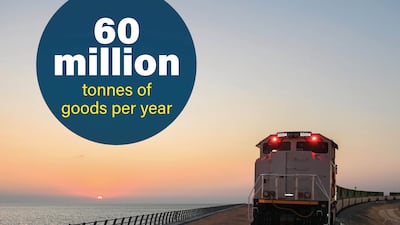
Etihad Rail's freight network is now operational. It can transport 60 million tonnes of goods a year. All photos: Etihad Rail -
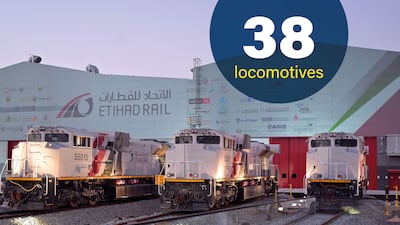
The new freight service has 38 locomotives -
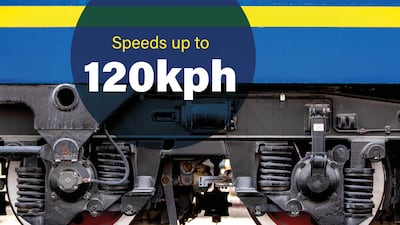
The freight trains will run up to 120kph, with each locomotive operating at 4,500 horsepower -
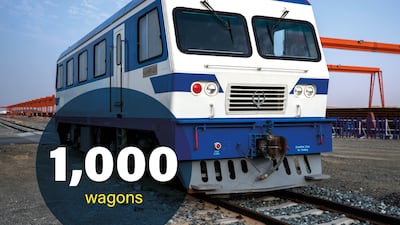
The locomotives pull a total of 1,000 wagons, transporting goods ranging from shipping containers to industrial material -

The tracks cross the UAE and feature 593 bridges -
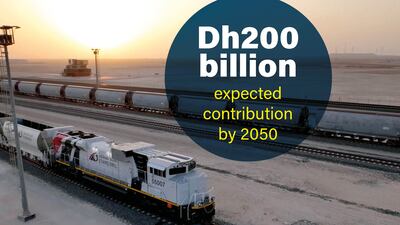
The network will contribute Dh200 billion ($54.4 billion) to the UAE economy and save Dh8 billion in road maintenance costs -
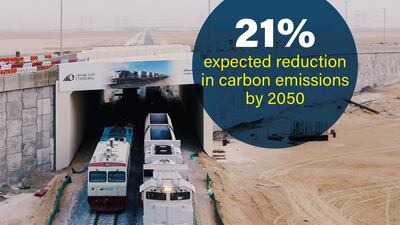
The project also aims to reduce carbon emissions from the road transport sector by 21 per cent by 2050, boosting the country's efforts to become net zero


A symbol of modernity
Many people are familiar with Japan’s bullet trains. But it is China that has built the greatest share of high speed with about 40,000km of track across the country.
Still, it is growing in the Middle East and North Africa region. Saudi Arabia’s Haramain train links Jeddah, Makkah and Madinah. Morocco is expanding its network and Egypt is also building several lines.
“They are green, efficient and carry high numbers of people,” said Kevin Smith, editor-in-chief at International Railway Journal, who said air travel reduces on routes served by high speed rail such as London and Paris. “Three to four hours is the sweet spot for high speed rail,” he said. “Beyond that is less competitive.
Mr Smith said it was an exciting project. “To have a high-speed line is a symbol of modernity.”
The last mile of connectivity
The high-speed line is distinct from the passenger and freight railway services that will cross the entire country.
The high-speed is electric while the other service will be slower as it uses diesel locomotives.
Mr Smith said the new line would have “substantially better” journey times as it had its own dedicated line. “With high-speed rail, you don’t have to mix and limit freight movements.”
It is not yet clear how these two lines might be integrated, if it all, but Etihad Rail said the regular line will be integrated with existing transport such as Dubai Metro.
Particularly important is known as the “last mile” integration – ensuring people don’t have lengthy walks to the station.
“If you have to drive half an hour, you may as well continue by car,” said Prof Menendez.
People should also be able to purchase tickets that work across rail and buses.
“If you need to buy a separate ticket for every mode it is quite painful. It needs a seamless transition,” she said.
Dr Gomes said improved connections between residential and employment hubs, and the train stations, was “crucial”.
“Consider the journey from downtown Abu Dhabi, where many people live and work, to the nearest station located on one of the islands,” said Dr Gomes.
“A reliable, accessible and interconnected public transport network will be essential for the success of this investment, not just in operational terms but also in enhancing the overall liveability of the cities.”
Benefits for everyone
Residents of both cities eagerly anticipate the launch of the service and there are potential benefits for everyone.
Smaller cities and even regions that are not directly located along the new lines can also benefit, said Mr Anciaes, as the whole nation becomes more well-connected.
“In an increasingly competitive global economy, this major investment in high-speed rail will also be a competitive advantage for the UAE, not only because conditions for businesses will improve but also because it will contribute to the image of the country,” he said.
“This can be the catalyst for further investment, leading to sustainable economic growth.”
Prof Menendez said it would bring Abu Dhabi and Dubai closer together “which makes sense in a globalised economy”.
“We must also acknowledge the complexity [of the project] as it is two emirates with different financial structures and ministries. But it is possible.”
-
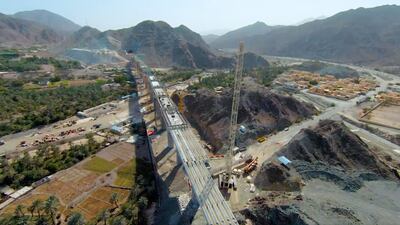
Construction is under way on the Etihad Rail bridge. This is part of the Etihad Rail development, a passenger and freight train project that will link all seven emirates in the UAE. All photos: Etihad Rail -
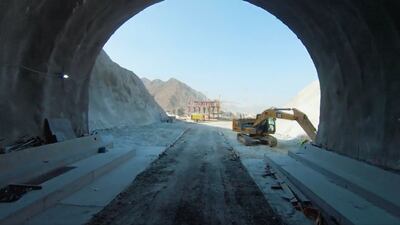
The bridge is located in Al Bithnah, Fujairah. Etihad Rail said it will act as the rail gateway to the UAE’s east coast and facilitate trade to and from Fujairah. -
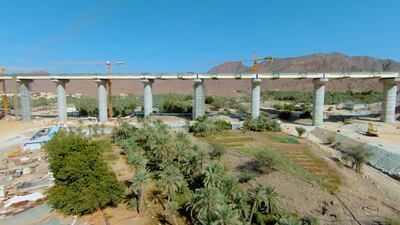
It passes through the Hajar Mountains and is 600 metres long. Construction for the Northern Emirates network involves building 54 bridges and nine tunnels across the mountains. -
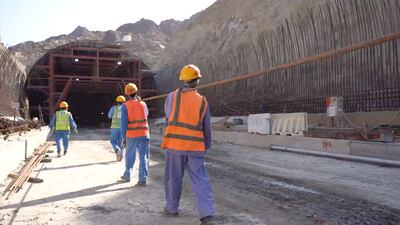
Workers on the site in Fujairah. The passenger trains will travel at up to 200 kilometres per hour, each carrying about 400 people. -
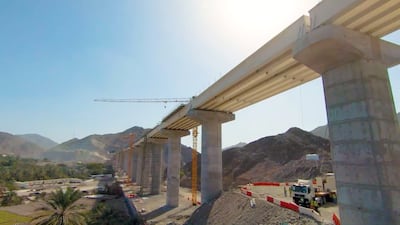
The bridge will afford passengers a beautiful backdrop of mountains in the distance. -
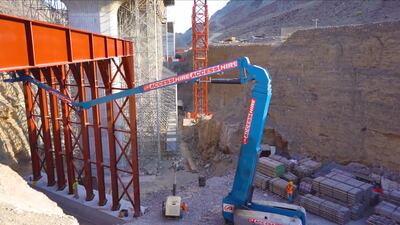
Heavy machinery on site. The complete network will measure about 1,200km. -
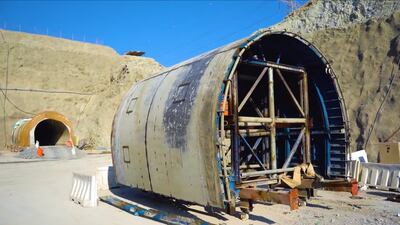
The eagerly awaited rail service, which will take people from Abu Dhabi to Fujairah in about an hour, is taking shape. -
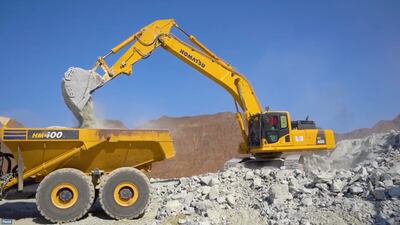
The Fujairah construction work (pictured) comes after the Abu Dhabi to Dubai stretch of the project was completed in March 2022. -
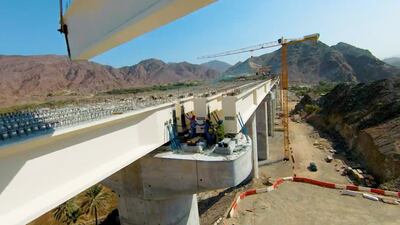
The passenger and freight service, which does not yet have a completion date, is expected to carry more than 36 million passengers a year by 2030.



