


Improved medical treatments for Emiratis could be the result of a major project researching the genetic variation within the UAE national population, scientists have told The National.
Researchers say that newly published work on the Emirati pangenome – a database describing the genetic variation among Emiratis – represents a step towards the use of personalised medicine.
Personalised medicine is regarded as one of the most exciting frontiers in modern science, as it offers the chance to tailor treatments according to the patient’s genetic make-up.
The findings, released in December by bioRxiv, are the latest generated through the Emirati Genome Project, a national initiative to characterise the genetic variation of hundreds of thousands of Emiratis.
A regional breakthrough
Prof Habiba Al Safar, dean of the College of Medical and Health Sciences at Khalifa University and the senior author of the paper, said the work “aims to address gaps in global genetic studies”, which often miss out Middle Eastern populations.
“The genetic evidence, it belongs to different ethnic groups, mainly Caucasian, African and Asian, but there’s a gap with the Arab populations,” she said.
Echoing this, in their paper the researchers said human reference pangenomes captured “only a narrow subset of global human genetic diversity”, leading to initiatives focused on particular populations, such as African, Arab or Chinese people.
“However, significant gaps remain, particularly for populations in the Middle East whose unique genetic landscapes are shaped by indigenous ancestry, historic trade routes, and extensive global connectivity,” they wrote.
The Emirati pangenome, Prof Al Safar said, “includes the collective genetic diversity of the population”, which includes records of “unique structural variants”. These are areas where the DNA has become rearranged, such as through a section being inserted, deleted or inverted.
The pangenome also captures what geneticists call single nucleotide polymorphism, which are the smallest and most common variants, involving a single change in the “letters” of the genetic code that make up a person’s genetic information.
“It’s not just identifying common genes, but understanding variation that may influence health and even responses to medication,” Prof Al Safar said. “The data from the pangenome enables you to develop personalised medicine by identifying individual genetic risk factors. We want to understand the prevalence, the genetic risk factors, the variants. Then we can understand the mechanisms of disease better.”
The Emirati Genome Project – in pictures
-
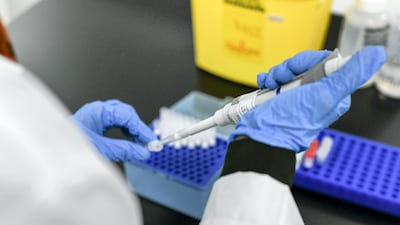
Emiratis in the UAE have been urged to voluntarily give an anonymous blood sample to help expand the data collection for the Emirati Genome Project. All photos by Khushnum Bhandari / The National -

The programme, which officially launched two years ago, has so far collected blood samples and buccal swabs from tens of thousands of people. -

Dr Walid Zaher is the chief research officer for G42 Healthcare and one of the lead researchers for the Emirati Genome Programme -
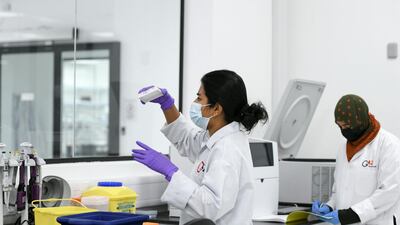
Using the data, experts say they can predict, and in some cases prevent, diseases before they happen -
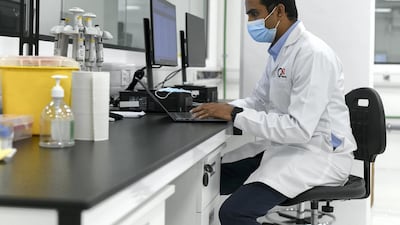
Researchers for the Emirati Genome Programme analyse sample data in the Omics laboratory -
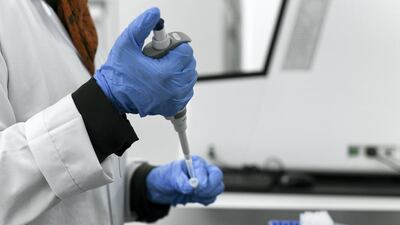
Researchers said the end goal is to collect samples from 100 per cent of the population -
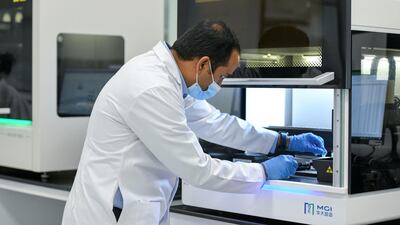
The risk of inheriting a gene mutation increases sharply when closely related individuals marry -
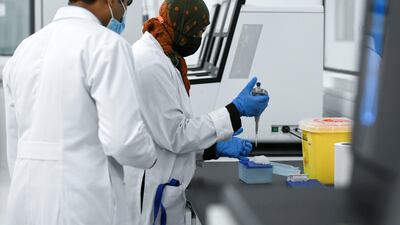
Teams working as part of the programme have already created the first reference genome from more than 1,000 volunteers -

The Omics Centre of Excellence run by G42 Healthcare in Masdar City, Abu Dhabi -

Using biotechnology and Artificial Intelligence, researchers can characterise things like genetic variation and understand how they relate to different diseases -
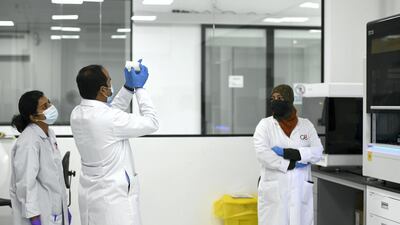
Volunteers can now submit DNA samples at a number of centres across Abu Dhabi including NMC Royal Hospital in Khalifa City, Bareen International Hospital, and NMC Specialty Hospital, Al Ain


A revolution in medicine
The potential for personalised medicine is such that a new field has emerged, pharmacogenetics, looking at how the particular gene types that a person has affects their response to medication. Released last month, the new study is titled An Emirati pangenome incorporating a diploid telomere-to-telomere reference.
The Emirati Genome Programme has so far involved the collection of genetic material from around 600,000 people or about half the Emirati population. Prof Al Safar explained how the programme created an advisory board of experts from countries including the UK and the US to ensure the initiative could “avoid the challenges that others faced”.
“The Emirati pangenome, it’s more than a scientific achievement,” she said. “It symbolises the UAE’s commitment to becoming a global leader in life sciences. The country is positioning itself at the forefront of genomics.”
As well as the potential medical applications, the work could reveal information about human migration and the geographical roots of the Emirati population, Prof Al Safar said.
In another development, late last year the UAE announced that from this month compulsory premarital genetic screening would be introduced for Emirati couples, which should highlight whether any children could be at risk of genetic diseases. In total 570 genes linked to more than 840 conditions will be analysed.
Improvement over time
Progress in genetics has happened rapidly since Francis Crick and James Watson revealed the double helix structure of DNA in 1953.
The first human genome – an individual’s set of genetic material – was published in 2001, just over a decade after the launch of the Human Genome Project, which burnt through billions of dollars in an effort to sequence human genetic material.
Costs have come down significantly, to the point where the price of sequencing a single human genome is in the hundreds of dollars. The processes have also become much faster and more routine.
Pangenome technology, which attempts to describe the full range of genetic variation within a population, has come to the fore in recent years thanks in part to advances in software used to analyse genetic sequence data.
Prof Jens Stoye, managing director of the Bielefeld Institute for Bioinformatics Infrastructure at Bielefeld University in Germany, said that pangenomics was poised to move from making theoretical progress into achieving advances in medical practice.
This follows, he indicated, a number of years in which software developers had been creating the tools for the field to progress.
“We talk about the core genome – the parts that are the same for everybody – and there are variants,” he said. “And you see that parts of the population – let’s say the Asian population – have some individual variants you never find in the Caucasian or African genomes.”
Using pangenomic methods, scientists can better understand how common or rare particular genetic variants are within a population.
Prof Stoye, who is involved in two European consortia for computational methods of pangenomic analysis, said the technology “gives a much better story than the traditional genetic approach”, some forms of which involve taking individuals from different parts of the world and using their data to create a “reference genome”.
Alongside work on human genetics, pangenomic approaches are also used to analyse bacteria, such as by creating databases of different strains kept in laboratories. Another major field is plant pangenomics, which may involve the genetic analysis in different countries of local accessions of particular plants.

