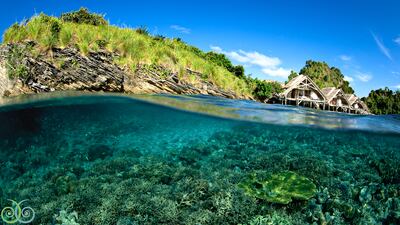
Sylvia Earle, one of the world’s most famous oceanographers and marine biologists, has raised the alarm over the stark threat posed to ocean ecosystems by climate change and rampant overfishing.
Dr Earle, 89, holds the record for the deepest untethered walk on the sea floor at a depth of 1,250 feet and was the first woman to lead the National Oceanographic and Atmospheric Administration in the US.
Speaking to The National on a visit to SeaWorld Abu Dhabi, she said the world is “perilously close” to tipping the balance of ocean life.
“We have time but not a lot,” she said. “That's why there's a sense of urgency about protecting what remains of the natural living systems, living deserts, living oceans, coral reefs and the deep sea. Why do we even think of disrupting the deep sea when we have a chance to protect it and keep it safe?”
The impact of fishing and climate change
Earth recorded its hottest year ever last year and Dr Earle spoke of the significant effects that climate change had on ocean life. She said the key was understanding the damage and repairing it, protecting the ocean and restoring stability to what has become an increasingly disrupted system.
“It's not just warming, it's the extremes of hot and cold. It's the unexpected,” said Dr Earle. “Because of the way we have disrupted the atmosphere and the ocean, the living systems, we are now seeing these extremes that are not really favourable to us, and could become so unfavourable that our existence is on the line.”
Dr Earle said that to have a secure, functioning and stable civilisation, we need to be able to anticipate seasons with some predictability. She also criticised overfishing and its damaging impact.
More than one third of all sharks, rays, and chimeras are now at risk of extinction because of overfishing, according to data from the World Wildlife Fund.
“We have taken with such abandon thinking that they [oceans] were infinite in their capacity to recover but now we know that's not true. We have to give them a break,” she said. “Every fish that we take from the wild is a fish that's no longer doing what it does naturally to keep not only itself but the ocean alive.”
Dr Earle said the Earth’s oceans were the planet’s life support system and were now in crisis. She called on people to use their skills and talents to raise awareness and work towards mitigating the problem.
“What are you willing to put into this goal of securing a habitable planet? To me, it's our highest priority,” said Dr Earle. “Nothing else matters. If there's a meltdown of the systems that keep us alive, and it's happening, we are experiencing a meltdown of our life support system. I can hold up the mirror and say, here are the problems and here are the solutions. Nobody can do it all, but everybody can do something.”
She also said there was an urgent need to invest in technology for ocean exploration as only about 10 per cent of the world's oceans have so far been surveyed.
A lifetime of work
Getting knocked over by a wave at the age of three inspired a fascination for the oceans in Dr Earle’s young mind, which turned into a lifelong passion.
“When my family moved to Florida, I was 12 and we lived right on the ocean, and it was part of my life every day,” she said. “I wanted to be an explorer. Children are natural explorers. I wanted to be a scientist. Children are natural scientists. We all start out that way. Somehow, many get turned away from asking questions.”
When Dr Earle started doing fieldwork in the 1950s, scuba equipment was just becoming available and she was one of the few female oceanographers in the world. She described how “innocent” the fish were at the time.
“They'd never seen humans underwater before and they were as curious about me as I was about them,” she said. “It was transformative to see that.”
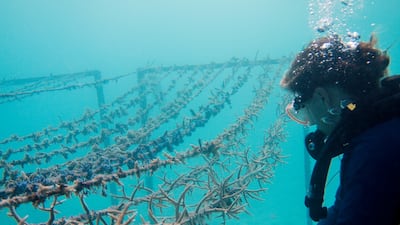
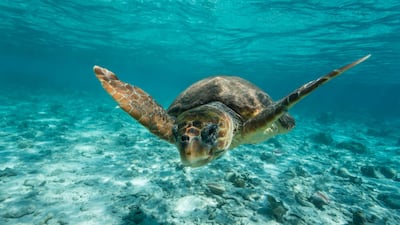
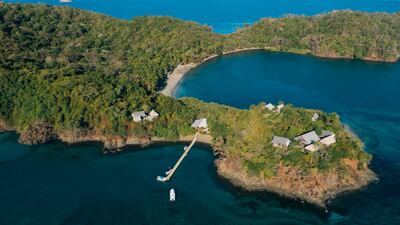
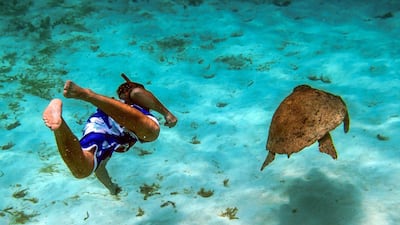
Ocean conservation - in pictures
What are the biggest challenges?
Dr Earle said ignorance and waste are the two most significant threats to the world's oceans.
“We have treated the ocean as the ultimate place to dump things, to get rid of waste,” she said. “I've had the privilege of being out under the ocean seeing where all that rubbish goes. I've also seen the loss of wildlife because of our ability to find, capture and extract wildlife. Millions of tonnes of wild animals have been taken from the ocean.
“Most people haven't seen what I've seen, the degradation, the gaps, the loss of sharks. We have stripped wildlife out of the ocean. I've been a witness over the decades of extracting wildlife unsustainably, the loss caused by the belief that the ocean is infinite in its way of being able to yield whatever we want to take and to accept whatever we want to put into the ocean.”
An international target, 30 by 30, sets the goal of protecting at least 30 per cent of the land and 30 per cent of the ocean by 2030. Dr Earle, however, said we are way off track to achieving that goal.
How can people help?
Dr Earle encouraged people to use their skills to create awareness of climate change or to advocate for saving marine life.
“Look in the mirror. Ask who you are, whether you're a child, a mum, a dad, a teacher, whoever you are, whatever power you've got … use what you have,” she said. “Some people can influence fashion, we should make it cool to want to protect nature.”
She said awareness was the best cause for optimism and it was up to humans to use their knowledge to protect the oceans.
“Every breath we take, every drop of water we drink, every bite of food we take, we are all part of what makes what the planet is and will be,” she said. “We have choices, the fish don't.”
“We have to eat differently if we're going to survive,” she said. “It's a different world. Our habits were OK 1,000 years ago,” she said. “I would never tell people what they should eat but I can say here is the consequence of our habits.
“If we continue to degrade the ocean through what we put in, through what we take out in ignorance, it’s not just the creatures of the sea who will suffer, all life on Earth, including ourselves, will pay the price.”
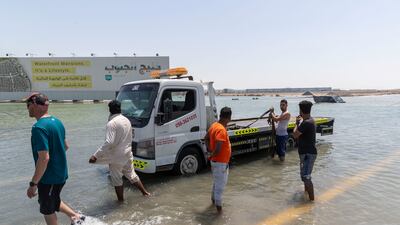
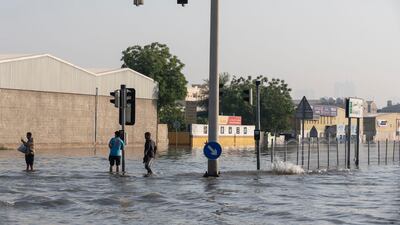
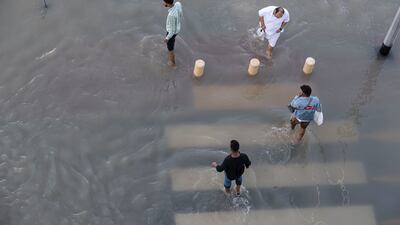
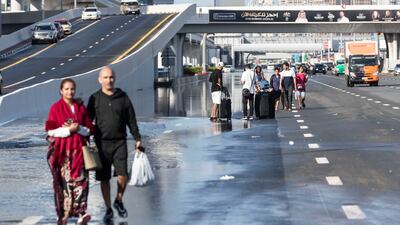
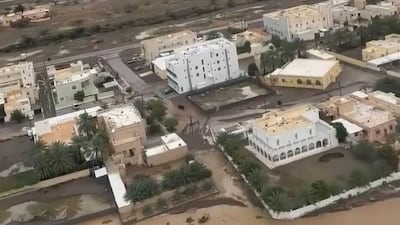
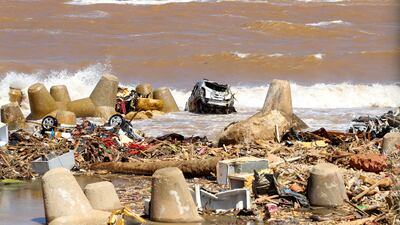
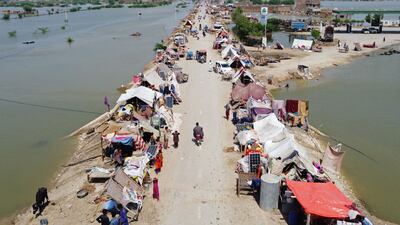
The impact of climate change in the Middle East – in pictures
How much sugar is in chocolate Easter eggs?
- The 169g Crunchie egg has 15.9g of sugar per 25g serving, working out at around 107g of sugar per egg
- The 190g Maltesers Teasers egg contains 58g of sugar per 100g for the egg and 19.6g of sugar in each of the two Teasers bars that come with it
- The 188g Smarties egg has 113g of sugar per egg and 22.8g in the tube of Smarties it contains
- The Milky Bar white chocolate Egg Hunt Pack contains eight eggs at 7.7g of sugar per egg
- The Cadbury Creme Egg contains 26g of sugar per 40g egg
Ten tax points to be aware of in 2026
1. Domestic VAT refund amendments: request your refund within five years
If a business does not apply for the refund on time, they lose their credit.
2. E-invoicing in the UAE
Businesses should continue preparing for the implementation of e-invoicing in the UAE, with 2026 a preparation and transition period ahead of phased mandatory adoption.
3. More tax audits
Tax authorities are increasingly using data already available across multiple filings to identify audit risks.
4. More beneficial VAT and excise tax penalty regime
Tax disputes are expected to become more frequent and more structured, with clearer administrative objection and appeal processes. The UAE has adopted a new penalty regime for VAT and excise disputes, which now mirrors the penalty regime for corporate tax.
5. Greater emphasis on statutory audit
There is a greater need for the accuracy of financial statements. The International Financial Reporting Standards standards need to be strictly adhered to and, as a result, the quality of the audits will need to increase.
6. Further transfer pricing enforcement
Transfer pricing enforcement, which refers to the practice of establishing prices for internal transactions between related entities, is expected to broaden in scope. The UAE will shortly open the possibility to negotiate advance pricing agreements, or essentially rulings for transfer pricing purposes.
7. Limited time periods for audits
Recent amendments also introduce a default five-year limitation period for tax audits and assessments, subject to specific statutory exceptions. While the standard audit and assessment period is five years, this may be extended to up to 15 years in cases involving fraud or tax evasion.
8. Pillar 2 implementation
Many multinational groups will begin to feel the practical effect of the Domestic Minimum Top-Up Tax (DMTT), the UAE's implementation of the OECD’s global minimum tax under Pillar 2. While the rules apply for financial years starting on or after January 1, 2025, it is 2026 that marks the transition to an operational phase.
9. Reduced compliance obligations for imported goods and services
Businesses that apply the reverse-charge mechanism for VAT purposes in the UAE may benefit from reduced compliance obligations.
10. Substance and CbC reporting focus
Tax authorities are expected to continue strengthening the enforcement of economic substance and Country-by-Country (CbC) reporting frameworks. In the UAE, these regimes are increasingly being used as risk-assessment tools, providing tax authorities with a comprehensive view of multinational groups’ global footprints and enabling them to assess whether profits are aligned with real economic activity.
Contributed by Thomas Vanhee and Hend Rashwan, Aurifer
The National Archives, Abu Dhabi
Founded over 50 years ago, the National Archives collects valuable historical material relating to the UAE, and is the oldest and richest archive relating to the Arabian Gulf.
Much of the material can be viewed on line at the Arabian Gulf Digital Archive - https://www.agda.ae/en
Profile
Company name: Jaib
Started: January 2018
Co-founders: Fouad Jeryes and Sinan Taifour
Based: Jordan
Sector: FinTech
Total transactions: over $800,000 since January, 2018
Investors in Jaib's mother company Alpha Apps: Aramex and 500 Startups
Mercer, the investment consulting arm of US services company Marsh & McLennan, expects its wealth division to at least double its assets under management (AUM) in the Middle East as wealth in the region continues to grow despite economic headwinds, a company official said.
Mercer Wealth, which globally has $160 billion in AUM, plans to boost its AUM in the region to $2-$3bn in the next 2-3 years from the present $1bn, said Yasir AbuShaban, a Dubai-based principal with Mercer Wealth.
“Within the next two to three years, we are looking at reaching $2 to $3 billion as a conservative estimate and we do see an opportunity to do so,” said Mr AbuShaban.
Mercer does not directly make investments, but allocates clients’ money they have discretion to, to professional asset managers. They also provide advice to clients.
“We have buying power. We can negotiate on their (client’s) behalf with asset managers to provide them lower fees than they otherwise would have to get on their own,” he added.
Mercer Wealth’s clients include sovereign wealth funds, family offices, and insurance companies among others.
From its office in Dubai, Mercer also looks after Africa, India and Turkey, where they also see opportunity for growth.
Wealth creation in Middle East and Africa (MEA) grew 8.5 per cent to $8.1 trillion last year from $7.5tn in 2015, higher than last year’s global average of 6 per cent and the second-highest growth in a region after Asia-Pacific which grew 9.9 per cent, according to consultancy Boston Consulting Group (BCG). In the region, where wealth grew just 1.9 per cent in 2015 compared with 2014, a pickup in oil prices has helped in wealth generation.
BCG is forecasting MEA wealth will rise to $12tn by 2021, growing at an annual average of 8 per cent.
Drivers of wealth generation in the region will be split evenly between new wealth creation and growth of performance of existing assets, according to BCG.
Another general trend in the region is clients’ looking for a comprehensive approach to investing, according to Mr AbuShaban.
“Institutional investors or some of the families are seeing a slowdown in the available capital they have to invest and in that sense they are looking at optimizing the way they manage their portfolios and making sure they are not investing haphazardly and different parts of their investment are working together,” said Mr AbuShaban.
Some clients also have a higher appetite for risk, given the low interest-rate environment that does not provide enough yield for some institutional investors. These clients are keen to invest in illiquid assets, such as private equity and infrastructure.
“What we have seen is a desire for higher returns in what has been a low-return environment specifically in various fixed income or bonds,” he said.
“In this environment, we have seen a de facto increase in the risk that clients are taking in things like illiquid investments, private equity investments, infrastructure and private debt, those kind of investments were higher illiquidity results in incrementally higher returns.”
The Abu Dhabi Investment Authority, one of the largest sovereign wealth funds, said in its 2016 report that has gradually increased its exposure in direct private equity and private credit transactions, mainly in Asian markets and especially in China and India. The authority’s private equity department focused on structured equities owing to “their defensive characteristics.”
Where to donate in the UAE
The Emirates Charity Portal
You can donate to several registered charities through a “donation catalogue”. The use of the donation is quite specific, such as buying a fan for a poor family in Niger for Dh130.
The General Authority of Islamic Affairs & Endowments
The site has an e-donation service accepting debit card, credit card or e-Dirham, an electronic payment tool developed by the Ministry of Finance and First Abu Dhabi Bank.
Al Noor Special Needs Centre
You can donate online or order Smiles n’ Stuff products handcrafted by Al Noor students. The centre publishes a wish list of extras needed, starting at Dh500.
Beit Al Khair Society
Beit Al Khair Society has the motto “From – and to – the UAE,” with donations going towards the neediest in the country. Its website has a list of physical donation sites, but people can also contribute money by SMS, bank transfer and through the hotline 800-22554.
Dar Al Ber Society
Dar Al Ber Society, which has charity projects in 39 countries, accept cash payments, money transfers or SMS donations. Its donation hotline is 800-79.
Dubai Cares
Dubai Cares provides several options for individuals and companies to donate, including online, through banks, at retail outlets, via phone and by purchasing Dubai Cares branded merchandise. It is currently running a campaign called Bookings 2030, which allows people to help change the future of six underprivileged children and young people.
Emirates Airline Foundation
Those who travel on Emirates have undoubtedly seen the little donation envelopes in the seat pockets. But the foundation also accepts donations online and in the form of Skywards Miles. Donated miles are used to sponsor travel for doctors, surgeons, engineers and other professionals volunteering on humanitarian missions around the world.
Emirates Red Crescent
On the Emirates Red Crescent website you can choose between 35 different purposes for your donation, such as providing food for fasters, supporting debtors and contributing to a refugee women fund. It also has a list of bank accounts for each donation type.
Gulf for Good
Gulf for Good raises funds for partner charity projects through challenges, like climbing Kilimanjaro and cycling through Thailand. This year’s projects are in partnership with Street Child Nepal, Larchfield Kids, the Foundation for African Empowerment and SOS Children's Villages. Since 2001, the organisation has raised more than $3.5 million (Dh12.8m) in support of over 50 children’s charities.
Noor Dubai Foundation
Sheikh Mohammed bin Rashid Al Maktoum launched the Noor Dubai Foundation a decade ago with the aim of eliminating all forms of preventable blindness globally. You can donate Dh50 to support mobile eye camps by texting the word “Noor” to 4565 (Etisalat) or 4849 (du).
The specs: 2019 Audi A8
Price From Dh390,000
Engine 3.0L V6 turbo
Gearbox Eight-speed automatic
Power 345hp @ 5,000rpm
Torque 500Nm @ 1,370rpm
Fuel economy, combined 7.5L / 100km
Know your Camel lingo
The bairaq is a competition for the best herd of 50 camels, named for the banner its winner takes home
Namoos - a word of congratulations reserved for falconry competitions, camel races and camel pageants. It best translates as 'the pride of victory' - and for competitors, it is priceless
Asayel camels - sleek, short-haired hound-like racers
Majahim - chocolate-brown camels that can grow to weigh two tonnes. They were only valued for milk until camel pageantry took off in the 1990s
Millions Street - the thoroughfare where camels are led and where white 4x4s throng throughout the festival
Courses%20at%20Istituto%20Marangoni%2C%20Dubai
%3Cp%3E%3Cstrong%3EUndergraduate%20courses%3C%2Fstrong%3E%3Cbr%3EInterior%20Design%3B%20Product%20Design%3B%20Visual%20Design%3B%20Fashion%20Design%20%26amp%3B%20Accessories%3B%20Fashion%20Styling%20%26amp%3B%20Creative%20Direction%3B%20Fashion%20Business%3B%20Foundation%20in%20Fashion%3B%20Foundation%20in%20Design%3Cbr%3E%3Cstrong%3EProfessional%20courses%3C%2Fstrong%3E%3Cbr%3EFashion%20e-Commerce%20%26amp%3B%20Digital%20Marketing%3B%20Fashion%20Entrepreneurship%3B%20Fashion%20Luxury%20Retail%20and%20Visual%20Merchandising%3Cbr%3E%3Cstrong%3EShort%20courses%3C%2Fstrong%3E%3Cbr%3EFashion%20design%3B%20Fashion%20Image%20%26amp%3B%20Styling%3B%20Fashion%20Trend%20Forecasting%3B%20Interior%20Design%3B%20Digital%20Art%20in%20Fashion%3Cbr%3EMore%20information%20is%20at%20%3Ca%20href%3D%22https%3A%2F%2Fwww.istitutomarangoni.com%2Fen%3Futm_source%3DLocal%26utm_medium%3Dorganic%26utm_campaign%3Dgmb%26utm_content%3Ddubai%22%20target%3D%22_self%22%3Ewww.istitutomarangoni.com%3C%2Fa%3E%3C%2Fp%3E%0A
360Vuz PROFILE
Date started: January 2017
Founder: Khaled Zaatarah
Based: Dubai and Los Angeles
Sector: Technology
Size: 21 employees
Funding: $7 million
Investors: Shorooq Partners, KBW Ventures, Vision Ventures, Hala Ventures, 500Startups, Plug and Play, Magnus Olsson, Samih Toukan, Jonathan Labin
Russia's Muslim Heartlands
Dominic Rubin, Oxford
Results
2pm: Serve U – Maiden (TB) Dh60,000 (Dirt) 1,400m; Winner: Violent Justice, Pat Dobbs (jockey), Doug Watson (trainer)
2.30pm: Al Shafar Investment – Conditions (TB) Dh100,000 (D) 1,400m; Winner: Desert Wisdom, Bernardo Pinheiro, Ahmed Al Shemaili
3pm: Commercial Bank of Dubai – Handicap (TB) Dh68,000 (D) 1,200m; Winner: Fawaareq, Sam Hitchcott, Doug Watson
3.30pm: Shadwell – Rated Conditions (TB) Dh100,000 (D) 1,600m; Winner: Down On Da Bayou, Xavier Ziani, Salem bin Ghadayer
4pm: Dubai Real Estate Centre – Maiden (TB) Dh60,000 (D) 1,600m; Winner: Rakeez, Patrick Cosgrave, Bhupat Seemar
4.30pm: Al Redha Insurance Brokers – Handicap (TB) Dh78,000 (D) 1,800m; Winner: Capla Crusader, Bernardo Pinheiro, Rashed Bouresly
SPECS
%3Cp%3E%3Cstrong%3EEngine%3A%3C%2Fstrong%3E%206-cylinder%203-litre%2C%20with%20petrol%20and%20diesel%20variants%3Cbr%3E%3Cstrong%3ETransmission%3A%20%3C%2Fstrong%3E8-speed%20automatic%3Cbr%3E%3Cstrong%3EPower%3A%3C%2Fstrong%3E%20286hp%20(petrol)%2C%20249hp%20(diesel)%3Cbr%3E%3Cstrong%3ETorque%3A%20%3C%2Fstrong%3E450Nm%20(petrol)%2C%20550Nm%20(diesel)%3Cbr%3E%3Cstrong%3EPrice%3A%20%3C%2Fstrong%3EStarting%20at%20%2469%2C800%3Cbr%3E%3Cstrong%3EOn%20sale%3A%20%3C%2Fstrong%3ENow%3C%2Fp%3E%0A
The biog
Name: Timothy Husband
Nationality: New Zealand
Education: Degree in zoology at The University of Sydney
Favourite book: Lemurs of Madagascar by Russell A Mittermeier
Favourite music: Billy Joel
Weekends and holidays: Talking about animals or visiting his farm in Australia