

Two Emirati experts have arrived in Antarctica to take part in the National Centre of Meteorology’s first scientific expedition to the South Pole.
Joining up with the Bulgarian Institute of Polar Research, Ahmed Al Kaabi and Badr Al Ameri have undergone intensive training to endure the icy continent’s harsh conditions.
Two meteorological and seismic monitoring stations will be installed, which will contribute to gathering data on weather patterns and seismic activity in the region. This information will support the NCM in developing more accurate numerical forecasting models, said officials.
The mission also aims to conduct critical research on climate change, atmospheric composition and polar meteorology – with the goal of contributing to global understanding of the South Pole's role in regulating the Earth's climate, state news agency Wam reported.
“This scientific expedition to the South Pole represents a significant step in enhancing the UAE's stature as a global hub for scientific research in meteorology and climate,” Dr Abdulla Al Mandous, director general of the NCM and president of the World Meteorological Organisation, said.
“This collaboration with the Bulgarian Institute for Polar Research demonstrates our commitment to actively engage with the international community to enhance knowledge and develop scientific solutions for current climate challenges.”
More precise forecasts
Dr Al Mandous also noted that the data collected will bolster efforts to provide precise forecasts and improve the national and global response to changing climate conditions. “I look forward to further advancements in our research projects and enhancing international scientific co-operation that supports our efforts to address climate change and achieve sustainable development,” he added.
So far, the team has collected atmospheric data to study the impact of polar weather patterns on the global climate, as well as monitoring melting ice and its effects on rising sea levels.
It follows research released by scientists at Khalifa University in Abu Dhabi in 2023 that shed greater light on the factors causing Antarctic ice to melt and their impact on coastal countries like the UAE.
“In our studies, we identified the atmospheric processes that are triggering and contributing to the ice melt,” Khalifa University's Diana Francis told The National at the time.
She said that these processes have been increasing in frequency and intensity since 2000, with the causes of both attributed to warmer global temperatures. “Antarctica is far from our region but ultimately the ice melt there would impact the sea-level rise globally and especially coastal countries like the UAE,” Dr Francis added.
NYUAD's Antarctica sea ice study of 2017 – in pictures
-

Researchers from NYUAD's Centre for Global Sea Level Change return from deploying a wave buoy to study ice in Antarctic in 2017. -
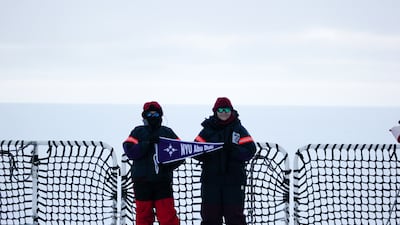
Clare Eayrs and Daiane Faller from NYUAD get ready to deploy onto the sea ice on a chilly spring morning in 2019. -
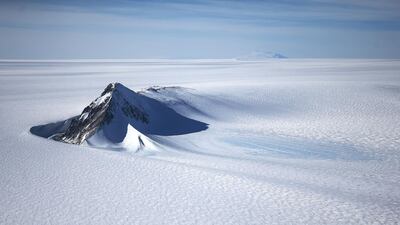
The vastness of the Antarctic viewed from a window of a Nasa plane. -
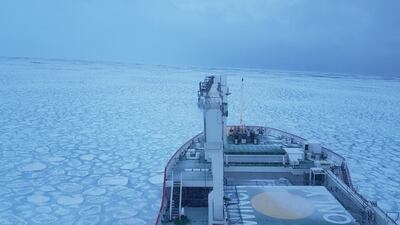
Travelling through sea ice in the Atlantic southern ocean aboard the 'S.A. Agulhas II', a South African ice-breaking polar supply and research ship, in the winter of 2017. -
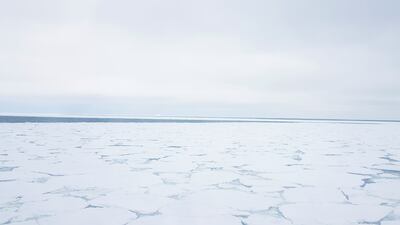
Ice in the Lazarev Sea, Antarctica, during spring 2019. A distant iceberg can be seen on the horizon. -
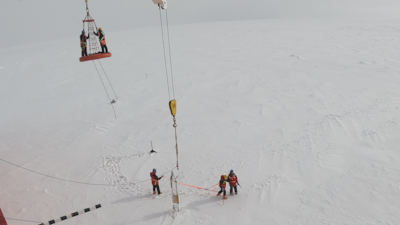
Researchers from NYUAD's Centre for Global Sea Level Change on their way to retrieve a mast installed on sea ice in the Southern Ocean in 2019. -
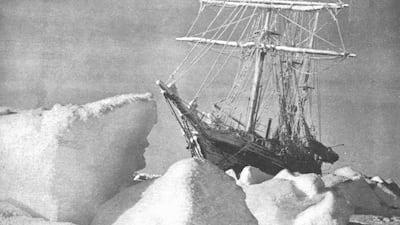
Antarctica has fascinated explorers for centuries. Explorer Ernest Shackleton's ship 'Endurance' was trapped and slowly crushed by ice in the Weddell Sea during his second expedition to the Antarctic in 1915. -
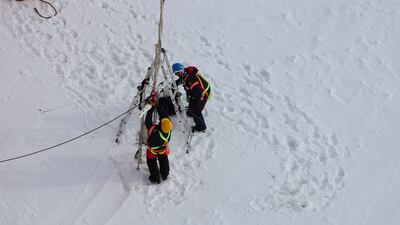
Clare Eayrs and Daiane Faller install a mast on sea ice in the Southern Ocean in 2019. The mast supports instruments to measure turbulent and radiative fluxes. -
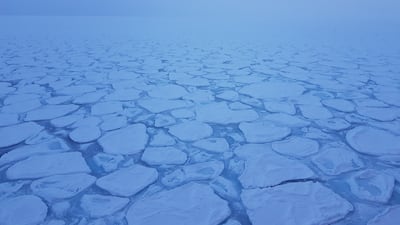
Sea ice in 2017 forming through the 'pancake cycle'. The characteristic raised rims are caused when the pancakes crash into each other through wind and wave action.



