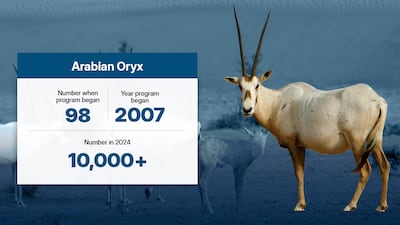
• The largest population of Arabian oryx now lives in protected areas in the UAE after previously being listed as extinct in the wild. All photos: Environment Agency - Abu Dhabi
    The largest population of Arabian oryx now lives in protected areas in the UAE after previously being listed as extinct in the wild. All photos: Environment Agency - Abu Dhabi
  • Arabian oryx were reclassified as vulnerable by the International Union for the Conservation of Nature in December 2023
    Arabian oryx were reclassified as vulnerable by the International Union for the Conservation of Nature in December 2023
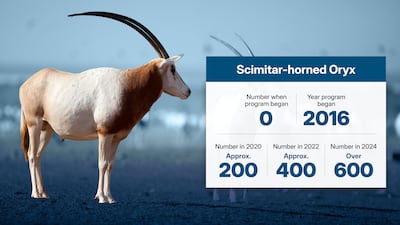
  • Environment Agency - Abu Dhabi has also spearheaded a repopulation programme for scimitar-horned oryx
    Environment Agency - Abu Dhabi has also spearheaded a repopulation programme for scimitar-horned oryx
  • Scimitar-horned oryx calves with their mothers in Chad
    Scimitar-horned oryx calves with their mothers in Chad
  • The Sahelian plains of Chad are now home to more than 600 scimitar-horned oryx
    The Sahelian plains of Chad are now home to more than 600 scimitar-horned oryx
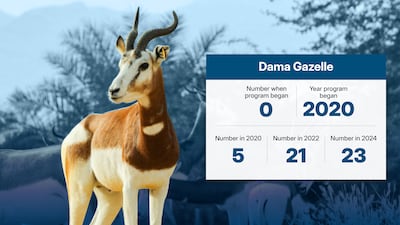
  • The agency released six Dama gazelles into a wildlife reserve in Chad in May 2024
    The agency released six Dama gazelles into a wildlife reserve in Chad in May 2024
  • The Dama gazelle is classified as critically endangered
    The Dama gazelle is classified as critically endangered
  • Three of the gazelles are equipped with satellite tracking devices, so the team can monitor the animals’ progress in the reserve
    Three of the gazelles are equipped with satellite tracking devices, so the team can monitor the animals’ progress in the reserve
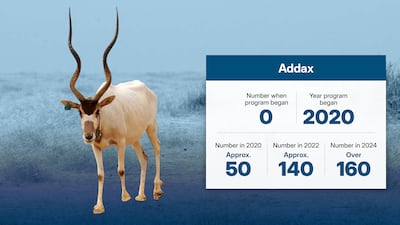
  • The agency has also helped repopulate the addax antelope in Chad
    The agency has also helped repopulate the addax antelope in Chad
  • The addax, also known as the white antelope, is native to the Sahara
    The addax, also known as the white antelope, is native to the Sahara
  • The addax is classified as critically endangered
    The addax is classified as critically endangered

Back from the brink: How the UAE is working to repopulate endangered wildlife


  • English
  • Arabic

The Arabian oryx, the largest land mammal native to the Arabian peninsula, has adapted to the harsh desert terrain in fascinating ways.

It can detect rainfall and fresh plant growth from up to 90km, for example, and it has a circulation system in its head that helps it stay cool, according to the Environment Agency – Abu Dhabi.

Despite these protective biological responses, the desert antelope, also known as the white oryx, was hunted to the verge of extinction by the 1970s, when it was declared extinct in the wild by the International Union for Conservation of Nature (IUCN). It was prized for its meat and hide, and habitat loss due to construction and development made survival difficult.

When that happened, UAE Founding Father of the UAE, the late Sheikh Zayed bin Sultan Al Nahyan, a well-known lover of animals and nature, launched conservation efforts that have since brought this species back to life.

President Sheikh Mohamed introduced the Arabian Oryx Reintroduction Programme in 2007, helping it to become the first animal to revert to vulnerable status after previously being listed as extinct in the wild.

Today, the UAE is home to the largest population of Arabian oryx in the world, with more than 10,000 animals living predominantly around protected areas in Abu Dhabi.

This is only one – and possibly the most famous – of the UAE’s success stories in wildlife repopulation, as hundreds of people across the country continue to work tirelessly to protect the environment, not only on the ground, but also further afield.

Large-mammal reintroduction

Most recently, the Environment Agency – Abu Dhabi, which was established in 1996 by a small group of ecologists passionate about continuing Sheikh Zayed’s legacy, launched one of the world’s biggest large-mammal reintroduction programmes in Chad.

The agency’s team released for the first time six Dama gazelles into the Ouadi Rime – Ouadi Achim Wildlife Reserve this year.

The Dama gazelle is classified by the IUCN as critically endangered, with only about 100 animals remaining in the wild in Chad and Niger.

  • The UAE has the biggest population of Arabian oryx in the world
    The UAE has the biggest population of Arabian oryx in the world
  • The scimitar-horned oryx has been reclassified by the International Union for Conservation of Nature as endangered, instead of extinct, in the wild
    The scimitar-horned oryx has been reclassified by the International Union for Conservation of Nature as endangered, instead of extinct, in the wild
  • The addax antelope is being repopulated in Chad
    The addax antelope is being repopulated in Chad
  • Dama gazelles were released into the wild again for the first time in 2024
    Dama gazelles were released into the wild again for the first time in 2024

It is on the verge of extinction and the agency's efforts aim to preserve and increase wild herd numbers in its natural habitats, in collaboration with Sahara Conservation, the Zoological Society of London, and the Smithsonian’s National Zoo and Conservation Biology Institute.

The project began in 2019 with a captive breeding programme, when five wild gazelles were captured in the Manga region and other areas of the wildlife reserve in Chad.

They were then transported to enclosures for breeding, where they were kept with other Dama gazelles from the agency’s wildlife conservation centres in the UAE and central Africa.

Those that were released in May are from two groups: one wild and the other bred in captivity. Three are equipped with satellite tracking devices, so the team can monitor the animals’ progress in the reserve, which is now home to about 50 gazelles.

“The post-release monitoring of gazelles will help us provide detailed information about the reproduction and mortality rates of these animals,” explained Ahmed Al Hashmi, executive director of the terrestrial and marine biodiversity sector at the environment agency.

“It also provides a unique opportunity to closely monitor wild Dama gazelles and to identify factors that limit their reproduction.

“This, in turn, will support this gazelle species in the long term.”

The story of the scimitar-horned oryx

The Dama gazelle project follows the successful reintroduction programmes for the scimitar-horned oryx, also known as the Sahara oryx, and the addax antelope in Chad.

The scimitar-horned oryx was once widespread across North Africa, but in 2000 was declared extinct in the wild, primarily because of poaching.

Fourteen years later, a reintroduction programme founded under the directive of Sheikh Hamdan bin Zayed, Ruler's Representative in Al Dhafra region and chairman of the board of directors of the agency, was launched and in 2016 the first shipment of animals was released back into the wild.

We realised that once we were successful within the UAE, then we should go beyond its borders
Dr Shaikha Salem Al Dhaheri,
secretary general of Environment Agency - Abu Dhabi

The following year, a herd of 75 animals arrived at the Ouadi Rime – Ouadi Achim Wildlife Reserve, in collaboration with the Chad Ministry of Environment and Fisheries, and the Sahara Conservation Fund.

Since then, the agency has been able to increase herd numbers to more than 630, exceeding the original target of 500, with the species downgraded to endangered by the IUCN in December.

Dr Shaikha Salem Al Dhaheri, secretary general of agency, said the reclassification was a significant conservation milestone, but also beneficial to the community through capacity building, raising awareness and the hiring of local people.

“[It is] not the end of our collective efforts,” she said at the time.

“One of the elements that contributed to our success was the experience we gained from our successful reintroduction programme of the Arabian oryx in Abu Dhabi.

"We realised that once we were successful within the UAE, then we should go beyond its borders.”

The challenges of repopulation

Mr Al Hashmi said reintroducing species is a delicate balancing act that is rife with challenges.

“People believe if you have an animal and you want to introduce it, it’s very easy,” he told The National.

“But it requires a huge [amount of] science, information and experience.”

It was thanks to the foresight of Sheikh Zayed that they were even able to get these projects off the ground in the first place, Mr Al Hashmi said, as the agency inherited the late leader’s collection of animals.

President Sheikh Mohamed with a baby Arabian oryx at a protected area in Abu Dhabi. Photo: Environment Agency - Abu Dhabi

“He used to have this collection because during his travels he saw many animals, like the scimitar-horned oryx, being poached severely. He had a small population, and he said 'with the current scenario, these animals will soon no longer exist'" said Mr Al Hashmi.

“So, what we did was we reproduced those animals together, but it’s not easy to do, because after 30 years in captivity, those animals are so vulnerable and their behaviour is changed and their body will be so weak, so you need genetic diversity.”

The agency worked with international partners in Europe and the US to import animals and cross-breed them until it could assure high genetic diversity and know the animal was ready for release.

“We kept testing [scimitar-horned oryx] behaviour in Abu Dhabi and then we built another enclosure area in Chad, just to ensure those animals will learn how to feed.”

A whole ecosystem

Location is key to these repopulation efforts, as, if the wrong place is chosen to release captive-bred animals, they will not survive. The conservation teams must also replant suitable vegetation for food and shelter.

All of this requires collaborative efforts, Mr Al Hashmi emphasised.

It takes several countries working together to ensure a sustainable repopulation programme. Oman and Jordan have been heavily involved in the agency’s efforts to boost Arabian oryx populations, for example.

"We want to assure this animal is back everywhere … then we will have a great international story," he said.

Moving forward, the agency plans to keep focusing on its repopulation efforts and it is hoping the Arabian oryx will soon be relisted by the IUCN as “least concern”.

But Mr Al Hashmi couldn’t put a timeframe on when this might happen.

“The difficult part with nature is to set very specific goals, because you don't control the ecosystem," he said.


SUZUME
%3Cp%3EDirector%3A%20Makoto%20Shinkai%3C%2Fp%3E%0A%3Cp%3EStars%3A%20Nanoka%20Hara%2C%20Hokuto%20Matsumura%2C%20Eri%20Fukatsu%3C%2Fp%3E%0A%3Cp%3ERating%3A%204%2F5%3C%2Fp%3E%0A
GAC GS8 Specs

Engine: 2.0-litre 4cyl turbo

Power: 248hp at 5,200rpm

Torque: 400Nm at 1,750-4,000rpm

Transmission: 8-speed auto

Fuel consumption: 9.1L/100km

On sale: Now

Price: From Dh149,900

The specs

Engine: 4.0-litre V8 twin-turbocharged and three electric motors

Power: Combined output 920hp

Torque: 730Nm at 4,000-7,000rpm

Transmission: 8-speed dual-clutch automatic

Fuel consumption: 11.2L/100km

On sale: Now, deliveries expected later in 2025

Price: expected to start at Dh1,432,000

The specs
Engine: 4.0-litre flat-six
Power: 510hp at 9,000rpm
Torque: 450Nm at 6,100rpm
Transmission: 7-speed PDK auto or 6-speed manual
Fuel economy, combined: 13.8L/100km
On sale: Available to order now
Price: From Dh801,800
Dhadak 2

Director: Shazia Iqbal

Starring: Siddhant Chaturvedi, Triptii Dimri 

Rating: 1/5

The biog

First Job: Abu Dhabi Department of Petroleum in 1974  
Current role: Chairperson of Al Maskari Holding since 2008
Career high: Regularly cited on Forbes list of 100 most powerful Arab Businesswomen
Achievement: Helped establish Al Maskari Medical Centre in 1969 in Abu Dhabi’s Western Region
Future plan: Will now concentrate on her charitable work

%3Cp%3EMATA%0D%3Cbr%3EArtist%3A%20M.I.A%0D%3Cbr%3ELabel%3A%20Island%0D%3Cbr%3ERating%3A%203.5%2F5%3C%2Fp%3E%0A

The Saga Continues

Wu-Tang Clan

(36 Chambers / Entertainment One)

The Sand Castle

Director: Matty Brown

Stars: Nadine Labaki, Ziad Bakri, Zain Al Rafeea, Riman Al Rafeea

Rating: 2.5/5

RIDE%20ON
%3Cp%3EDirector%3A%20Larry%20Yang%3C%2Fp%3E%0A%3Cp%3EStars%3A%20Jackie%20Chan%2C%20Liu%20Haocun%2C%20Kevin%20Guo%3C%2Fp%3E%0A%3Cp%3ERating%3A%202%2F5%3C%2Fp%3E%0A
SPEC%20SHEET%3A%20NOTHING%20PHONE%20(2)
%3Cp%3E%3Cstrong%3EDisplay%3A%3C%2Fstrong%3E%206.7%E2%80%9D%20LPTO%20Amoled%2C%202412%20x%201080%2C%20394ppi%2C%20HDR10%2B%2C%20Corning%20Gorilla%20Glass%3C%2Fp%3E%0A%3Cp%3E%3Cstrong%3EProcessor%3A%3C%2Fstrong%3E%20Qualcomm%20Snapdragon%208%2B%20Gen%202%2C%20octa-core%3B%20Adreno%20730%20GPU%3C%2Fp%3E%0A%3Cp%3E%3Cstrong%3EMemory%3A%3C%2Fstrong%3E%208%2F12GB%3C%2Fp%3E%0A%3Cp%3E%3Cstrong%3ECapacity%3A%3C%2Fstrong%3E%20128%2F256%2F512GB%3C%2Fp%3E%0A%3Cp%3E%3Cstrong%3EPlatform%3A%3C%2Fstrong%3E%20Android%2013%2C%20Nothing%20OS%202%3C%2Fp%3E%0A%3Cp%3E%3Cstrong%3EMain%20camera%3A%3C%2Fstrong%3E%20Dual%2050MP%20wide%2C%20f%2F1.9%20%2B%2050MP%20ultrawide%2C%20f%2F2.2%3B%20OIS%2C%20auto-focus%3C%2Fp%3E%0A%3Cp%3E%3Cstrong%3EMain%20camera%20video%3A%3C%2Fstrong%3E%204K%20%40%2030%2F60fps%2C%201080p%20%40%2030%2F60fps%3B%20live%20HDR%2C%20OIS%3C%2Fp%3E%0A%3Cp%3E%3Cstrong%3EFront%20camera%3A%3C%2Fstrong%3E%2032MP%20wide%2C%20f%2F2.5%2C%20HDR%3C%2Fp%3E%0A%3Cp%3E%3Cstrong%3EFront%20camera%20video%3A%3C%2Fstrong%3E%20Full-HD%20%40%2030fps%3C%2Fp%3E%0A%3Cp%3E%3Cstrong%3EBattery%3A%3C%2Fstrong%3E%204700mAh%3B%20full%20charge%20in%2055m%20w%2F%2045w%20charger%3B%20Qi%20wireless%2C%20dual%20charging%3C%2Fp%3E%0A%3Cp%3E%3Cstrong%3EConnectivity%3A%3C%2Fstrong%3E%20Wi-Fi%2C%20Bluetooth%205.3%2C%20NFC%20(Google%20Pay)%3C%2Fp%3E%0A%3Cp%3E%3Cstrong%3EBiometrics%3A%3C%2Fstrong%3E%20Fingerprint%2C%20face%20unlock%3C%2Fp%3E%0A%3Cp%3E%3Cstrong%3EI%2FO%3A%3C%2Fstrong%3E%20USB-C%3C%2Fp%3E%0A%3Cp%3E%3Cstrong%3EDurability%3A%3C%2Fstrong%3E%20IP54%2C%20limited%20protection%3C%2Fp%3E%0A%3Cp%3E%3Cstrong%3ECards%3A%3C%2Fstrong%3E%20Dual-nano%20SIM%3C%2Fp%3E%0A%3Cp%3E%3Cstrong%3EColours%3A%3C%2Fstrong%3E%20Dark%20grey%2C%20white%3C%2Fp%3E%0A%3Cp%3E%3Cstrong%3EIn%20the%20box%3A%3C%2Fstrong%3E%20Nothing%20Phone%20(2)%2C%20USB-C-to-USB-C%20cable%3C%2Fp%3E%0A%3Cp%3E%3Cstrong%3EPrice%20(UAE)%3A%3C%2Fstrong%3E%20Dh2%2C499%20(12GB%2F256GB)%20%2F%20Dh2%2C799%20(12GB%2F512GB)%3C%2Fp%3E%0A
Trump v Khan

2016: Feud begins after Khan criticised Trump’s proposed Muslim travel ban to US

2017: Trump criticises Khan’s ‘no reason to be alarmed’ response to London Bridge terror attacks

2019: Trump calls Khan a “stone cold loser” before first state visit

2019: Trump tweets about “Khan’s Londonistan”, calling him “a national disgrace”

2022:  Khan’s office attributes rise in Islamophobic abuse against the major to hostility stoked during Trump’s presidency

July 2025 During a golfing trip to Scotland, Trump calls Khan “a nasty person”

Sept 2025 Trump blames Khan for London’s “stabbings and the dirt and the filth”.

Dec 2025 Trump suggests migrants got Khan elected, calls him a “horrible, vicious, disgusting mayor”

Know before you go
  • Jebel Akhdar is a two-hour drive from Muscat airport or a six-hour drive from Dubai. It’s impossible to visit by car unless you have a 4x4. Phone ahead to the hotel to arrange a transfer.
  • If you’re driving, make sure your insurance covers Oman.
  • By air: Budget airlines Air Arabia, Flydubai and SalamAir offer direct routes to Muscat from the UAE.
  • Tourists from the Emirates (UAE nationals not included) must apply for an Omani visa online before arrival at evisa.rop.gov.om. The process typically takes several days.
  • Flash floods are probable due to the terrain and a lack of drainage. Always check the weather before venturing into any canyons or other remote areas and identify a plan of escape that includes high ground, shelter and parking where your car won’t be overtaken by sudden downpours.


Race 3

Produced: Salman Khan Films and Tips Films
Director: Remo D’Souza
Cast: Salman Khan, Anil Kapoor, Jacqueline Fernandez, Bobby Deol, Daisy Shah, Saqib Salem
Rating: 2.5 stars

Updated: August 04, 2024, 3:00 AM