

Archaeologists in Bahrain have unearthed what is believed to be one of the oldest Christian buildings in the Gulf, dating back to as early as the fourth century.
The remarkable findings offer the first physical evidence of the existence of an ancient Christian community in the island nation.
The Church of the East, also known as the Nestorian Church, is known to have flourished in the region for hundreds of years, until the 7th century, coinciding with the spread of Islam.
Excavation teams from Bahrain and the United Kingdom discovered an eight-room building, thought to be home to the bishop of the diocese, in Samaheej, a village on the northern coast of Muharraq Island.
The joint project between the Bahrain Authority for Culture and Antiquities, led by Dr Salman Al Mahari, and a team headed by Professor Timothy Insoll, of the Institute of Arab and Islamic Studies at Exeter University in the UK, began in 2019 and culminated in these significant discoveries in 2023.
Their work sheds fascinating light on the Christian settlements in Bahrain many centuries ago, before Islam took root.
Radiocarbon dating of the Samahij site confirms the building was occupied between the mid-4th and mid-8th centuries CE, likely abandoned as Islam spread among the local population.
-
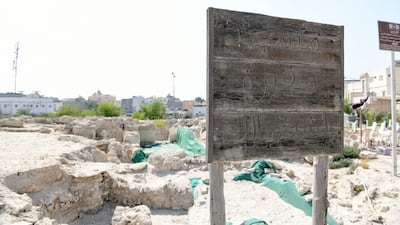
The site of a Christian building discovered under the ruins of an ancient mosque in Muharraq, Bahrain. Khushnum Bhandari / The National -
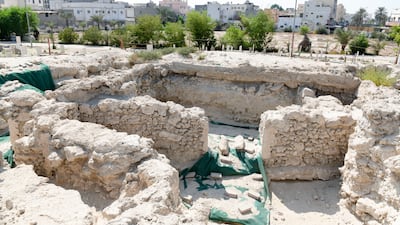
This wall was found under an ancient mosque in the middle of a Muslim graveyard in Muharraq. Khushnum Bhandari / The National -
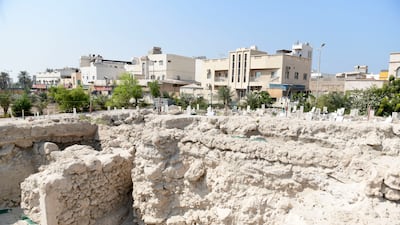
A living area, kitchen and workshops in a Christian home that likely belonged to a bishop dating back to the fourth century. Khushnum Bhandari / The National -

Teams will resume excavations and dig deeper into the site this month. Khushnum Bhandari / The National -
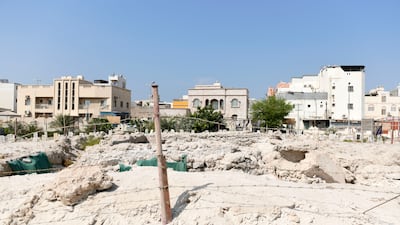
Experts at the archeological site have uncovered the first concrete evidence that Christianity existed in Bahrain before the spread of Islam. Khushnum Bhandari / The National -
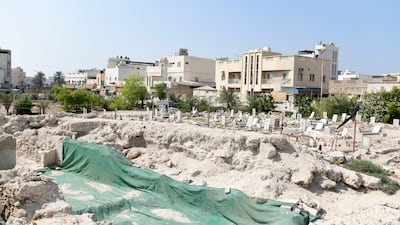
The archeological site is inside a cemetery where families still come to pray for the departed. Khushnum Bhandari / The National -
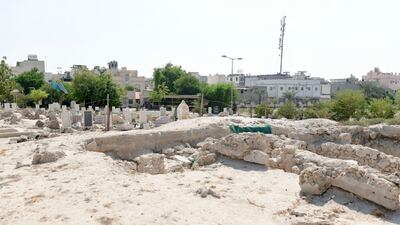
The excavation project began in 2019. Khushnum Bhandari / The National -

Across the burial ground are wooden plaques with inscriptions in memory of those who have passed away. Khushnum Bhandari / The National -
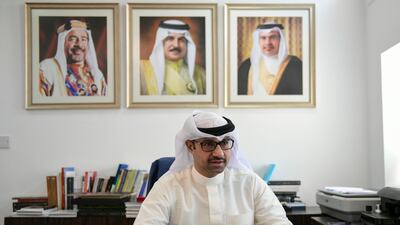
Dr Salman Al Mahari, director of archaeology and museums at the Bahrain Authority for Culture and Antiquities in Manama, says work will resume aiming to find more treasures of the past. Khushnum Bhandari / The National -
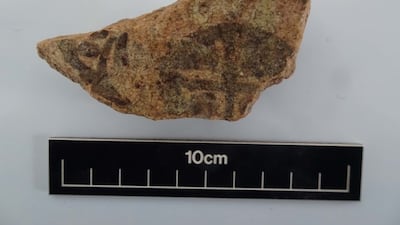
A small glazed pottery piece with the mark of a cross found at the excavation site. Photo: Bahrain Authority for Culture and Antiquities -
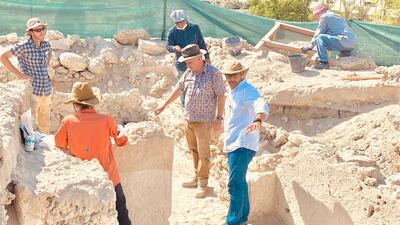
Experts from the UK's Institute of Arab and Islamic Studies of the University of Exeter with a Bahraini team excavating the site. Photo: Bahrain Authority for Culture and Antiquities -
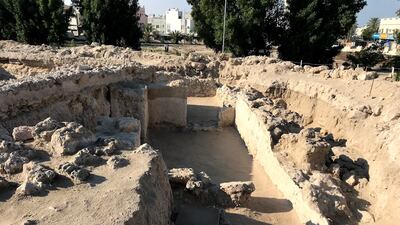
A closer view of the excavation site that uncovered a Christian dwelling under a 300-year-old mosque in Bahrain. Photo: Bahrain Authority for Culture and Antiquities -

An aerial view of an excavation site. Photo: Bahrain Authority for Culture and Antiquities


Digging into the past
The dig started at a mound within the Samahij cemetery, where archaeologists discovered the remnants of a 300-year-old mosque beneath the mound.
Further excavation revealed a large building with eight rooms, including a kitchen, dining room, workshop, and three living quarters.
It is believed that the construction of the mosque contributed to the preservation of the building.
"The findings suggest the building may have been the residence of the bishop of the diocese, which included Samahij," said a statement issued by a Bahraini government media team.
"Records also indicate a connection between the region and central church authorities, with one bishop dismissed in 410 CE and another condemned for challenging church unity in the mid-7th century," the statement continued.
This discovery is said to be unique due to its location, in the heart of a modern, densely populated town, unlike previous Christian structures found in remote areas along the Gulf coast.
Notable finds during the excavation included three plaster crosses, two adorning the building's exterior and one possibly kept as a personal memento, along with wall carvings featuring a fish symbol and part of the "Chi Rho" symbol, representing the word Christ.
Dr Al Mahari said excavation is in its final stages, and underlined the site's importance for Bahraini history, providing valuable insights into the Christian presence in the region.
The excavation also revealed details about the building and its inhabitants' lives.
Constructed with stone walls coated in plaster and plaster floors, the building featured sockets and holes indicating door and seat placements.
The kitchen contained built-in ovens with bases and storage areas. Artefacts suggest the inhabitants enjoyed a good standard of living, consuming meat, fish, shellfish, and various crops.
The discovery of semi-precious agate beads and broken Indian pottery indicates the occupants were involved in trade, particularly with India.
Small drinking glasses and 12 copper coins suggest the use of Sassanian Empire currency. Additionally, spindle whorls and copper needles hint at the possibility of cloth production for religious purposes.
"We stress the importance of this site and the need to preserve it, highlighting its historical and archaeological value," said Prof Insoll.
"We were amused to find someone had drawn part of a face on a pearl shell using bitumen, possibly for a child who lived in the building.
"This is the first physical evidence of the Nestorian Church in Bahrain, providing a fascinating insight into how people lived, worked, and worshipped."

