

Live updates: Follow the latest news on Israel-Gaza
Lana Nusseibeh, the UAE's Assistant Minister for Political Affairs in the Ministry of Foreign Affairs, said this week's meeting of Arab leaders with the EU Foreign Affairs Council in Brussels showed that the bloc wanted closer ties with the region.
“One recurring message from my engagements here was the desire to further strengthen the co-ordination between the EU and Arab partners," Ms Nusseibeh, also envoy of the Foreign Minister to the EU, said of the two-day meeting, Wam reported on Wednesday.
She attended along with foreign ministers from Egypt, Jordan, Qatar and Saudi Arabia, as well as the Arab League Secretary General, Ahmed Aboul Gheit, on Monday and Tuesday.
Monday’s council session was part of a two-day set of high-level meetings focused on the war in Gaza.
The discussion focused on the Middle East Peace Process, and how to strengthen co-operation between the EU and Arab countries, with a view to finding a political solution to the conflict in Gaza.
Throughout the discussions in Brussels, Ms Nusseibeh called for an immediate ceasefire, unhindered humanitarian access, unconditional release of hostages, respect for international law, and renewed commitment by Israel and a reformed Palestinian Authority to the two-state-solution.
“The UAE is the largest bilateral humanitarian aid donor to Gaza," she said.
"Since the start of the conflict, the UAE has delivered more than 32,000 tonnes of food, medical supplies and other items essential to alleviating the suffering of the civilian population."
UAE drop aid into Gaza - in pictures
-
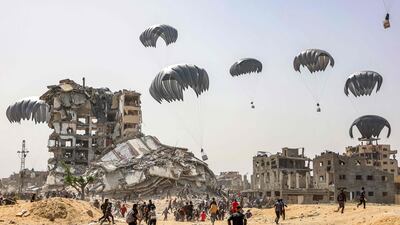
Palestinians rush to intercept humanitarian aid packages as they land in the northern Gaza Strip, dropped by a UAE plane in a joint effort with Egypt. All photos: AFP -
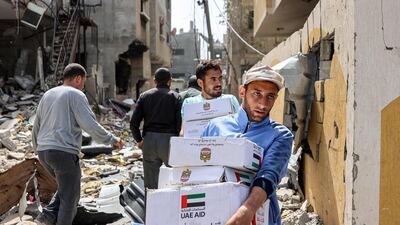
Men carry boxes of aid through the rubble of damaged buildings after the airdrop -
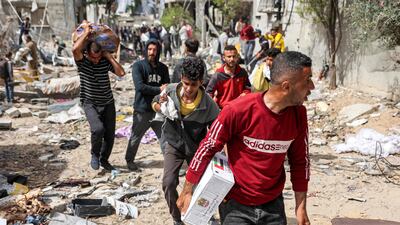
The packages are a lifeline for many amid the continuing war in the Gaza Strip -
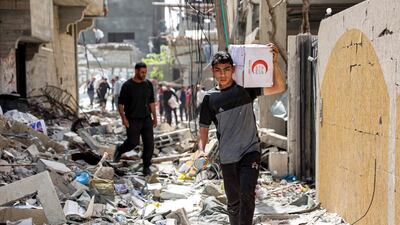
A youth carries a box of aid to his family -
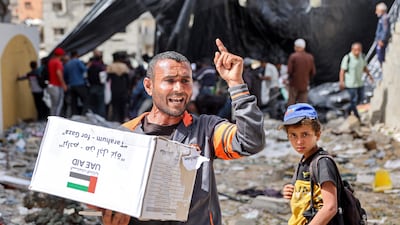
The additional supplies – including food – were sent by parachute into remote areas -
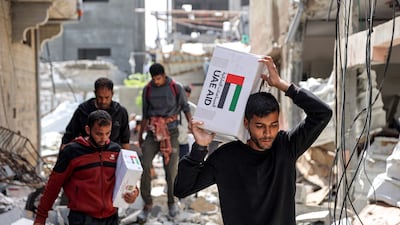
The UAE has been donating humanitarian relief to Gaza since shortly after the latest war began -
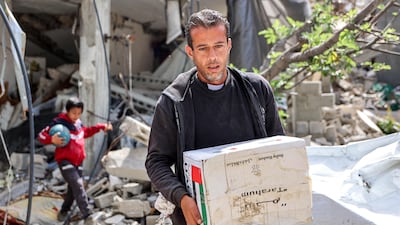
A man collects this aid package from the UAE-Egypt airdrop


Ms Nusseibeh also provided an update on UAE efforts to provide medical treatment and access to drinking water for people in Gaza.
She briefed those present on the latest aid shipment through the maritime corridor from Cyprus, delivering 1,100 tonnes to the enclave.
Ms Nusseibeh acknowledged that such efforts cannot compensate for the lack of access through border crossings, calling for restrictions to be lifted immediately and for faster screening of aid deliveries.
"There is strong commitment on all sides to ensuring peace and security in our shared neighbourhood.”
She also held several bilateral meetings, including with Tobias Lindner, Minister of State at the German Federal Foreign Office, Tor Wennesland, UN special co-ordinator for the Middle East peace process, and Robert Oliphant, Minister of Parliamentary Affairs at the Canadian Ministry of Foreign Affairs.
She was accompanied by Mohamed Al Sahlawi, ambassador of the UAE to Belgium, the EU and the Grand Duchy of Luxembourg, and Abdulrahman Al Neyadi, director of the European Affairs Department at the Ministry of Foreign Affairs.

