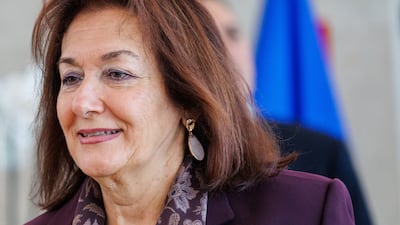

The EU will gather investors for a conference in Jordan next week, as the bloc seeks to secure cheaper renewable energy and investment opportunities for European companies in “the most stable country” in the region, a senior official has told The National.
Dubravka Suica, the EU’s Commissioner for the Mediterranean, said there would be "60, 70 or even more European companies" that had shown interest in investing in the kingdom.
“This is why we really want to push Jordan, because they are the most stable country,” she said.
Europeans want to create jobs and develop skills, while supporting continued stability in Jordan and gaining access to cheaper renewable energy than is available at home, Ms Suica said.
“Of course it's not easy, but by doing this we are in fact engaging young people of Jordan to work there, to develop their country,” she said. “At the same time they are also electrifying their country and they are producing this energy.”
Ms Suica condemned a church attack in Jordan late last month, which killed nine people. But she stopped short of saying the incident would prompt additional EU counter-terrorism financing for the kingdom.
“We express full support to Jordanian authorities' investigation on this, of course, but we already work closely with them on security matters,” she said.
The EU already has significant security co-operation with countries around the Mediterranean and has made that work a central part of its “Pact for the Mediterranean”, an initiative launched last year to deepen ties with its southern neighbours.
“We say that our delegations on the ground are our ears and eyes”, she said when asked about mechanisms to detect possible human rights abuses in partner countries that receive EU funding. Human rights organisations have criticised EU cooperation with countries including Libya, where migrants have reported widespread abuses in detention centres.
“This is not popular to say, but sometimes this is the precondition to get the money and if we talk about macro financial assistance, the state of human rights and democracy becomes [a] precondition for this," Ms Suica said. "Of course, it's not always easy, but we are trying to have the same standards around or across the Mediterranean.”
Clean energy push
A Croatian politician and long-serving EU official, Ms Suica spoke to The National during the annual Cop31 climate summit. The UN event is being held in Antalya, Turkey, where negotiators are pushing for electricity to replace fossil fuels as an energy source.
Asked whether partner countries around the Mediterranean were ready to increase their reliance on electricity, given the power shortages some nations, such as Lebanon, already experience, Ms Suica said Europe itself had learnt lessons about being “overly dependent” on Russian fossil fuel imports.
“You know, even us in Europe at the moment have problems with energy and with electrification,” she said. “So the more diverse we are, the better.”
Alongside security co-operation, the EU’s Pact for the Mediterranean also includes work on economic integration, improving job opportunities and skills, and boosting clean energy investments. The European Commission, the EU’s executive body, last month launched an investment platform backed by €4.5 billion in EU guarantees, intended to mobilise large-scale investment in renewable energy and clean technologies across the Mediterranean.
The platform is part of the “T-Med” initiative, which is already working on renewable energy projects in Egypt and Tunisia. Projects include the Sidi Bouzid 100MW solar project, which is due to come online in the second half of 2027.
Projects in Egypt tend to progress faster, Ms Suica said, citing the Ain Sokhna green ammonia project. The plant, the first of its kind in North Africa, produces ammonia for export to the EU market.
Syria 'on a good track'
Ms Suica will travel to Jordan next week, after visiting Syria where she will co-chair a major forum in Damascus alongside Syrian Foreign Minister Asaad Al Shibani.
“We put all our trust in Syrian authorities because we think they're on a good track,” she said before the Syria Partnership Co-ordination Forum on Tuesday.
“Although there are many problems, as all of us know – but they need our technical assistance to build institutions.” She cited the example of the central bank, where Syrian authorities "need the expertise" on "how to start the country after what happened there."
The EU has already committed €620 million in support for Syria in 2026 and 2027, and the talks in Damascus on Tuesday will also focus on attracting investment and the return of Syrians who fled abroad, Ms Suica said.
"We’re trying to, not to push, but we are trying to make the environment for Syrian people who are in Europe now to go back to rebuild their country,” she said.
“And they are willing to do it, but they need of course at least basics in order to come back.”
Mediterranean climate crisis
Ms Suica spoke at Cop31 after launching new initiatives to boost climate resilience and sustainable investment in partner countries around the Mediterranean.
The region is warming 20 per cent faster than the global average, amid climate and environmental crises that have seen tens of thousands of excess deaths due to scorching summers, forest fires and rising sea temperatures. Academics have described the Mediterranean as having “one of the highest levels of plastic pollution globally,” with 730 tonnes of plastic waste entering the Mediterranean Sea every day.
Co-operation between the EU and its southern neighbours is key to minimising the impact of climate and environmental crises, Ms Suica said – not by imposing standards on them but by working with them to reach the same standards across the region.
"When I say standards, that means not only rule of law, freedom of expression and democracy, but also these environmental standards,” she said.
“Because if we want to keep [the] Mediterranean clean, not polluted, then we need [the] same standards. Otherwise, what are we doing in the northern part if they don't follow in the southern part?”
‘We need ceasefires’
All the EU’s aims in the Mediterranean are underpinned by the need for peace and security, Ms Suica said.
“We are seeking partnerships and they are seeking partnership too,” she said. “But in order to achieve this, we need ceasefires – peace, prosperity would come.”
Countries around the Mediterranean include Israel, Lebanon and Palestine. A ceasefire in Gaza has not ended the violence in the war-torn strip: six people were killed and about 30 injured in an Israeli air strike on a hospital in the south of the enclave this week.
Ms Suica spoke with Israel's Foreign Minister Gideon Saar earlier this week about aid deliveries to Gaza, where humanitarian organisations are reporting delays as winter approaches and demand for assistance increases. Israel denies blocking humanitarian aid to Gaza.
"With winter approaching, we must ensure that essential water, sanitation and waste management services in Gaza continue to be delivered, regardless of political developments," Ms Suica said in a post on X.
The conflict between the US and Iran also remains unresolved. Although predictions of a new round of strikes on Iran after the US midterm elections have not materialised, there is also no clear end to the war or a reopening of the Strait of Hormuz, a key maritime passage for global energy supplies.
On the Iran conflict, the EU is “not the biggest, the most important partners when we speak about Iran, because [the] Americans are important here,” Ms Suica said. “We are doing everything we can in order to calm the situation down, also between Israel and Palestine,” she added.

