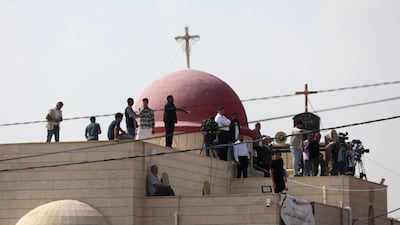

A prominent security specialist has called for reviving a government plan to undermine extremism in Jordan after an attack on a church last month that killed nine people and shook the country.
The Oct 23 attack in the village of Hmoud, 80km south of Amman, riled Jordan’s small Christian community and challenged official assertions of Jordan as a bulwark against militancy.
Saud Al Sharafat, a former intelligence brigadier general, told The National that the authorities had devised a National Strategy for Countering Violent Extremism but had not followed through on it. The strategy was completed as ISIS expanded in 2014, and up to 4,000 Jordanians went to fight in Iraq and in Syria's civil war.

“It ended up in a drawer,” said Mr Al Sharafat, who retired in 2015 and now leads the Shorufat ِCentre for Globalisation and Terrorism Studies in Amman.
“ISIS was defeated and the impression was that the threat from extremism lessened,” Mr Al Sharafat said in an interview. However, he said it is not too late to “act” and start a national debate on how the strategy “can be translated into measurable action”.
The strategy called for improvements in the education system, human rights, and socio-economic conditions in the country. The objective is to counter extremism and produce a “tolerant religious culture that would allow pluralism and acceptance of others to flourish”.

A month before the killings in Hmoud, King Abdullah told the UN General Assembly that Jordan was “confronting terrorism in the region and beyond”. He said the kingdom has been protecting Christians and promoting “the true image of Islam against the voices of hate”.
Jordan has a defence pact with Washington and is a major recipient of US aid. Its geopolitical importance rose after the country became part of regional plans to find alternatives to the Strait of Hormuz.
The economy has been stagnant for the last 15 years, with official unemployment at 16 per cent. In the last three years since the Gaza war, the authorities have adopted a tougher approach to dissent.
The strategy emphasised a need to strengthen co-ordination on combating extremism among the sectors of government, which Mr Al Sharafat said remains lacking.
“Prevention must become a continuous national priority, not merely a response to individual incidents,” Mr Al Sharafat said.
He said terrorism has affected the kingdom for decades, although many attacks had been foiled. “We cannot act surprised every time there is an attack,” he added.
In 2020, security forces arrested what they described as four terrorists linked to ISIS who planned to attack an Armenian Orthodox church and a liquor store in east Amman. Although security forces have developed considerable experience, a significant proportion of the counter-terrorism operations have resulted in casualties among the security forces.

The last death on the government side occurred in December 2022 in the southern governorate of Maan, where three members of the security forces were killed in an operation against what the government described as a “takfiri” cell.
The authorities said the cell was responsible for killing a police commander during unrest in Maan in the same month. "Takfiri" denotes a perceived right to deem others as apostates – a major plank of ISIS and other militant groups.
The authorities did not name any specific group as being behind the attack in Hmoud. However, officials described the suspected assailants as having takfiri ideology. On October 27, Jordan attacked from the air what it described as ISIS targets in Syria in response to the attack on Hmoud Mr Al Shurafat said that it was the first deadly terrorist attack on a church in modern-day Jordan.
“We have to wait for the investigation to know their objective”, he said, adding that ISIS, compared to other militant groups, has had the least qualms about attacking places of worship. Mr Al Sharafat said that most of the terrorists who have been pursued in Jordan tend to be inspired by ISIS, rather than being outright members of the group.
In 2005, Jordanian authorities blamed Al Qaeda in Iraq for suicide bombings against three hotels in Amman that killed around 60 people. The group was headed by Jordanian militant Abu Mussab Al Zarqawi, who had a major influence on ISIS.

