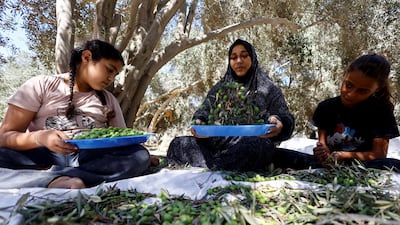

The smell of freshly baked zaatar bread mingled with smoke rising from an open fire as Saed Abu Baraka gathered with his family beneath the olive trees in central Gaza, trying to revive a tradition that the war has severely disrupted.
Around him, displaced families who had taken shelter on his land joined the breakfast gathering, sharing home-made bread and tea brewed over a fire, and recalling years when the olive harvest was among the happiest occasions of the Palestinian year.
For a few hours, despite the sound of Israeli warplanes overhead, familiar rituals returned. Men climbed the olive trees to pick the fruit, while women gathered the fallen olives from the ground and filled sacks with the harvest.
But this year’s gathering was painfully different.
Many of the relatives who once joined the harvest were no longer there. Much of the family’s land lay beyond the Israeli-controlled yellow line, out of reach. Around Gaza, olive production has fallen dramatically as farmland has been destroyed or made inaccessible.
Before the war, Mr Abu Baraka spent four days each autumn picking olives with relatives on the family’s 17-dunam (1.7 hectares) grove east of Deir Al Balah. They sang songs, cooked traditional food and gathered around a fire at night.
“We tried to bring back some of the atmosphere that reminded us of life before the war,” Mr Abu Baraka, 45, told The National. “But no matter how hard we tried, something was always missing.”

For generations, the olive harvest in Gaza has been more than an agricultural season. It has been a family celebration, a source of income and a deeply rooted expression of Palestinian identity. Relatives gather in the groves to pick fruit, prepare traditional food, sing folk songs and share stories around evening fires.
This year's harvest, however, has become another measure of the devastation inflicted on Gaza's agricultural sector during three years of war.
Gaza’s Ministry of Agriculture says about 40,000 of the 45,000 dunams planted with olive trees before the war have been damaged.
Annual olive production, which previously approached 40,000 tonnes, has fallen to no more than 3,300 tonnes this season, about 8 per cent of its former level, according to Mohammed Awda, a ministry spokesman.
One million trees destroyed
The ministry also estimates that more than one million olive trees have been destroyed along the Gaza Strip, while many surviving groves remain inaccessible.
Israeli military operations have destroyed and damaged Palestinian olive groves, while restrictions on access have left farmers unable to reach much of their remaining land. In the occupied West Bank, UN agencies have documented repeated attacks by Israeli settlers on Palestinian olive trees and farmers, particularly during the annual harvest.
“Before the war, Gaza was self-sufficient in olive production and we imported only limited quantities of olive oil,” Mr Awda told The National. “Today, however, the situation has changed dramatically and Gaza now relies primarily on imports.”
The shortage is visible in household kitchens.
For families such as Mr Abu Baraka’s, the figures represent far more than lost agricultural production. They reflect the disappearance of places where generations gathered, as well as the loss of livelihoods and familiar traditions.
But the war changed the landscape and the people who gathered there.
Mr Abu Baraka said most of his family’s land now lies beyond the Yellow Line, which marks areas under Israeli military control, leaving them with access only to their property in western Deir Al Balah.
Displaced families are also sheltering on much of the land that remains accessible.
45, of Gaza
About two weeks ago, Mr Abu Baraka went to the grove with his wife and children. They began the morning with breakfast, before starting to pick the olives.
It was a scene that resembled the harvests of previous years, but the absence of familiar faces and the loss of much of the family’s land weighed heavily on the gathering.
“First, there is the land we have lost,” Mr Abu Baraka said. “Then there is the way people’s lives have changed, and the loved ones we have lost who used to join us every year during the olive harvest.”
The difficulties continued after the picking was finished.
Before the war, the family would take their olives to a nearby press in eastern Deir Al Balah. That has since been destroyed.
This year, Mr Abu Baraka had to transport the harvest to Nuseirat, where he waited two days for the olives to be pressed.
'Nothing has been the same'
For many families, the shortage has also made it increasingly difficult to preserve enough olives and oil for the year ahead.
Ayman Al Shandaghli, 51, once bought at least 30 ratls (about 75kg) of olives to preserve for the year, along with two large tins of locally produced olive oil. This season he could only find – and afford – six ratls and three litres of oil.
He said a ratl of Suri olives now costs 60 shekels (about $19), up from 20 before the war, while a litre of oil has risen from 30 to as much as 120 shekels.
“Palestinian olives are special, and the taste of their oil is unlike anything else,” Mr Al Shandaghli told The National. “But since the war began, nothing has been the same.”
He previously bought olives and oil from Beit Hanoun in northern Gaza, but said the area is now inaccessible beyond the Yellow Line.
While families in Gaza struggle to maintain the tradition, efforts are also under way outside the territory to preserve the cultural and economic significance of its olive harvest.

The Last Harvest, a campaign by Palestinian olive oil brand Jenin and the Big Heart Foundation, is raising funds for farmers and awareness of the destruction of olive cultivation.
Renad Nahfawi, an account executive involved in the campaign, said it features a small quantity of oil pressed by a Gaza family and preserved in handcrafted glass vessels designed by Palestinian artist Lameice Abu Aker. Made with burnt olive wood and glass vials shaped like olive seeds, the vessels evoke both loss and the possibility of regrowth.
“Through the last harvest we wanted the small amount of olive oil to go a long way,” Ms Nahfawi told The National.
The campaign offers an auction of the vessels, direct donations and sales of limited-edition olive oil, with proceeds directed to the Arab Group for the Protection of Nature to implement its programmes. Organisers say a donation of Dh35 can help plant one olive tree.
For Mr Abu Baraka, however, preserving the harvest begins with gathering beneath the trees that remain.
“The olive harvest is one of the most important seasons in Palestinian life,” he said. “We have inherited its traditions from our fathers and grandfathers, generation after generation.”

