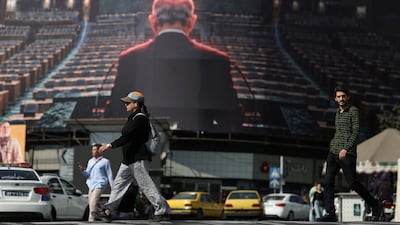

After two conflicts in as many years between Israel and Iran, and signs of more war to come, Iranians watched Israel’s elections with a mixture of trepidation, scrutiny and apathy.
“I am wondering why, as an Iranian, I should care about other countries’ elections more than our own,” one man who opposes the Tehran government and now lives outside the country told The National.
Some in the nation of 90 million predict a resumption of military operations, whether or not current Prime Minister Benjamin Netanyahu prevails in forming another government, and more devastating fallout for the lives of ordinary Iranians.

The conflict that began on February 28 has lessened in intensity but has not definitively concluded either. A series of ceasefires have failed to bring about a lasting peace amid a deadlock in negotiations between the US and Iran.
“Iranians are following this election and it’s important to them, in terms of whether Netanyahu remains in power or steps down,” Javad Heirannia, a Tehran-based political analyst, told The National.
Mr Netanyahu has publicly stated an aim to overthrow the clerical-led system of government in Tehran, without explaining how that would happen. “There is only one way to remove this threat once and for all: overthrow the regime in Iran,” he said last week. “And that is my directive to the [military], the Mossad and the security branches.”
The US has prepared for renewed strikes, American media has reported, although Washington has ruled out action before the midterm elections on November 3.
The scramble to form a government has begun in Israel after the country finished counting votes. Neither Mr Netanyahu nor his main rival, Gadi Eisenkot, obtained enough seats for a majority: the pro-Netanyahu bloc has 53 seats, the anti-Netanyahu bloc has 48, and the Arab factions has 19.
Even in the event of Mr Netanyahu losing power, pro and anti-government Iranians believe another Israeli government will start a war eventually.
"If Bibi loses, the other party won’t start a war immediately," said the man now living outside the country said, who remained anonymous for security reasons. "But also, Israeli foreign policy is not going to change, so it’s [just] going to give Iran a break before the new government starts the war."
That belief has led some to shun following updates on the vote because they think little will change in terms of Israel’s plans for Iran, regardless of who ultimately takes up the reins of power.
“I follow the elections in Israel just as much as I follow the elections in Guinea-Bissau,” one political observer in Tehran told The National, with a lick of sarcasm.
Who holds the prime minister position does not have a significant impact on the war, he said. “While we might see some variations in how the conflict unfolds, there will be no fundamental shifts,” he added. “The decision to wage war in the Middle East – specifically against Iran – is a decision and a policy that transcends the personal views of any single individual serving as prime minister of a nation with a population of roughly 10 million.”
Mr Eisenkot told Israeli army radio this month that he did not know of any “critical” reason why the US and Israel should launch more strikes on Iran, The Times of Israel reported, and accused Mr Netanyahu of being unfit to lead another military campaign.
Other Iranians have zoned out because, struggling to make ends meet in a flailing economy, they have become exhausted by a flurry of contradicting and uncertain news.
“Overall, I am really limiting how much I follow the news, because we have just gotten fed up with it,” one regime critic in Tehran, who also opposes war on Iran, told The National. “The news just doesn’t give you actual information – will there be another war or not? Will there be a ceasefire or not? Will the Islamic Republic go or not? Will Netanyahu go or not? So for that reason, I follow everything in a really limited way.”
Iranian state media has followed the polls closely, and underlined in coverage divisions in Israeli society highlighted by the vote.
The Islamic Revolutionary Guard Corps-linked Tasnim news agency described “confusion and ambiguity in the Zionist political scene” on polling day.
At the same time, Iranian state officials have dismissed the vote, widely deemed the most important in Israel’s recent history, saying the results will not change anything in terms of Israeli strategy.
“It makes no difference to us who, in these elections, takes the helm of a regime that has brought nothing but violence and massacres to our region,” Foreign Ministry spokesman Esmaeil Baghaei told journalists on Monday, before the election.
Many Iranians who view their own government with contempt do not support its arch-rival Israel either. Should another Israeli government launch more strikes after the election dust settles, they fear more destruction and violence in lives already crippled by years of war and economic turmoil, amid a US blockade of Iran’s ports that has worsened already sky-high inflation.
An crackdown on dissent has also been taking place in the shadow of war, according to the UN and human rights groups, who report a sharp increase in the arrest and execution of regime opponents.
Some people who initially supported the war in the hope that it would lead to the fall of the clerical leadership in Tehran have changed their minds, having seen the destruction of infrastructure and a more hardline leadership emerge as a result of the conflict.
Many Iranians feel stuck between a government that is unwilling and unable to deliver on political, social and economic reform, and the unpredictability of US and Israeli actions.
The “man on the street” who is “critical of the [Iranian] regime”, as well as parts of a more politically literate middle class, does not support the idea of more foreign intervention, Mr Heirannia said.
“The issue of independence for this middle class is important,” he said. “Their experience of foreign interventions in Iran has led them to conclude that it is not appropriate, does not bring democracy, and is not in the people's interests.”
Iranian history is littered with examples of foreign intervention that many see as having served the interests of foreign powers over Iranians themselves. They include the CIA and British-backed coup that ousted elected prime minister Mohammad Mosaddegh in 1953 in favour of the pro-western Shah.
Although it is hard to estimate its size, another sector of Iranian society supports the idea of Mr Netanyahu forming Israel’s next government and attempting to topple the regime.
“They believe that Netanyahu is the only one who can actually wipe out and destroy the Islamic Republic regime,” Mr Heirannia said.
That is not always born out of admiration for Israel, or the belief that the country has Iranians' best interests at heart, the man now living abroad said. It stems from a belief that Iranians tried every other way of changing their government – protesting, dissent and pushing for reform – and nothing worked, meaning foreign intervention is their only option, some have said.
"It's a bit sad to say, but many Iranians are putting their hopes in other countries, mostly Israel, and to some extent the US," the Iranian now living abroad said. "Netanyahu clearly wants the regime gone, while Trump tends to start and stop and change his mood. So Bibi has become really popular, and people hope that if another war starts, it might give them an opening to get back into the streets and take control again."
At least 8,000 people were killed during anti-government protests in January that formed the greatest challenge to the Islamic Republic system of government since its establishment in 1979. A UN-backed fact-finding mission said last month that a government crackdown on the protests that included murder, torture and enforced disappearance amounted to crimes against humanity.
He did not support the idea of another war. "I don't think that another war will be very helpful for the future of the people in Iran," he said. "Quite the contrary, I think it will make the Islamic Republic stronger."
Others still believe that an end to Mr Netanyahu's leadership, should it come, could be a chance for a partial reset and decrease in tensions across the region.
Mr Netanyahu was a "smart politician" who was simultaneously responsible for a "staggering" number of deaths across the region, through "political power without ethics," Mohammad Ali Sayedhanaee, founder of the Tehran-based Nation's Diplomacy think tank, told The National.
Mr Netanyahu boasts of inflicting significant damage on Iran through military operations and pursuing pressure to dismantle Tehran's nuclear programme, among other policies, Mr Sayedhanaee said. His possible departure could be an opportunity for a reset in relations between Iran and the rest of the region.
“If Netanyahu is defeated, it could be an opportunity for Iran to reassess its own policies and engage with the region on a new basis,” Mr Sayedhanaee added. “It could also create space for regional countries to develop their relations with Iran more independently, without the same level of external pressure.”

