The UAE, Saudi Arabia and Bahrain are to sell France the equivalent of 10 per cent of its usual diesel consumption in the coming weeks, French government sources said, as President Emmanuel Macron continued his tour of the Gulf.
The aim is reduce European energy prices, which have drawn protests and public anger in France and elsewhere. “The greater the quantity, the lower the price. It’s quite simple,” an adviser to French President Emmanuel Macron said.
A large part of the deal was negotiated by Mr Macron during a tour of the Gulf that started with visits to Kuwait and the UAE on Monday. He visited Bahrain on Tuesday, before travelling on to Qatar.

France previously obtained guarantees from Saudi Arabia to sell the country 95,000 tonnes of diesel in October and November, bringing the total to 190,000 tonnes over the two months. In addition, the UAE and Bahrain are in the coming weeks expected to separately sell 100,000 tonnes of diesel to France for an unknown duration.
“These are political commitments obtained from countries in the region because they know us and they know we are reliable – because we have been there during every critical moment, notably by deploying air defence capabilities,” the adviser said.
Sales are to go through French energy company TotalEnergies, whose chief executive, Patrick Pouyanne, has accompanied Mr Macron on his Gulf tour.
“Our mission is primarily to secure supplies because there is a risk. We have a diesel deficit, as we are a major importer,” Mr Pouyanne said. “We are in contact with [...] national companies and we are going to sign a contract specifically for France. The commitment in Saudi Arabia is to ensure that supplies continue beyond November.”
The announcement is a political win for Mr Macron, who is under pressure in France, which is in the grip of large-scale protests over a cost-of-living crisis. Some demonstrations have turned violent. Authorities have imposed a curfew in central Paris and other parts of the country.
European diesel is currently trading at almost $200 a barrel amid the war in Iran and Ukrainian attacks on Russian oil refineries. That compares with about $80 at the start of 2026, with refined products rallying much harder than crude prices this year.
AI and tech deals
During Mr Macron's stop in the UAE on Monday, France and the UAE signed deals in energy, artificial intelligence and advanced technology as the countries strengthen investment and economic ties.
The preliminary agreements were signed in the presence of Sheikh Khaled bin Mohamed, Crown Prince of Abu Dhabi, and Mr Macron in the UAE capital. Three agreements focused on AI and advanced technology were signed with French start-up AMI Labs to strengthen research and technological co-operation and explore new applications across several fields, Abu Dhabi Media office reported.
Emmanuel Macron visits UAE on Gulf tour – in pictures
-
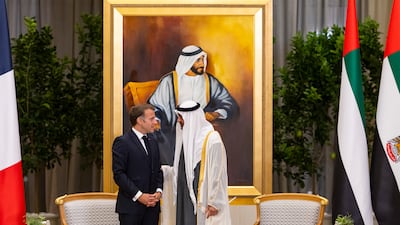
President Sheikh Mohamed and Emmanuel Macron, President of France, during an official visit reception in Abu Dhabi. UAE Presidential Court -
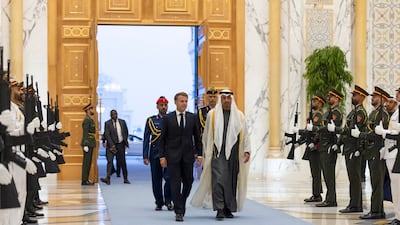
Sheikh Mohamed and Mr Macron during the reception. UAE Presidential Court -
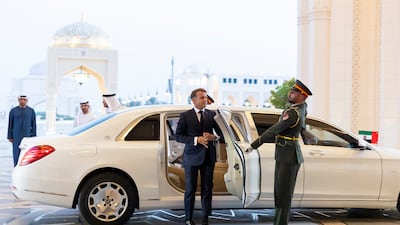
Sheikh Mohamed and Mr Macron arrive for the reception. UAE Presidential Court -
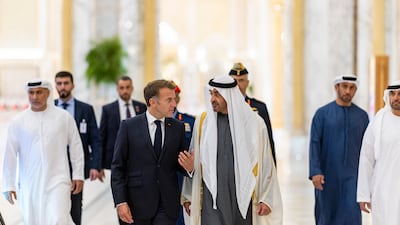
Sheikh Mohamed receives Mr Macron during the reception. UAE Presidential Court -
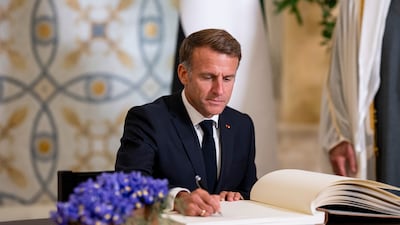
Mr Macron signs the guest book during the reception. UAE Presidential Court -
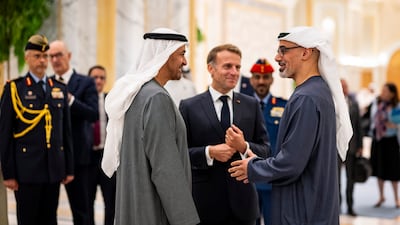
Sheikh Mohamed and Sheikh Khaled bin Mohamed, Crown Prince of Abu Dhabi and Chairman of Abu Dhabi Executive Council, bid farewell to Mr Macron. UAE Presidential Court -
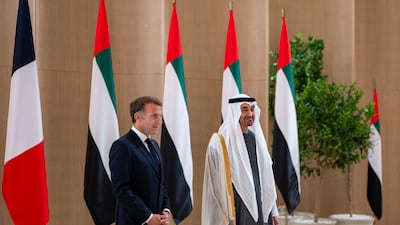
Sheikh Mohamed receives Mr Macron on arrival. UAE Presidential Court -
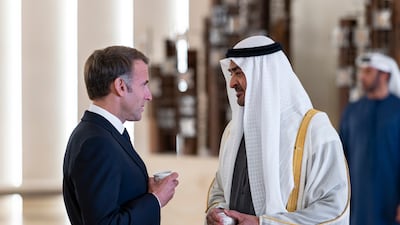
An official reception ceremony was held for Mr Macron, who is in the UAE on an official visit as part of his tour of the Gulf. UAE Presidential Court -
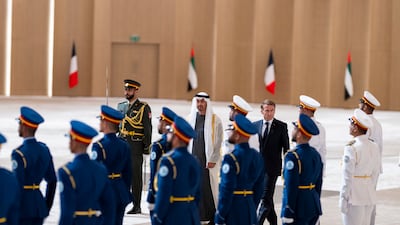
Sheikh Mohamed and Mr Macron inspect a UAE honour guard. UAE Presidential Court -
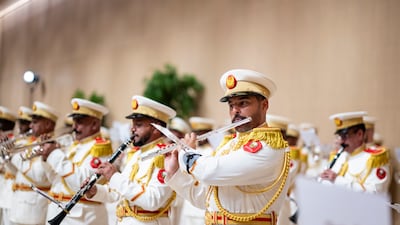
A UAE military band strikes up to welcome Mr Macron to Abu Dhabi. UAE Presidential Court -
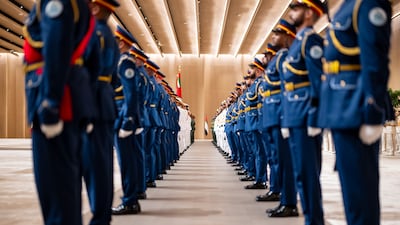
The honour guard in place as part of the welcoming ceremony for the French President, who arrived from Kuwait. UAE Presidential Court -
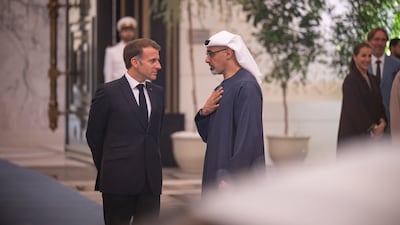
Sheikh Khaled and Mr Macron attend UAE-France Business Dialogue. Abu Dhabi Media Office -
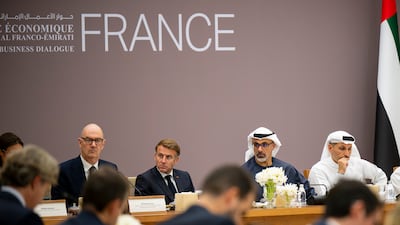
The UAE-France Business Dialogue in Abu Dhabi. Abu Dhabi Media Office -
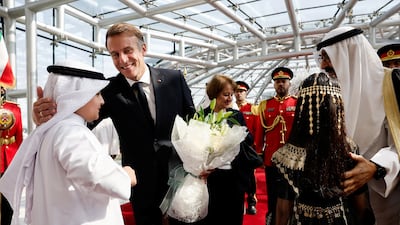
Sheikh Meshal, Emir of Kuwait, welcomes Mr Macron at Kuwait International Airport. Reuters -
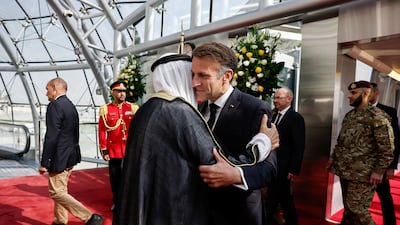
The leaders meet in Kuwait, as Mr Macron tours the Gulf. Reuters -
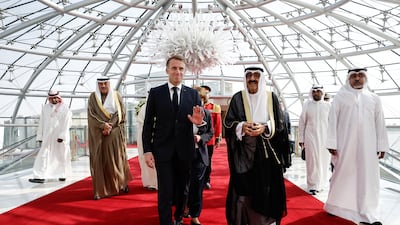
The French leader arrived in Kuwait as part of a Gulf tour. Reuters -
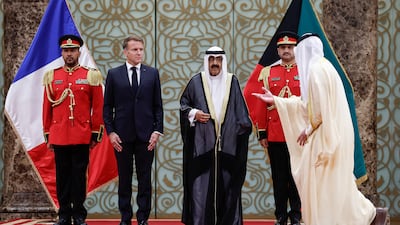
A welcoming ceremony for Mr Macron. Reuters -
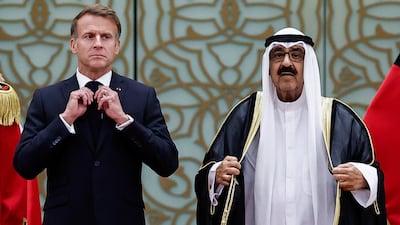
Discussions were expected to focus on securing and diversifying our energy supplies. Reuters -

Sheikh Meshal and Mr Macron witness the signing of an agreement at Bayan Palace, in Kuwait City. Reuters


The deals cover Mohamed bin Zayed University of Artificial Intelligence, Abu Dhabi’s G42 and computing company Analog.
MBZUAI is to focus on strengthening co-operation with AMI Labs in AI research and development, while G42 aims to establish a framework for strategic co-operation in cloud computing infrastructure and AI models.
Analog’s deal with AMI Labs is related to exploring opportunities to integrate AI models into robotics and physical AI applications and opening new avenues for developing intelligent systems and expanding their use in industrial and technology sectors.
AI is a cornerstone of French-Emirati relations. During a visit by Sheikh Mohamed to France in February 2025, the UAE announced that billions of euros was to be investment in an AI campus and date centre project near Paris.
The UAE and France will also boost co-operation in the energy sector, with Adnoc Gas and Schneider Electric signing an initial pact to assess advanced technology and opportunities for operational improvements to help enhance efficiency and improve the performance of energy systems.
Adnoc Refining and Technip Energies also signed two contracts relating to a refining capacity enhancement project and a sustainable aviation fuel project.
“These agreements demonstrate both countries’ commitment to broadening economic and investment co-operation, strengthening integration between their industrial, technological and research capabilities, and opening new avenues for public-private partnerships to support the development of innovative and sustainable solutions in shared priority sectors,” Abu Dhabi Media office said.

