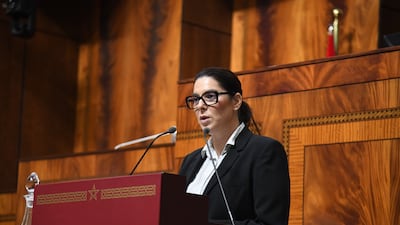
Morocco's Prime Minister Fatima Ezzahra El Mansouri vowed to support the Palestinian cause by pushing for a two-state solution as she presented her government's programme to the parliament.
The country last week swore in its new government, led by its first female prime minister, in a ceremony presided over by King Mohammed VI. Ms El Mansouri kept several former government ministers in their posts, including Foreign Minister Nasser Bourita and Interior Minister Abdelouafi Laftit.
The government formation followed a deal between Ms El Mansouri's centrist Authenticity and Modernity Party, which won the September 23 election, and three other parties. The coalition holds 207 seats in parliament, above the 198 needed for a majority.

On Monday, she presented her government's programme to members of both houses of parliament, outlining a five-year agenda focused on tackling corruption, strengthening the social welfare state, integrating young people into the economy, protecting sovereignty and building a productive economy.
Ms El Mansouri stressed "Morocco’s long-standing position on the Palestinian cause and Jerusalem", as well as her "support for a peaceful settlement based on a two-state solution that would ensure a just and lasting peace".
In September, Israel and Morocco agreed to upgrade their diplomatic ties by elevating missions to full embassies.
Ms El Mansouri also promised to "mobilise international support for Morocco's autonomy proposal" for the Sahara region and to "accelerate economic development in the southern provinces" to strengthen the region's role as "Morocco's gateway to Africa".
On the economy, she said her government aimed for average annual economic growth of 5 per cent from 2027 to 2031, up from an expected 4.7 per cent this year. She aims to keep the fiscal deficit under 3 per cent of GDP and maintain inflation at 2 per cent "to protect purchasing power and stability".

The government also plans to expand the tax base and reform the income tax, raise direct social aid to needy households, reduce food prices and push private investment to two thirds of total national investment. Public debt is to drop to about 62 per cent of GDP by 2031, she said.
There are plans to improve the efficiency of public enterprises and criminalise illicit enrichment and conflicts of interest, Ms El Mansouri said. "We believe that institutions will not regain public trust without an effective fight against corruption and conflicts of interest," she added.
The government faces pressure to address unemployment and demands for better education and health services. It will also oversee the final stages of a $20 billion push to prepare for the 2030 World Cup, which Morocco is to co-host with Portugal and Spain.

