
The Sudanese man in the video speaks with obvious elation.
“Come on, you guys, quit your jobs selling food in the market and come and join us,” he says as he chips away at a rocky wall rich with glittering gold veins.
“We have discovered where the gold is and it's a huge treasure trove,” he adds in the video purportedly shot in a gold mine and shared widely online. “We had been digging for 16 months before we reached these rocks. It has been exhausting,” claims the young man, speaking directly to camera.
With every extraction made by the slender, bearded man, another man standing nearby watching chants “Allahu akbar!” in a voice filled with jubilation and gratitude.
The video was shot last month in a mountainous area in northern Sudan near the Egyptian border and the Red Sea. It is where scores of Sudanese goldminers were killed in an air strike on October 10. No group has claimed responsibility for the attack.
In a Sudan already torn by the ravages of a civil war that has claimed tens of thousands of lives, the goldminers' deaths have touched a raw nerve among Sudanese, plunging the vast Afro-Arab country into grief and rage.
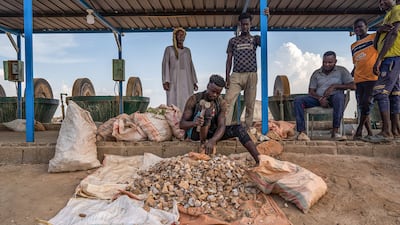
Many have taken to social media to lament the fate of their impoverished yet resource-rich nation, where the war has forced hundreds of thousands into the dangerous work of mining in remote and inhospitable regions so they can feed their families.
They blame the military-aligned government for failing to protect its people and question the sincerity of its public declarations that it intends to launch an inquiry.
Neither Egypt nor Sudan has said who might have been behind the attack. Statements by the authorities in the two allied nations spoke of respect for each other's sovereignty and borders.
Both said they were investigating the incident, with Sudanese human rights and watchdog groups putting the death toll at 72 and unconfirmed Sudanese media reports saying as many as 200 had been killed.
Images and video shared online, which The National has been unable to verify, purport to show the aftermath of the air strike, with bodies strewn across rubble, others wrapped in sheets and survivors, mostly men in their 20s and 30s, bristling with anger.

But regardless of who was responsible, the tragic deaths have laid bare the grim reality of a country blighted by more civil wars in the past 70 years than any other nation.
At least 14 million people have been displaced in the current conflict and widespread hunger has plagued the population.
Gold prospectors head to the mines equipped with sledgehammers, chisels, jerry cans filled with drinking water, torches and food. They stay on-site for weeks, sometimes months, before returning home for a break or sojourn at shanty towns that have popped up to cater for the miners' needs.
Many of the men who chose gold prospecting to make a living are natives of the western Darfur and central Kordofan regions who have been displaced by the fighting between the Sudanese Armed Forces (SAF) and its enemy, the paramilitary Rapid Support Forces.
Hashem Darar, 27, a native of eastern Sudan, counts himself lucky to escape the air strike.
“I was out of the site at the time of the attack. I was buying food and water, and selling gold we extracted at a nearby Al Ansari market in Al Oqaidat,” he said, referring to the region where the attack took place.
“I am saddened by the death of the men I got to know the past two months. We joked and laughed as we toiled among the rocks and in the dust, and I just lost them like this,” he said. “When I heard the blast, I rushed back to help the wounded and recover the bodies from under the rubble.”
Gold production in Sudan has for years been a murky business, attracting adventurers, smugglers and foreign parties seeking quick profit. In several ways, the country's current gold rush is a by-product of most of the Sudan’s oilfields being lost when South Sudan seceded in 2011.
The civil war that erupted in April 2023 has intensified the scramble for gold in Sudan. Some estimates put the number of artisanal miners involved at about two million.
Official figures say Sudanese government revenue from gold exports stands at about $2 billion but experts say smuggling and the use of gold outside official channels account for far more. Last year, for example, Sudan’s gold production was about 70 tonnes but only 20 tonnes were exported, with the remainder smuggled out of the country or treated at primitive local refineries.
Al Shafie Ahmed contributed to this report from Kampala, Uganda.

