
Egypt and Sudan say they are investigating the deadly shooting of two Egyptians in Khartoum, an attack that followed the weekend death of scores of Sudanese goldminers in an air strike near the Egyptian border.
Police in Sudan said they have apprehended the gunman whom they identified as Ibrahim Abdullah Adam, 23. They say he has admitted carrying out the attack, in which a third Egyptian was wounded, to avenge the death of his brother in Saturday's air strike.
They said all three Egyptians were lorry drivers. A Sudanese police officer was also wounded in an exchange of fire before the gunman's arrest.

“The investigation is continuing to establish the circumstances of the incident and its motives,” police said late on Monday night. “We will firmly deal with the matter under the law.”
Neither Egypt nor Sudan publicly have said who was behind the air strike. The Egyptian military issued a statement saying troops and police were continuing to counter “illegal” gold prospecting in the country's Eastern Desert.
It said it had dropped flyers on what it called criminal elements, warning them they must stop illegal mining “so that full sovereignty is safeguarded inside the Egyptian state's borders”.
Egypt's Foreign Ministry, meanwhile, said it was closely following the “regrettable” shooting in Khartoum. It said Foreign Minister Badr Abdelatty and his Sudanese counterpart in the military-backed government, Mohieldin Salem, spoke on the phone on Monday evening.
It added that the ministers “emphasised the mutual respect that binds the two nations, including respect for each other's sovereignty, and the safety and integrity of their territories and borders”.
The air strike near the border was initially reported by human rights and watchdog groups in Sudan, including the Emergency Lawyers, the civilian-led Somoud alliance and the Sudan Doctors' Network.
They gave widely varying death toll figures, from 13 to 72. Some media reports in Sudan put the figure as high as 200.

“We reject the targeting of civilians and putting their lives at risk, which cannot be justified on security grounds,” Somoud said. “The leadership of the relevant authorities appointed by the armed forces bears the responsibility for what happens in areas under their control.”
Sudan's military-led Sovereign Council said the air strike took place in the border region with Egypt. “The leadership in the two brotherly nations have been in contact since immediately after the incident took place to guarantee the protection of lives and safeguarding relations between the two peoples, find out the circumstances of the incident and give public opinion ownership of the facts,” it said.
Images and video shared online, which The National has been unable to verify, purport to show the aftermath of the air strike, with bodies strewn across rubble, others wrapped in green sheets and angry survivors, mostly men in their 20s or 30s.
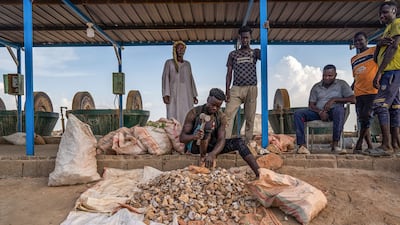
There has been an influx of gold prospectors in northern Sudan in recent years as the civil war between the Sudanese Armed Forces and the paramilitary Rapid Support Forces has hit the economy hard, driving hundreds of thousands to seek alternative sources of income.
Egypt's military said in June it was engaged in a large-scale operation in the south of the country to tackle gangs involved in drugs and arms trafficking, as well as illegal gold prospecting. It said 87 Egyptians and 136 foreigners had been arrested.
Gold production in Sudan has for years been a murky business, attracting adventurers, smugglers and foreign parties seeking quick profit. In several ways, the current gold rush is a by-product of most of the country’s oilfields being lost when South Sudan seceded in 2011.
The civil war that erupted in April 2023 has intensified the scramble for gold in Sudan. Some estimates put the number of artisanal miners involved at about two million.
Official figures place Sudanese government revenue from gold exports at about $2 billion but experts say smuggling and the use of gold outside official channels account for far more.
Last year, Sudan’s gold production was about 70 tonnes but only 20 tonnes were exported, with the remainder smuggled out of the country or treated primitive localised refineries.
Al Shafie Ahmed contributed to this report from Kampala, Uganda