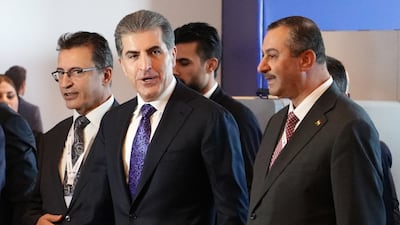

President Nechirvan Barzani of Iraq's Kurdistan region has said weapons must be held by the Iraqi government and warned that the country must not threaten Gulf states, as Baghdad enters a new phase following the withdrawal of US-led coalition forces.
“Iraq should not be a threat to Gulf countries. Iraq should never do that, that is not sovereignty,” Mr Barzani said at the annual Middle East Research Institute Forum in Erbil on Monday. “Weapons should be in the hands of the government,” he added, arguing that Iraq needed to strengthen its ability to exercise sovereignty and take responsibility for its own security.
The remarks come as Iraq faces pressure to bring armed factions under state control following attacks by Iran-aligned groups on targets in Iraq and across the region. The US-led coalition against ISIS completed its military withdrawal from Iraq on September 30, with security co-operation between Baghdad and Washington now moving towards a bilateral framework.
In a statement marking October 1 as the day of full Iraqi sovereignty following the withdrawal, Iraqi Prime Minister Ali Al Zaidi said the serious work of dealing with weapons outside state control began now.
Mr Barzani said Iraq no longer needed such a large international coalition after 12 years of its presence, adding that the country should develop bilateral security relationships with partner states. “We thank them, but we are happy today that Iraq stands on its feet,” he said. However, he stressed that the Kurdistan region still needed air defence systems to protect itself, following repeated drone and missile attacks.
On the wider regional situation amid the Iran war, Mr Barzani said the changes unfolding across the Middle East presented both opportunities and threats for the Kurds, but he believed the opportunities could outweigh the risks. The greatest threat to Iraq, he said, was economic uncertainty, particularly the country's dependence on oil exports.
“If the Strait of Hormuz is not resolved, it will be a long-term challenge,” he said, referring to the vital waterway through which a significant share of the world's oil supply passes and which has been effectively blockaded by Iran since the war began.
He also warned that Iraq and the Kurdistan region faced challenges in maintaining stable relations with neighbouring countries while navigating the shifting regional landscape. Mr Barzani was more critical of Iranian Kurdish opposition groups, saying their actions during the war had placed the Kurdistan region in a difficult position.
“The opposition Iranian forces unfortunately behaved irresponsibly and put the Kurdistan region in an embarrassing position,” he said. He said the Kurdistan region's position had been clear from the beginning and that it would not become involved in the war.
Reports that Iranian Kurdish opposition fighters were preparing to cross into Iran emerged in early March, after the Iran war broke out. Several media outlets reported that Washington had contacted Iranian Kurdish groups based in Iraq about a possible ground operation, with some fighters said to be on standby near the border.
However, the groups denied that their forces had crossed into Iran. Iraqi Kurdish officials also rejected reports of an incursion, amid fears that any involvement could draw the Kurdistan region into the conflict and provoke further Iranian attacks. “It was not our war,” Mr Barzani said.
The Kurdistan region shares a border of more than 600km with Iran. Mr Barzani said it was impossible for Erbil to allow its territory to become a staging ground for an attack on its neighbour.
He said the regional government had closed the border during the early days of the conflict and deployed forces along it, making clear that it would not allow anyone to use the Kurdistan region to attack Iran.