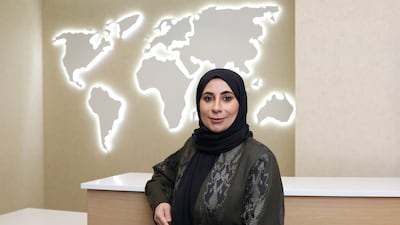

An Abu Dhabi-based global health institute is taking the UAE’s disease-elimination expertise to the international stage, as it seeks to help other countries adapt to the rapid development of artificial intelligence.
Dr Farida Al Hosani, chief executive of the Global Institute for Disease Elimination (Glide), told The National in New York that AI could help close long-standing gaps in healthcare access and expertise, particularly as countries grapple with constrained health budgets.
“There are a lot of opportunities, but most of the opportunities for AI are currently tailored for the need of the highly developed countries,” Dr Al Hosani said. “So low and middle-income countries are left behind in terms of their utilisation of the potential of AI.”

Glide used the UN General Assembly high-level week to launch new AI training programmes for public health leaders and formalise a partnership aimed at helping countries hardest hit by malaria use new technologies according to their own priorities.
It joined the government of Nigeria and the RBM Partnership to End Malaria to convene ministers, funders, diagnostics leaders and health advocates on the sidelines of UNGA.
The meeting focused on how AI could help countries make better use of limited resources as donor budgets shrink, including through improved disease surveillance.
“Progress towards malaria elimination depends on ensuring that global knowledge and innovation translate into practical capabilities at the country level,” Dr Al Hosani said.
She added that the aim was to equip national programmes and public health leaders with the tools and knowledge to advance disease elimination “in ways that respond to their own priorities and realities”.
The gathering concluded with Glide and RBM signing a Letter of Mutual Understanding to support country-led malaria control and elimination, connecting national programmes with global expertise, AI and technical innovation. Nigeria, which carries the largest share of the global malaria burden, was a co-host of the event.
Training in AI
Dr Al Hosani also announced two training programmes aimed at ensuring health officials have the skills to use AI rather than simply importing technologies developed elsewhere.
Glide Leadership Excellence in AI for Health is aimed at senior decision-makers, while AI for All was developed by Abu Dhabi’s Mohamed bin Zayed University of Artificial Intelligence and tailored with Glide for public health professionals.
“We believe that AI has a lot of potential to support not only one country or one geography, but also we can use it as a tool to bridge the gap of inequity in healthcare,” Dr Al Hosani said.
Glide is already testing how such technology can work on the ground. In Madagascar, it is supporting a project using AI-assisted microscopy to detect and diagnose neglected tropical diseases.
Dr Al Hosani explained that the technology could help address shortages of specialists able to diagnose diseases using conventional microscopes, while allowing several diseases to be identified in one set-up.
“Instead of having a one-disease focus, we are focusing on multiple diseases that can be tested and diagnosed in one sitting,” she said.
Her institute is working on about 14 projects across Africa, the Middle East and Latin America. She said disease-elimination programmes needed to be integrated into wider health systems if they were to have lasting impact.
“You cannot look at one disease in isolation of the realities of the healthcare system,” she said. “The more the disease programme is integrated within the bigger system, the more sustainable and resilient it is becoming.”
The UAE has supported global efforts against polio, malaria and neglected tropical diseases through initiatives, while developing its AI sector at home.
“Glide sits in both elements where we are very much linked to the neglected tropical diseases, but we are also leveraged to be in such kind of ecosystem that is supporting the advancements of AI,” she said. “We can use and leverage this to support countries that are most in need of it.”
But Dr Al Hosani warned that AI must be balanced against its risks. “We are very optimistic. But again, the use of AI should always be with caution,” she explained.

