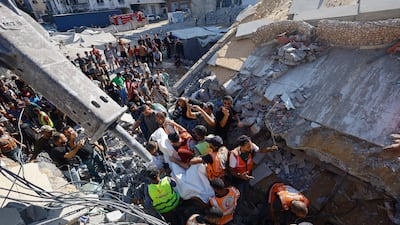
At least 20 Palestinians were killed and 16 rescued after a six-storey residential building damaged in an earlier Israeli strike collapsed in western Gaza city overnight.
The Al Saada building had been sheltering nearly 100 people, including 10 displaced families, when it collapsed, the Civil Defence agency said in a statement on Wednesday.
Scores remained missing beneath the rubble of the building and surrounding tents, it added.

“Our crews are working with the basic tools and digging by hand,” Civil Defence spokesman Mahmoud Basal told The National. “We have no heavy equipment that can be used in such situations, making the operation extremely difficult.”
The Civil Defence agency said its members, working with an Egyptian team, the International Committee of the Red Cross and Gaza Municipality, had rescued 16 people, including 10 who were injured, and recovered 16 bodies from the rubble.
The agency said it urgently needed two excavators, a digger and bulldozers to continue rescue operations and warned that dozens of structurally damaged buildings could collapse in the winter.
It called on the UN Security Council and guarantors of the Gaza ceasefire agreement to facilitate the entry of rescue machinery and equipment to the territory.
Alessandro Mrakic, head of the UN Development Programme's Gaza office, said UN agencies were taking part in the rescue operations.
"The situation, as you see, is tragic because we don't have the equipment and machinery that is needed," said Mr Mrakic. "So there are actually people that are digging with their bare hands."
"There are approximately 400 buildings at risk of collapse. And we know that these buildings will collapse, especially now with the upcoming winter," he added, referring to the damaging effect of rain and extreme weather on the weakened structures.
The collapse has highlighted the dangers facing families living in buildings severely damaged during the war. Gaza’s Civil Defence agency estimates that about 2,000 occupied buildings and homes across the enclave are at risk of collapse.
Mohammed Salha, head of the Palestinian NGOs network in Gaza, told The National: “People in the Gaza Strip are resorting to living in partially collapsed homes because they have no alternatives. Most homes have been destroyed, while [emergency] tent and mobile homes are unavailable.”
Mr Salha appealed for shelter supplies, recovery materials, and heavy machinery to remove rubble and rescue those trapped beneath it. He echoed Mr Mrakic's warning.
“The crisis will worsen during winter when weather conditions will increase the risk of damaged buildings cracking further to collapsing,” he said.
Trapped beneath rubble
Amjad Sleem, 34, who lives nearby, said residents heard a very loud noise at about 3am local time and rushed outside to find that the building had collapsed.
“The families were our friends,” he said. “In our daily conversations, they often expressed fears that the building might collapse, but necessity forced them to remain there despite the severe danger.”
With no electricity, neighbours, volunteers and emergency crews searched through the rubble by hand in darkness until morning. “We could hear people calling out, but after some time, their voices would fall silent,” he said.
Ramiz Alakbarov, the UN humanitarian co-ordinator for the Occupied Palestinian Territory, said he was “devastated” by reports of people trapped under the rubble and said search and rescue operations were continuing.
“Lives may still be saved, and every effort must be made to reach those trapped under the rubble,” he said in a statement.
Dr Alakbarov said Egypt had provided heavy machinery, while the UAE and Qatar were set to deliver aid. Humanitarian agencies would use available supplies in Gaza to provide survivors with health, shelter and other critical assistance, he said.
He called for urgent approval for the entry of heavy machinery, specialised equipment, engine oil and fuel for search and rescue operations. He also called for tents, tarpaulins and other essential items to reach vulnerable communities in the coming weeks.
Dr Alakbarov said hundreds of damaged structures across Gaza had been assessed as unsafe.
"Ahead of the rains, humanitarian agencies were supporting people who chose to relocate from damaged buildings and flood-prone areas to safer sites," he added.
A US-backed ceasefire in October 2025 halted large-scale fighting in Gaza, but it has not ended Israeli strikes and there has been little progress on steps towards permanent peace.
Hamas accuses Israel of violating the ceasefire and undermining efforts to implement US President Donald Trump's broader plan to end the Gaza conflict. The plan includes Israeli withdrawal from the Gaza Strip and the disarmament of Hamas. Israel says Hamas has been violating the deal.
More than 1,300 Palestinians, mostly civilians, have been killed in Gaza since the ceasefire took effect, according to the territory's health officials, while the Israeli military says four Israeli soldiers have been killed.

