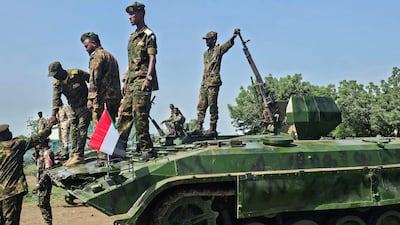
Sudanese politicians have painted a bleak picture of the war-torn country, warning that it is sliding towards total state collapse as the warring parties chase an elusive military victory instead of a political solution.
Fighting between the Sudanese Armed Forces (SAF) and the paramilitary Rapid Support Forces (RSF) has devastated the country of 50 million people and battered its economy.
The war has killed tens of thousands of people, displaced millions and created one of the world's largest humanitarian crises. Yet SAF leader Gen Abdel Fattah Al Burhan has vowed to continue fighting until the RSF is defeated, rejecting repeated attempts by the US and regional powers to broker a ceasefire. Both forces have been accused of grave abuse during the war.
“We are talking about a crisis, but in reality, it is more than a crisis. It is the beginning of a complete collapse of the state," former mining minister Adel Ibrahim told Sky News Arabia in an interview aired on Saturday. “The state has not collapsed yet, but the process has begun, and every day it is moving closer to total collapse," he added.
“If you look at the value of the Sudanese pound against the dollar, it is changing and falling every day. As you mentioned, it has lost more than tenfold of its value compared with where it stood before."
Earlier this month, the SAF faced fresh evidence over its use of chemical weapons. Reports published by The New York Times and Washington Post revealed the SAF has not only used chemical weapons in the devastating war but also built a secret stockpile that it later sought to conceal. A dossier of evidence detailed how the SAF tested bombs in Sudan’s desert and built up its chemical weapons operation piece by piece before attempting to cover its tracks.
Khalid Omar Youssef, Sudan’s former minister of cabinet affairs, told Sky News Arabia that the issue of chemical weapons “has moved beyond media reports and speculation and is now on the table of UN and international organisations”.
He called for an independent fact-finding mission to be allowed into the country to investigate the allegations.
“By preventing inspection teams from entering, the Sudanese Armed Forces are putting themselves in the dock. But ultimately, it is the Sudanese people who pay the price, because they have the right to know the truth,” he said.
Mr Youssef added that the US position appeared to have moved beyond making accusations to asserting that the allegations had been proven.
He also warned that “gold is the lifeline sustaining the war and is being used to buy ammunition and drones".
The issue of chemical weapons emerged alongside a US push to force a ceasefire in Sudan, including efforts to expand the UN arms embargo beyond Darfur to cover the entire country.
A UN fact-finding report revealed this month that the Sudanese Armed Forces used foreign-supplied drones in operations that harmed civilians. While it repeated that external players have supported the RSF by facilitating weapons transfers, the report cast a harsher light on the SAF's actions.
On Friday, the UN Security Council gave members one month to discuss the proposal. Washington pushed for the short-term extension to allow further negotiations to widen the embargo, rather than simply renewing the existing sanctions regime for another year.
Mohamed Abdel Hakam, a leader of the Sumoud Alliance, which advocates civilian rule, said the US must now use the coming month “to broaden negotiations with the countries that have threatened to use their veto”.
He told Sky News Arabia that the situation in Sudan is “not what it was two decades ago”, when the arms embargo was first imposed. “Sudan is now going through very different circumstances. We are talking about a bloody and brutal war that has claimed tens of thousands of lives, and the reality on the ground has changed,” he added.
“From a humanitarian and moral standpoint, this resolution should be passed for the sake of Sudanese civilians.”

