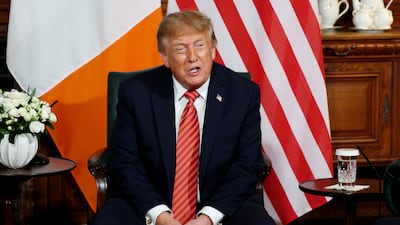
US President Donald Trump on Saturday said that Iran was probably behind an attack on Saudi Arabia’s East-West oil pipeline, while stating that Yemen's Houthi rebels did not want a confrontation with America.
“Iran is probably responsible for the attack,” Mr Trump told reporters in Dublin, where he met Irish Prime Minister Michael Martin.
Mr Trump also said he was confident the situation would be resolved, pointing to his relationship with Saudi Crown Prince Mohammed bin Salman. “The Crown Prince is a good friend of mine. Everything will work out fine,” he said.

Asked about the Iran-backed Yemeni rebels, he said the Houthis “don’t want to fight with us”.
Before Mr Trump spoke, a wave of regional condemnation had followed the assault on Saudi Arabia’s East-West oil pipeline, with Gulf and Arab states warning that strikes on the kingdom’s energy infrastructure marked a dangerous escalation.
The Gulf Co-operation Council criticised the attack “in the strongest terms”, calling for “necessary, decisive measures” to prevent Iraqi territory from being used to launch further attacks.
Qatar also strongly condemned attacks on civilian and economic sites as a flagrant breach of international law and a threat to regional security, while expressing full solidarity with Saudi Arabia. Jordan described the attack as a breach of Saudi sovereignty and said it supported measures taken by Riyadh to protect the kingdom, its people and resources.
Bahrain also condemned the attack and stressed its solidarity with Saudi Arabia, while the Muslim World League described it as “treacherous and criminal” and backed the kingdom’s right to protect its sovereignty and deter further attacks.
Saudi Arabia's Ministry of Energy on Friday announced that the vital East-West oil pipeline had been closed as a precautionary measure after "multiple" attacks. The attacks on the pipeline in the Riyadh and Madinah regions happened on Thursday and resulted in injuries, the ministry said.
Officials later said the pipeline was attacked by drones launched from Iraq, but added it would not retaliate for now, after a request from Iraqi Prime Minister Ali Al Zaidi.
The kingdom reserved the right to take all necessary measures to protect its sovereignty, security and critical facilities, the Saudi Ministry of Foreign Affairs said in a statement.
The full pumping capacity through the East–West pipeline amounts to about seven million barrels per day. It is critical in linking oil production sites in the Eastern Province with Yanbu on the west coast, and providing flexibility to export from Saudi Arabia's east and west coasts.
Following Riyadh's accusation that the strikes came from Iraq, Mr Al Zaidi ordered an investigation and dismissed a military commander over the incident. He issued a statement declaring Baghdad's "rejection of any aggression that threatens the kingdom's security and stability".
The extent of the damage to the pipeline is unclear. Saudi Arabia said specialised technical teams were working to "secure the pipeline and assess its safety".
The closure came after the kingdom traded a series of strikes with the Houthi rebels, who have been on an expansion campaign amid the US-Iran war, although Tehran and its proxies have previously carried out attacks on regional energy infrastructure.
The Houthis have taken over Yemen's entire western coast along with several strategic islands, establishing a chokehold over the vital Bab Al Mandeb strait.
Bahrain noted the attack on Saudi Arabia's East-West pipeline as one of several reasons it rejected a meeting proposed by Tehran, reportedly in Oman, to discuss the Strait of Hormuz, which has been under dual blockade by the US and Iran.
"The kingdom will not be a party to any collective meeting involving Iran prior to the restoration of diplomatic relations between the two countries," the Foreign Ministry said in a statement on Saturday.
The ministry said that Bahrain's position had been previously conveyed to Oman. "It neither diminishes the Kingdom’s appreciation for Oman’s sincere efforts nor alters its commitment to dialogue as a means of resolving disputes," the statement added.
Bahrain said that dialogue needed to involve facts, including attacks on its infrastructure and civilian assets such as the assault on an ammonia tank, "which nearly resulted in a catastrophic disaster".
"Targeting civilian and economic facilities remains an imminent threat, not a past event," the ministry added. The Oman meeting was to be held between Iran and the neighbouring countries. But none of those countries expressed willingness to attend.