
When the war between Iran and the US escalates, the skies above the arid expanse of north Jordan can become the scene of a brief aerial war, with defences targeting Iranian projectiles.
Often the drones and missiles can be seen being intercepted, or when they occasionally hit their target. They did so last month, when three American soldiers were killed in an Iranian attack on an airbase near Azraq, a severely depleted oasis.
Footage shared online on Monday showed Iranian missiles being intercepted near Mafraq, a Jordanian city close to the border with Syria where another airbase housing US forces is located. The Islamic Revolutionary Guard Corps, Iran's de facto ruling faction, said it targeted a base in the area – and another near Azraq – in retaliation for a US attack on Iran's Larak Island in the Strait of Hormuz. There were no reports of casualties as a result of the latest Iranian attacks on Jordan.

This time, the escalation has generated less fear and even less interest in Jordan.
Agricultural engineer Fayez Youssef, who manages 12 hectares of olive groves on the outskirts of Mafraq, said he paid no attention to the latest round of strikes. This is partly due to worries that a heatwave last month may have ruined the harvest season, after an extremely bad one last year.
“My sister is staying with us, and she told me about the missiles on Mafraq as I was leaving for work,” Mr Youssef said. “The war has stopped being our concern. Life is becoming harder and people are worried about securing their livelihood.”
New rules?
The Iran war broke out against the backdrop of economic difficulties in Jordan. Revenue from tourism, a significant source of foreign currency, fell 9.2 per cent to $2.8 billion in the first five months of this year compared with the same period in 2025, official data shows.

In Amman, air-raid sirens, which were frequent at the start of the Iran war, remained silent on Monday. Rania Al Jammal, who works for a bank, said the war, as far as Jordan is concerned, appears to have settled into a pattern of Iranian attacks on American military bases.
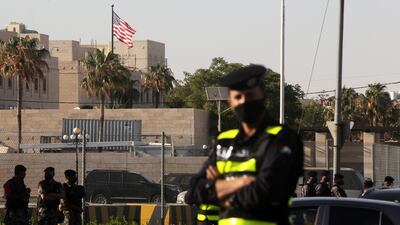
This contrasts with the first phase of fighting, when Amman's residents saw Iranian drones hovering over the capital and projectiles hit by air defences fell on some neighbourhoods. Some of these were apparently targeting the US embassy.
“There seems to be new rules and Amman is excluded, but people are fed up with this empty war anyway,” said Ms Al Jammal.
Ranad, who owns a barber shop not far from the US embassy, said he had stopped watching news channels. He works seven days a week and on Monday, Troy, the 2004 film featuring Brad Pitt, was playing on the TV in his empty shop. The Iran war has stopped being a subject of conversation, he said.