A group of drones flying alongside an Apache attack helicopter could provide another major layer of defence to Gulf states attacked by Iran.
The Thunder drone, unveiled at the Farnborough International Airshow, is capable of carrying a range of rockets and missiles plus interceptor drones that can take out Iran’s deadly Shahed-136 weapons.
Capable of flying as a “loyal wingman” either operated by an Apache pilot or operated autonomously, Thunder significantly increases the chances of human survival amid the increasingly robotic modern battlefield.


Built by the California company Anduril, the unmanned vehicle will make its first flight next year and dramatically upgrade the firepower of attack helicopters.
Thunder carries an identical payload to manned Apaches, with 10 Hellfire missiles, 72 Hydra rockets – which have been adapted to shoot down drones – and, more importantly, in its nose cone a mini-squadron of 12 interceptor drones that can be launched during flight.
Thunder has drawn heavily on the lessons from the wars in Ukraine and the Middle East, where the ability to conduct the “deep fight” has been seriously impacted by the proliferation of one-way attack drones and cheap air defences.
Furthermore, as demonstrated by the dearth of attack helicopters today in Ukraine, manned aircraft on the front lines are now at very high risk.
“We need a new way of enhancing both the survivability and lethality of those crews,” an Anduril spokesman said. “Thunder as a capability is something that is directly informed by both Ukraine and the Middle East where the near surface is increasingly the most lethal part of the battlefield.”
-
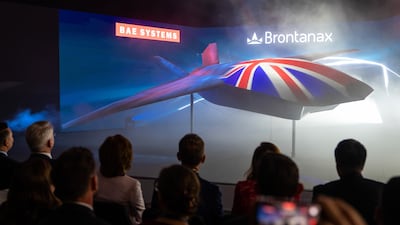
Brontanax, an uncrewed Collaborative Combat Aircraft by BAE Systems, is unveiled at the Farnborough International Airshow. Getty Images -
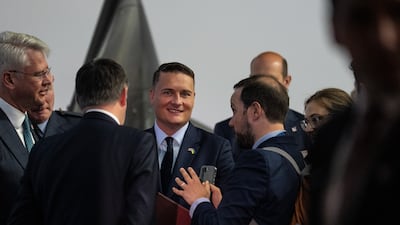
Wes Streeting, Britain's new Defence Secretary, arrives at the BAE Systems stand. Getty Images -
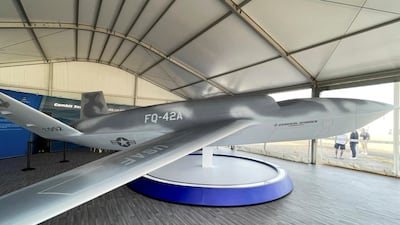
General Atomics displays its unmanned combat aircraft called Dark Merlin. Reuters -
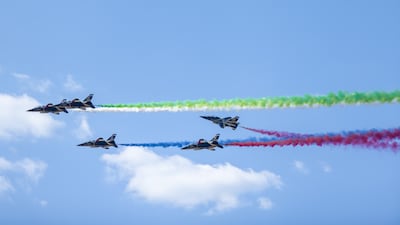
The Fursan Al Emarat display team perform. Bloomberg -
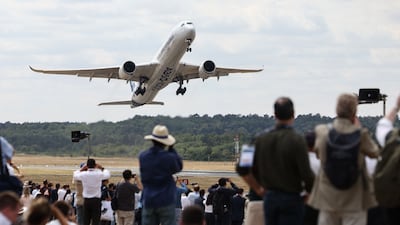
An A350-1000 by Airbus takes off. AFP -

Emirates airline President Sir Tim Clark speaks. Reuters -
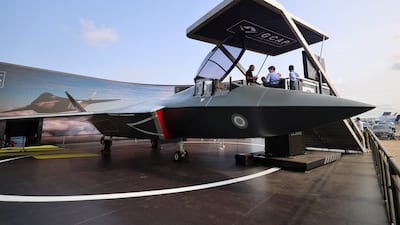
A mock-up of the GCAP fighter jet at the Farnborough International Airshow. EPA -
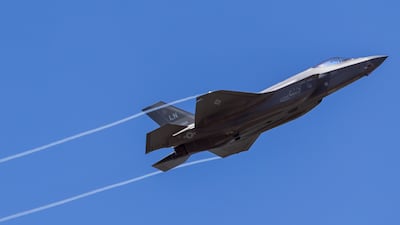
A Lockheed Martin F-35A Lightning military jet flight display. Bloomberg -
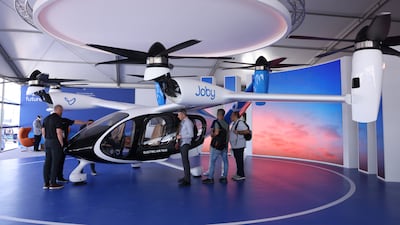
A Joby Aviation eVTOL piloted all-electric vertical take-off and landing aircraft. Bloomberg -
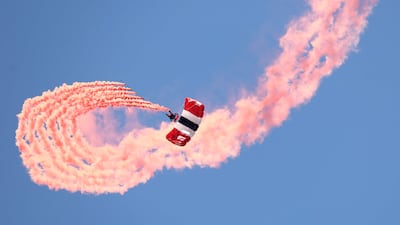
A member of the British Army parachute display team, the Red Devils, takes part in a display. AFP


Thunder is a tilt-rotor vertical take-off and landing (VTOL) aircraft, which gives it both the ability to lift heavy payloads vertically and to achieve high-speed forward flight. With a speed of about 520kph and a range of 2,100km, the drone can be flown into the combat zone from a distance.
Human pilots will also remain in the loop, providing the ability to differentiate between priority targets and continue communicating locally with their Thunder wingman if satellites or other systems have been jammed.
It is capable of flying in very tight formation with attack helicopters but can also break off and perform autonomous tasks. Just two Apaches can operate six Thunders, and between them bring down considerable firepower.

With Apaches helping shoot down drones attacking the UAE during the Iran war, the Thunders will be “very useful to anybody who operates an Apache force”, the spokesman said. The drones are also “attritable” – the military term for being destroyed – as they come at a fraction of the cost of the $52 million Apache.
The UAE also operates Anduril’s Ghost reconnaissance drone helicopter, which is used for search and rescue missions, particularly in the desert. Furthermore, the UAE has purchased the highly adaptable tilt-rotor Omen drone, which can take off from a beach, has excellent maritime surveillance capabilities and can carry medium-sized precision missiles.
The company’s advances are now likely to play a much greater role in defending the Gulf states as the proliferation of drones in modern warfare continues.