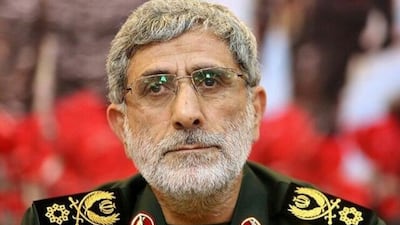

Iran's Quds Force commander Brig Gen Esmail Qaani said Tehran regards a peace deal to be formally signed with the US this week as a victory and its network of regional proxies is intact and will not be stood down.
Brig Gen Qaani described the involvement of what Tehran calls the Axis of Resistance – its network of regional militant groups that joined Iran in its war with the US and Israel – as an act of solidarity rather than a response to orders from the Islamic republic.
"Without anyone asking a single word of them," he said, all of them had decided independently that protecting Iran was their duty. That network remains operational, he added.

"From the Al-Aqsa Flood until today, you will not find a single resistance group that has left the field," he said, referring to Hamas's October 7, 2023 attack on Israel, which set off the current cycle of conflict.
The Quds Force is the covert external operations arm of Iran's Islamic Revolutionary Guard Corps. Its most prized asset is the Lebanese Shiite militant group Hezbollah, which entered the fray days after Israeli-US strikes against Iran on February 28 that started the war. It also backs Yemen's Houthi rebels, the Palestinian militant group Hamas and militias in Iraq.
In a rare interview broadcast on state television on Monday, Brig Gen Qaani said US President Donald Trump had "scrambled" and called Israeli Prime Minister Benjamin Netanyahu in a panic after Iran began preparing retaliatory strikes in the final stages of ceasefire negotiations.
"You fired three missiles, we will fire three in return," he quoted Iranian officials as telling Washington. "If you continue, we will respond in kind."
Mr Trump's social media posts "showed how he was trembling", Brig Gen Qaani said. The remarks were in reference to indirect Iran-US talks during which Israel bombed Dahieh, a Hezbollah stronghold in Beirut's southern suburbs.
The memorandum of understanding, mediated by Pakistan and Qatar, is to be formally signed in Switzerland on Friday. It opens a 60-day window for talks on Iran's nuclear programme, with sanctions relief tied to Tehran's compliance. Iran insists the US must fulfil its obligations before substantive negotiations can begin – a condition Brig Gen Qaani described not as diplomacy but as victory.
He was blunt about what the deal does not represent. "Wherever you engaged with the resistance, you lose your honour," he said, warning Washington and Israel not to confuse the agreement with submission.
"With mischief and planning, they want to dismantle Hezbollah," he said. "They must understand: Hezbollah cannot be dismantled."
The group, he said, had fought for 104 days against a succession of rotating Israeli military forces and "came back stronger".
In Iraq, US forces absorbed more than 600 attacks. In the Red Sea, US Navy planners spent nearly two weeks deliberating whether to cross the Bab Al Mandeb strait "without a single AK-47 round having been fired" before turning back.
Brig Gen Qaani cast the anticipated reopening of the Strait of Hormuz as proof that Iran's pressure tactics work but said there are other means available.
"Arrogant powers should not think their entire strength rests in guns, tanks and aircraft carriers," he said.
Brig Gen Qaani's verdict on the broader conflict was unsparing.
"America is no longer what it was before," he said, arguing that the war had accelerated Washington's decline and brought closer what he described as the inevitable collapse of Israel.

