
Syria's Ministry of Defence in the early hours of Friday declared a temporary ceasefire in the Sheikh Maqsoud, Ashrafieh and Bani Zeid neighbourhoods of Aleppo, demanding fighters affiliated with the Syrian Democratic Forces leave the area.
Departing fighters are permitted to take only light weapons, and the Syrian military will ensure their safe passage to the north-east, the ministry said in a release. They have been given until 9am Friday to leave.
"The Ministry of Defence affirms that this measure aims to end the military situation in these neighbourhoods, paving the way for the return of the rule of law and official institutions," the statement, carried by state-run news agency Sana, said. It will also allow displaced residents to return to their homes.

The neighbourhoods, which include two Kurdish-majority areas, have been rocked by violence since Tuesday.
The Ministry of Interior said on Thursday that internal security forces had been posted in the Ashrafieh neighbourhood.
This is “part of a plan to re-establish security and stability in neighbourhoods that were recently handed over to the state, following the withdrawal of armed group affiliated with the Syrian Democratic Forces", it added, referring to the Kurdish-led militias that also control large areas of north-eastern Syria.
The deadly clashes widened the rift between Damascus and Kurdish authorities in north-eastern Syria, which poses a major challenge for Syrian President Ahmad Al Shara, who has pledged to reunite the country after 14 years of civil war.
Heavy fighting between the Syrian army and Kurdish forces shook the contested neighbourhoods of Sheikh Maqsoud and Ashrafieh on Thursday as the army launched a “heavy and concentrated bombardment” after two days of clashes.
Those clashes continued late into the night. “The violence is very intense, involving heavy weapons. There are artillery shelling and missiles from both sides,” a witness told The National, sending video of a relentless exchange of fire amid loud explosions.
Plumes of smoke rose above the city at dusk and images from the area showed vehicles and buildings on fire.
The army had earlier published maps of sites it said it would attack in the Sheikh Maqsoud and Ashrafieh neighbourhoods, which are held by Kurdish militias. It claimed the sites are used by the SDF to shell the neighbourhoods and residents of Aleppo, and called on citizens to immediately leave.
“The Syrian army has now begun targeting the positions and strongholds of the separatist SDF forces. The area is witnessing an intense battle,” a member of the general security forces in Aleppo told The National.
The official said that many SDF members have been arrested, and claimed that they have also secured two groups of SDF members who “defected” to the general security forces.
The SDF said that its troops were “confronting the aggression” after “the government-affiliated factions” carried out “widespread, indiscriminate and brutal shelling using tanks, artillery and drones” on the two areas.
It accused the Syrian army of attacking “civilians and medical facilities”, including the Khaled Fajr Hospital in the Sheikh Maqsoud neighbourhood, which was hit with an artillery strike on Thursday evening.

The Governor of Aleppo, Azzam Gharib, said he had received information that “a large number of SDF fighters have defected in the Sheikh Maqsoud and Ashrafieh neighbourhoods, while others have fled, paving the way for a significant shift in the situation on the ground in those areas”.
“Internal security forces are now preparing to deploy within these neighbourhoods to fully secure them and ensure the safe return of displaced residents to their homes,” Mr Gharib said in a post on Instagram.
State news agency Sana said that 142,000 people had been displaced by the clashes so far, including 13,000 on Thursday.
Four journalists were injured as “a result of the SDF targeting parts of the Ashrafieh neighbourhood with mortal shells", according to Sana news agency.
An Aleppo health official told Sana that at least seven people have been killed and 52 wounded in SDF attacks on the city's neighbourhoods.
The SDF said on Thursday that at least eight people had been killed in “artillery, rocket and tank shelling, and drone attacks, carried out by factions affiliated with the Damascus government”. It said that 57 civilians have been wounded since the clashes erupted.
It accused the government of carrying out “an organised, bloody campaign” that directly strikes civilians “through the use of siege, indiscriminate shelling and starvation”.
Each side has accused the other of starting the fighting, indicating that a stalemate between Damascus and Kurdish authorities, who have resisted integrating into the central government, was growing deadlier.
-

Syrian civil defence personnel carry a woman to safety as residents of Aleppo's Sheikh Maqsoud and Ashrafieh neighbourhoods flee fighting between the army and Syrian Democratic Forces. Anagha Nair for The National -
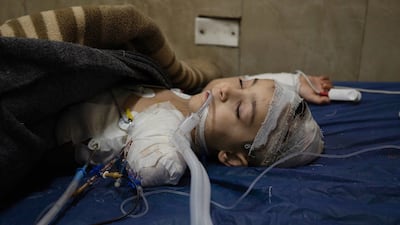
Syrian boy Ibrahim, who lost an arm and was severely injured as government forces and Kurdish militias clashed in Aleppo, receives treatment at Al Razi Hospital, in the northern city. All photos: Anagha Nair for The National -
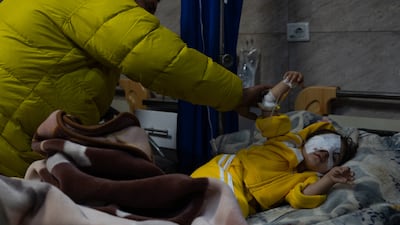
Four-year-old Fatima Al Zahra, who lost an eye, is comforted by her father at Al Razi Hospital -
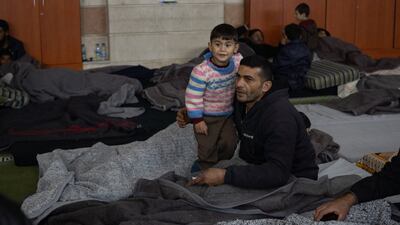
A child and his father shelter in a displacement centre set up in Zein Al Abidien Mosque, Aleppo -
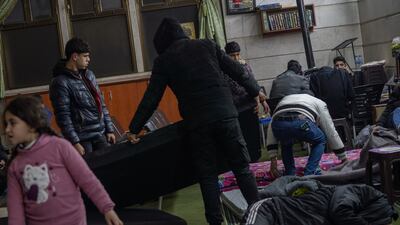
People spread out mattresses in the displacement centre -
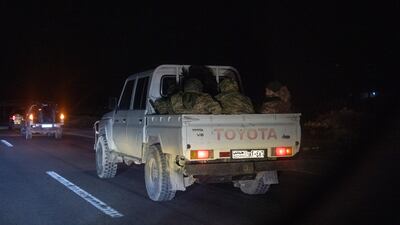
Syrian government reinforcements on the road to Aleppo


Pleas for de-escalation
UN spokesman Stephane Dujarric told reporters in New York that Secretary General Antonio Guterres “continues to be gravely alarmed by the escalating hostilities that we're seeing in Aleppo and by the mounting reports of civilian casualties”.
“There is a government in Syria. We've been working with them to try to help them. It is important that government ensures that everyone in Syria, whether Kurd, Alawite, Christian, any other minority, or whether religious or ethnic, feel protected, and that continues to be our message.”
The Prime Minister of the Kurdistan Regional Government in Iraq, Masrour Barzani, said the attacks on Kurdish neighbourhoods in Aleppo were “deeply concerning”.
He said that attacking civilians and attempts to alter the area's demography amount to ethnic cleansing. Mr Barzani called on all sides to exercise restraint, protect civilians and pursue dialogue.
Officials from Iraq's Kurdistan region have been involved in talks on the integration of Syrian Kurdish forces into the central government.
The US, which has mediated between the SDF and the Damascus government to implement an integration agreement signed last year, called for restraint on both sides.
“All parties should focus on how to build a peaceful, stable Syria that protects and serves the interests of all Syrians, rather than pushing the country back into a cycle of violence,” a State Department representative told The National.
The representative said US special envoy to Syria Tom Barrack “continues to support and facilitate dialogue” between the government and the SDF.

Mr Barrack posted on X that the US “is closely following developments in the Ashrafieh and Sheikh Maqsoud neighbourhoods of Aleppo with grave concern”.
“We urge all parties to exercise the utmost restraint and to place the protection of civilian lives and property above all other considerations,” he said.
These clashes are the third round of violence between the SDF and government forces in Aleppo since October, highlighting the instability caused by continued cracks in Syria’s military and security.
The SDF has held the Sheikh Maqsoud and Ashrafieh districts − home to tens of thousands of people − since 2015. The group retained control when a Hayat Tahrir Al Sham-led offensive swept into Aleppo in November 2024. HTS fighters led the campaign that toppled the Assad regime the following month.
An agreement in April last year over the fate of the districts saw a prisoner exchange and the withdrawal of hundreds of SDF fighters to the resource-rich Kurdish-held territory east of the Euphrates, more than 100km away.
But other SDF-affiliated forces have remained in the area, as full integration of the two districts into state structures stalled. The district’s local civilian council remains affiliated with north-eastern Syria’s Kurdish-led authorities, and not with the Damascus government.
A deadline for the SDF’s overall integration into forces controlled from Damascus at the end of last year, as laid out in a separate agreement last March, passed without a resolution, creating the conditions for the current instability.
Ankara ready to help Syria
Turkish Foreign Minister Hakan Fidan said it was time for national unity in Syria, calling on the SDF to fulfil its responsibilities.
“In Syria, it is time for national unity. The SDF needs to do its part,” Mr Fidan told a joint media conference with Omani Foreign Minister Sayyed Badr Al Busaidi in Ankara on Thursday.
“Instead, its transformation into an actor that serves Israel’s ‘divide and rule’ policy in our region, in co-ordination with Israel, is unfortunately not a coincidence,” he added.
Mr Fidan said recent developments in Aleppo reflect warnings Ankara has repeatedly raised over the past year.
Diplomats warn that failure to integrate the SDF into Syria's army could bring further violence and could draw in Turkey, which has threatened to launch military action against Kurdish fighters it regards as terrorists.
Ankara is the strongest foreign backer of the interim administration in Damascus and maintains a substantial military presence in northern Syria.

