

With a surgeon’s precision, the team began their examination of the corpse by delicately removing crumbling bandages. What they found were among the greatest archaeological treasures of all time.
Exactly a century ago, the mummified body of the boy pharaoh Tutankhamen was unwrapped for the first time. It was three years after the discovery of his tomb in Egypt’s Valley of the Kings by Howard Carter and Lord Carnarvon.
The list of “wonderful things” first seen by Carter on opening the tomb in November 1922 would continue with the autopsy in 1925. Adorning the body were rings, amulets and a collar shaped like a vulture, all of solid gold.
Now, the drama of that occasion is available for all to see. Carter’s meticulous records, including notes, photographs and drawings, have been digitalised and put online this week to mark the centenary of the unwrapping.
Stepping back in time
The documents and photographs, including the original magic-lantern glass slides, held by the Griffith Institute at the University of Oxford in England as the Tutankhamun Spatial Archive, is currently in beta format, with the public invited to comment and make suggestions.
The institute specialises in Egyptology and first received the collection after Carter’s death in 1939 when it was donated by his niece.
“What we are talking about is about 20,000 records that were produced during the 10-year process that it took the team to excavate the tomb,” said Daniela Rosenow, an Egyptologist and manager of the institute.

“Since the 1960s we have been trying to publish the material in the classical book form and by the 1990s it was clear this way it would take us 200 years to publish everything.”
Work on creating the website in its present form began this year thanks to a donation from a fund financed by the Oxford University Press.
The institute has big plans for the future, including a 3-D model of Tutankhamen’s tomb and an Arabic version of the site, but is depending on donations to make this possible.
“I think it is just a much more engaging and connected way to explore the data,” said Ms Rosenow. “My hope is that it could go beyond that. It's also a window in how archaeology was practised 100 years ago.
“I’m sure there will be a lot of historians who will research questions like the politics of knowledge and empire. It's also useful for conservators, of course, especially for our Egyptian colleagues who work to preserve the objects.”
Revisiting ancient history
Carter’s own excitement can be felt in the diary entry he wrote on November 11, 1925. “Today has been a great day in the history of archaeology, I might also say in the history of archaeological discovery, and a day of days for one who after years of work, excavating, conserving & recording, has longed to see in fact what previously has only been conjectural.”
Over the next nine days, more than 100 artefacts were discovered under the nearly 3,500-year-old body. They included a gold apron, two hawk collars, a vulture-head diadem, a gold dagger and rings for fingers and toes, all designed for the pharaoh to use in the afterlife.
Carter was astonished at the craftsmanship, writing “it would tax our goldsmiths of today to surpass such refinement as is found in these royal ornaments”.

Almost of equal value for historians are series of 18 “autopsy drawings” made by Carter as the work progressed, showing the exact placement of the objects on Tutankhamen’s body, which is drawn muscular and youthful, rather than the withered corpse which was discovered.
Much had changed since the opening of the tomb in 1922. At the instance of the Egyptian government, all the contents would remain in Cairo rather than be sent overseas, as had happened in past times. These included the magnificent funerary mask, made of gold and decorated with semi-precious stones, which had been uncovered with the exposure of the inner coffin in October 1925.
Lord Carnarvon, sponsor of the original expedition, died aged just 56, the result of an infection from a mosquito bite, which led to stories that the tomb was cursed.
Grand Egyptian Museum - in pictures
-
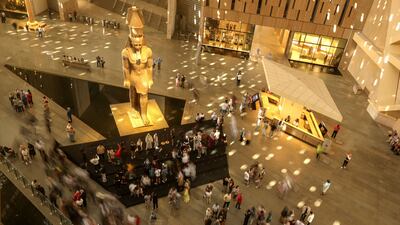
People walk in front of a statue of King Ramses II at the entrance of the Grand Egyptian Museum (GEM), during the first day for visitors on Tuesday. Reuters -
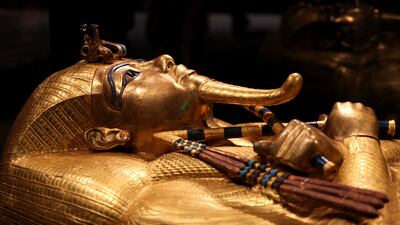
The golden coffin of ancient Egyptian King Tutankhamun. Reuters -

King Tutankhamun's ring. Reuters -
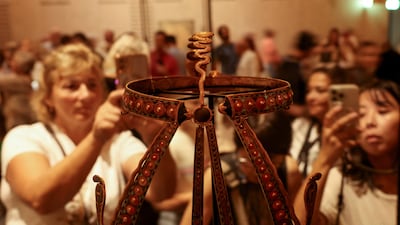
Jewellery belonging to King Tutankhamun. Reuters -
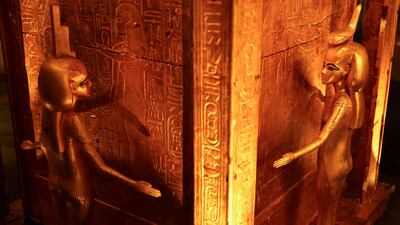
The golden shrine of King Tutankhamun. Reuters -
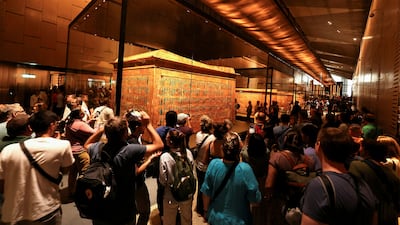
Visitors in the gallery of King Tutankhamun. Reuters -
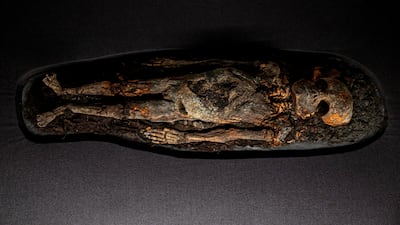
The remains of one of two infant daughters of King Tutankhamun. AFP -
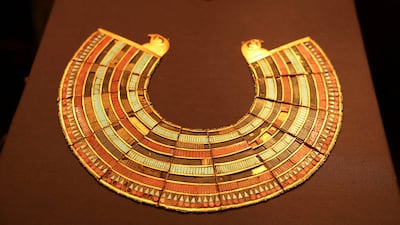
Jewellery of King Tutankhamun. Reuters -

A pair of sandals belonging to King Tutankhamun. AFP -
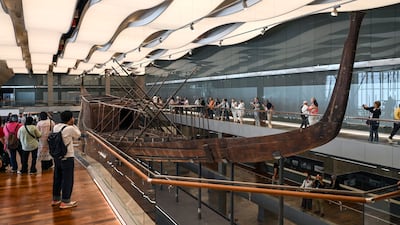
Visitors walk inside the Khufu's Boats Museum, part of the Grand Egyptian Museum complex. EPA -
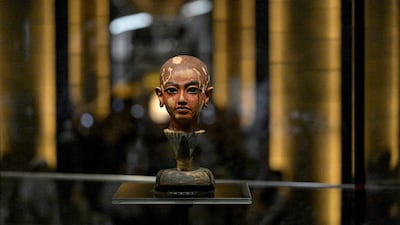
A small wooden statue of King Tutankhamun (1341-1323 BC) as the god Re or Nefertem. AFP


The unwrapping of the mummy was conducted under the authority of the Egyptian Antiquities Service, along with several representatives of the Egyptian government.
Dr Saleh Hamdi, former director of Cairo Medical School, and Prof Douglas Derry, a British anatomist and anthropologist, were on hand to examine the body.
Alfred Lucas, a British chemist, was recruited as a conservationist, his first job to apply a thin layer of paraffin wax to stabilise the bandages, which had crumbed to powder. Prof Derry was then able to removed them, layer by layer,
As the treasures were exposed, they were photographed in place by Harry Burton, a British snapper, then assigned a number by Carter.
The contents of the tomb would not be fully examined and conserved until 1933, by which time they had been placed on view at the Museum of Egyptian Antiquities in Tahrir Square, Cairo.
Today, the treasures of Tutankhamen are among the jewels of the collection that can be seen at the new Grand Egyptian Museum, finally opened in full this month.

