Hamas handed over the remains of two of the 13 dead hostages it was still holding on Thursday as the latest Israeli bombardment of the Gaza Strip stoked growing fears that a US-backed ceasefire agreement could collapse.
The Israeli military said it had received the bodies that had been handed over to the Red Cross in central Gaza and that they would be taken for identification. It leaves the remains of 11 hostages still in Gaza.
Earlier on Thursday, Israeli planes and tanks pounded military-controlled areas in eastern Gaza, without causing casualties.
Witnesses told Reuters that Israeli planes carried out 10 air strikes in areas east of Khan Younis in the southern Gaza Strip, while tanks shelled areas east of Gaza city in the north.
The Israeli military said it carried out "precise" strikes against "terrorist infrastructure that posed a threat to the troops" in those areas.
The bombardment came after Israel launched heavy overnight strikes across Gaza on Tuesday in response to the death of soldier in an attack in southern Gaza earlier that day. The Israeli government also accused Hamas of deception by claiming to have returned the remains of one more dead hostage on Monday, which they found belonged to a hostage who had been returned earlier.
Hamas had previously returned the remains of 15 of the 28 dead hostages it was holding, but said it was having difficulty finding the others.
After three weeks of a fragile ceasefire, Palestinians in Gaza are growing increasingly anxious about when they will be allowed to return to their homes and farms in areas still occupied by the Israeli military.
The truce has largely held despite two rounds of deadly bombings by Israel and the delay in Hamas handing over the remains of all hostages. Meanwhile, the Israeli military has withdrawn to the so-called Yellow Line as agreed but still holds the eastern, northernmost and southernmost areas. It is required to pull back further as more provisions of the truce agreement are fulfilled.
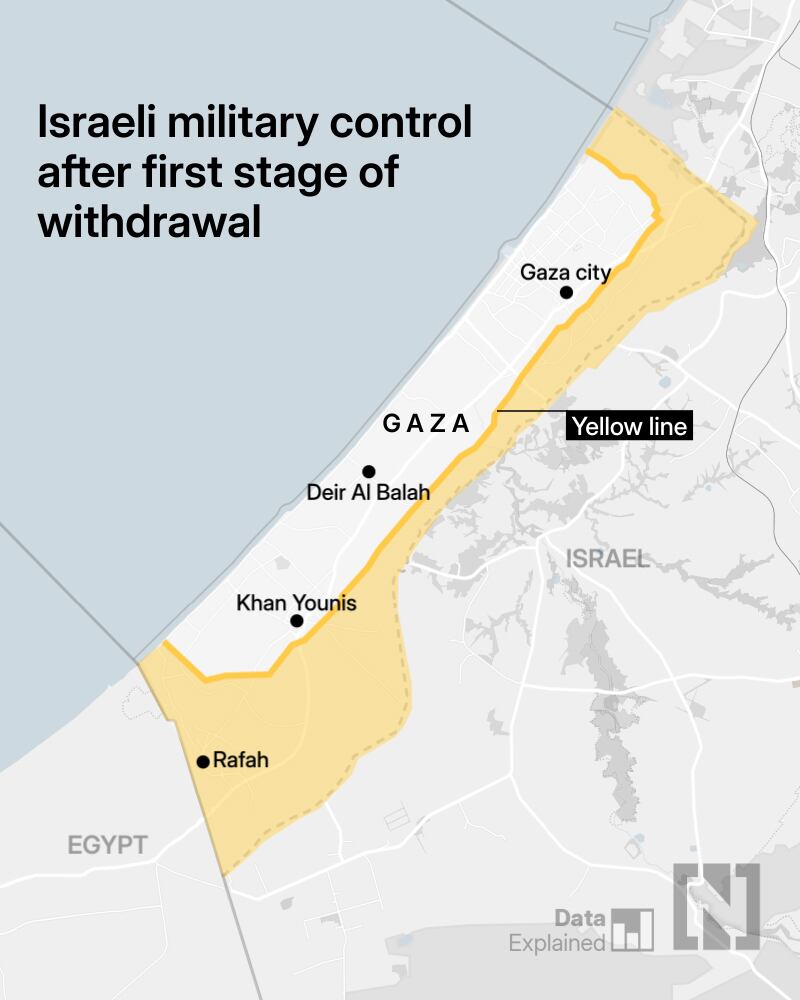
For Wisam Qdeih, 36, the ceasefire means little while he remains displaced from his land and home in Khuza’a, a southern town east of Khan Younis, next to the border with Israel.
“Our family’s farmland, about 60 dunums [six hectares], lies beyond the Yellow Line,” the father of three told The National. “It’s all under Israeli control now. The war isn’t over for us until we return to our land and rebuild.”
The war isn’t over for us until we return to our land and rebuild
Wisam Qdeih,
farmer from eastern Khan Younis
Before the war, Gaza’s farmlands had sustained families with fresh crops all year round. Now, most of them are destroyed and their restoration is being delayed indefinitely, exacerbating the already dire situation in the territory, Mr Qdeih said.
“The division of Gaza is the greatest catastrophe of our lives,” he says. “Before the war, Gaza was small, barely enough for its people. Now even that little space is gone.”
He warned that full-blown hostilities could be renewed in the coming months, with Israel demanding the remaining bodies of hostages while Hamas insists it does not know the location of them all. Meanwhile, the unresolved question of Hamas’s weapons and the international committee meant to oversee the next steps could spark deeper disagreement.
“Our story in this war isn’t over,” Mr Qdeih said. Although the relentless Israeli attacks of the past two years have ceased, "we’re still living other kinds of wars every day – wars of loss, waiting, and survival”, he said.
In Deir Al Balah, central Gaza, Ismail Mousa, 51, originally from Jabalia Camp in northern Gaza, says he feels trapped in a conflict that refuses to end.
“The bombing has stopped, yes,” the father of nine told The National, “but the war on the ground is still here. The army still controls more than half of Gaza and doesn’t allow us near our homes.”
Mr Mousa’s house in Jabalia was reduced to rubble months ago. When Palestinians displaced from northern Gaza were allowed to return during a previous truce that began in January, he pitched a tent on top of the ruins and lived there, a symbolic act of defiance and belonging. But now, even that is impossible.
“This time, I can’t even reach my home, I can’t see what’s left of it," he said. "That alone feels like another war, the war of displacement that never ends.”
Mr Mousa said he doubts the ceasefire can last under current conditions. “As long as the army controls so much of Gaza, there will be no stability. Hamas won’t surrender its weapons or accept Israel’s presence here, not now, not ever.”
Tens of thousands of people from the occupied areas are forced to live in already overcrowded western districts, where their tents and makeshift shelters line the streets. “We’re packed together like never before,” Mr Mousa said. “And winter is coming. I don’t know how people will survive.”

Email sent to Uber team from chief executive Dara Khosrowshahi
From: Dara
To: Team@
Date: March 25, 2019 at 11:45pm PT
Subj: Accelerating in the Middle East
Five years ago, Uber launched in the Middle East. It was the start of an incredible journey, with millions of riders and drivers finding new ways to move and work in a dynamic region that’s become so important to Uber. Now Pakistan is one of our fastest-growing markets in the world, women are driving with Uber across Saudi Arabia, and we chose Cairo to launch our first Uber Bus product late last year.
Today we are taking the next step in this journey—well, it’s more like a leap, and a big one: in a few minutes, we’ll announce that we’ve agreed to acquire Careem. Importantly, we intend to operate Careem independently, under the leadership of co-founder and current CEO Mudassir Sheikha. I’ve gotten to know both co-founders, Mudassir and Magnus Olsson, and what they have built is truly extraordinary. They are first-class entrepreneurs who share our platform vision and, like us, have launched a wide range of products—from digital payments to food delivery—to serve consumers.
I expect many of you will ask how we arrived at this structure, meaning allowing Careem to maintain an independent brand and operate separately. After careful consideration, we decided that this framework has the advantage of letting us build new products and try new ideas across not one, but two, strong brands, with strong operators within each. Over time, by integrating parts of our networks, we can operate more efficiently, achieve even lower wait times, expand new products like high-capacity vehicles and payments, and quicken the already remarkable pace of innovation in the region.
This acquisition is subject to regulatory approval in various countries, which we don’t expect before Q1 2020. Until then, nothing changes. And since both companies will continue to largely operate separately after the acquisition, very little will change in either teams’ day-to-day operations post-close. Today’s news is a testament to the incredible business our team has worked so hard to build.
It’s a great day for the Middle East, for the region’s thriving tech sector, for Careem, and for Uber.
Uber on,
Dara
SPEC%20SHEET
%3Cp%3E%3Cstrong%3EProcessor%3A%3C%2Fstrong%3E%20Apple%20M2%2C%208-core%20CPU%2C%20up%20to%2010-core%20CPU%2C%2016-core%20Neural%20Engine%3C%2Fp%3E%0A%3Cp%3E%3Cstrong%3EDisplay%3A%3C%2Fstrong%3E%2013.6-inch%20Liquid%20Retina%2C%202560%20x%201664%2C%20224ppi%2C%20500%20nits%2C%20True%20Tone%2C%20wide%20colour%3C%2Fp%3E%0A%3Cp%3E%3Cstrong%3EMemory%3A%3C%2Fstrong%3E%208%2F16%2F24GB%3C%2Fp%3E%0A%3Cp%3E%3Cstrong%3EStorage%3A%3C%2Fstrong%3E%20256%2F512GB%20%2F%201%2F2TB%3C%2Fp%3E%0A%3Cp%3E%3Cstrong%3EI%2FO%3A%3C%2Fstrong%3E%20Thunderbolt%203%20(2)%2C%203.5mm%20audio%2C%20Touch%20ID%3C%2Fp%3E%0A%3Cp%3E%3Cstrong%3EConnectivity%3A%3C%2Fstrong%3E%20Wi-Fi%206%2C%20Bluetooth%205.0%3C%2Fp%3E%0A%3Cp%3E%3Cstrong%3EBattery%3A%3C%2Fstrong%3E%2052.6Wh%20lithium-polymer%2C%20up%20to%2018%20hours%2C%20MagSafe%20charging%3C%2Fp%3E%0A%3Cp%3E%3Cstrong%3ECamera%3A%3C%2Fstrong%3E%201080p%20FaceTime%20HD%3C%2Fp%3E%0A%3Cp%3E%3Cstrong%3EVideo%3A%3C%2Fstrong%3E%20Support%20for%20Apple%20ProRes%2C%20HDR%20with%20Dolby%20Vision%2C%20HDR10%3C%2Fp%3E%0A%3Cp%3E%3Cstrong%3EAudio%3A%3C%2Fstrong%3E%204-speaker%20system%2C%20wide%20stereo%2C%20support%20for%20Dolby%20Atmos%2C%20Spatial%20Audio%20and%20dynamic%20head%20tracking%20(with%20AirPods)%3C%2Fp%3E%0A%3Cp%3E%3Cstrong%3EColours%3A%3C%2Fstrong%3E%20Silver%2C%20space%20grey%2C%20starlight%2C%20midnight%3C%2Fp%3E%0A%3Cp%3E%3Cstrong%3EIn%20the%20box%3A%3C%2Fstrong%3E%20MacBook%20Air%2C%2030W%20or%2035W%20dual-port%20power%20adapter%2C%20USB-C-to-MagSafe%20cable%3C%2Fp%3E%0A%3Cp%3E%3Cstrong%3EPrice%3A%3C%2Fstrong%3E%20From%20Dh4%2C999%3C%2Fp%3E%0A
What is dialysis?
Dialysis is a way of cleaning your blood when your kidneys fail and can no longer do the job.
It gets rid of your body's wastes, extra salt and water, and helps to control your blood pressure. The main cause of kidney failure is diabetes and hypertension.
There are two kinds of dialysis — haemodialysis and peritoneal.
In haemodialysis, blood is pumped out of your body to an artificial kidney machine that filter your blood and returns it to your body by tubes.
In peritoneal dialysis, the inside lining of your own belly acts as a natural filter. Wastes are taken out by means of a cleansing fluid which is washed in and out of your belly in cycles.
It isn’t an option for everyone but if eligible, can be done at home by the patient or caregiver. This, as opposed to home haemodialysis, is covered by insurance in the UAE.
How to wear a kandura
Dos
- Wear the right fabric for the right season and occasion
- Always ask for the dress code if you don’t know
- Wear a white kandura, white ghutra / shemagh (headwear) and black shoes for work
- Wear 100 per cent cotton under the kandura as most fabrics are polyester
Don’ts
- Wear hamdania for work, always wear a ghutra and agal
- Buy a kandura only based on how it feels; ask questions about the fabric and understand what you are buying
Our family matters legal consultant
Name: Hassan Mohsen Elhais
Position: legal consultant with Al Rowaad Advocates and Legal Consultants.
Desert Warrior
Starring: Anthony Mackie, Aiysha Hart, Ben Kingsley
Director: Rupert Wyatt
Rating: 3/5
RESULTS
5pm: Maiden (PA) Dh80,000 1,200m
Winner: Ferdous, Szczepan Mazur (jockey), Ibrahim Al Hadhrami (trainer)
5.30pm: Arabian Triple Crown Round-3 Group 3 (PA) Dh300,000 2,400m
Winner: Basmah, Fabrice Veron, Eric Lemartinel
6pm: UAE Arabian Derby Prestige (PA) Dh150,000 2,200m
Winner: Ihtesham, Szczepan Mazur, Ibrahim Al Hadhrami
6.30pm: Emirates Championship Group 1 (PA) Dh1,000,000 2,200m
Winner: Somoud, Patrick Cosgrave, Ahmed Al Mehairbi
7pm: Abu Dhabi Championship Group 3 (TB) Dh380,000 2,200m
Winner: GM Hopkins, Patrick Cosgrave, Jaber Ramadhan
7.30pm: Wathba Stallions Cup Conditions (PA) Dh70,000 1,600m
Winner: AF Al Bairaq, Tadhg O’Shea, Ernst Oertel
%E2%80%98White%20Elephant%E2%80%99
%3Cp%3E%3Cstrong%3EDirector%3A%3C%2Fstrong%3E%20Jesse%20V%20Johnson%3Cbr%3E%3Cstrong%3EStars%3A%3C%2Fstrong%3E%20Michael%20Rooker%2C%20Bruce%20Willis%2C%20John%20Malkovich%2C%20Olga%20Kurylenko%3Cbr%3E%3Cstrong%3ERating%3A%3C%2Fstrong%3E%203%2F5%3C%2Fp%3E%0A
Benefits of first-time home buyers' scheme
- Priority access to new homes from participating developers
- Discounts on sales price of off-plan units
- Flexible payment plans from developers
- Mortgages with better interest rates, faster approval times and reduced fees
- DLD registration fee can be paid through banks or credit cards at zero interest rates
Muslim Council of Elders condemns terrorism on religious sites
The Muslim Council of Elders has strongly condemned the criminal attacks on religious sites in Britain.
It firmly rejected “acts of terrorism, which constitute a flagrant violation of the sanctity of houses of worship”.
“Attacking places of worship is a form of terrorism and extremism that threatens peace and stability within societies,” it said.
The council also warned against the rise of hate speech, racism, extremism and Islamophobia. It urged the international community to join efforts to promote tolerance and peaceful coexistence.
War 2
Director: Ayan Mukerji
Stars: Hrithik Roshan, NTR, Kiara Advani, Ashutosh Rana
Rating: 2/5
