Every morning, 13-year-old Mahmoud Al Mahalawi wakes up in a tent pitched beside the rubble of his family’s home in the Al Saftawi neighbourhood of Gaza. Before the war, the summer months meant school holidays and time to play. Now, he says, his days revolve around “looking for ways to keep me and my family alive”.
“I start my day thinking where I should go first, to find some water or stand in line at the tikkia [charity kitchen] so I can bring food home for my brothers,” Mahmoud told The National.
He shares the responsibility for his family's survival with his father, who works whenever he can find a job. Together, they try to scrape together enough for their basic needs amid famine-like conditions created by Israeli restrictions on the entry of aid.
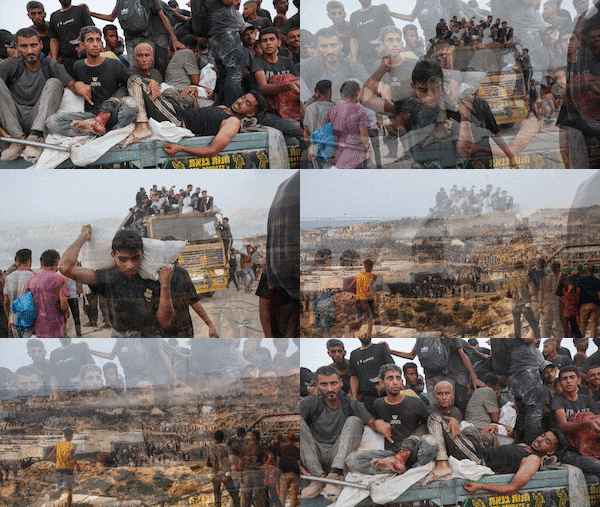
Desperate crowds often swarm the few aid lorries allowed to enter Gaza, while hundreds of people have been killed by Israeli forces near the few food distribution sites run by the US and Israel-backed Gaza Humanitarian Foundation.
“I’ve thought more than once about chasing down the aid trucks or going to the American aid centre just to get food for my family,” Mahmoud says. “But my parents always say no. They’re afraid something will happen to me.”
Gazan family's relief after receiving food aid
As with most families in Gaza nowadays, anything beyond basic necessities, even fruit, is out of reach because of prices inflated by scarcity and siege. Small quantities of mangoes and bananas that appeared in the markets on Monday were being sold at 200 shekels (more than $50) for 1kg of mangoes and 17 shekels for a banana.
“Sometimes I see fruit and wish I could have some. But I’d never ask my father. He can barely afford to buy us flour, let alone fruit,” Mahmoud says.
“Sometimes I feel like I just want to die. No one really feels our pain. I’m a child, just like children anywhere in the world. I should be in a summer camp, playing football, swimming – not standing in line for water or food, not living in a tent.”
Like many parents in Gaza, Mohammed Abu Asr, 41, is fighting not just hunger but heartbreak. Displaced by the war from Jabalia refugee camp, he now lives in a makeshift home with his wife and four children – two boys and two girls aged between three and 15 – in the Sheikh Radwan neighbourhood.
“Yesterday, I told my kids not to leave the house, not because of danger, but because I didn’t want them to see the fruit being sold outside,” he told The National. “If they asked me to buy some, I wouldn’t be able to. I can’t even meet their basic needs, like bread and flour.”
However, his children saw photos on Facebook of fruit arriving in Gaza and rushed to him saying, 'Dad, the fruit is here! Please buy us some', he says. “Honestly, the feeling of helplessness was unbearable. There’s no income. And even if there were, how could I justify paying such a huge amount just for fruit when we don’t have food?”
For Ilham Al Asi, 38, who lost her husband in an air strike last year, the burden of survival rests on her two young sons – Ibrahim, 14, and Yahya, 10. “I have no one in this life but my children,” Ms Al Asi told The National. “They’re the ones doing everything they can to help us survive.”
Each day, Ibrahim ventures out from their home in Al Tuffah to collect firewood from bombed buildings, risking injury or worse, so his mother can cook, if there is food or flour to prepare. Yahya, meanwhile, stands in line at a charity kitchen for up to five hours each day to bring home a pot of food.
“Sometimes he leaves at nine in the morning and doesn’t come back until three in the afternoon,” Ms Al Asi says. “And what he brings back isn’t even enough for two people.”
She says Yahya once suffered a head injury during a crush at the food kitchen. “We had to take him to the hospital. The crowd was so desperate. Famine in Gaza has reached an unimaginable level. People can’t even secure the most basic food or clean water.”
Ms Al Asi is infuriated by Israel's claims that sufficient quantities of aid are reaching Gaza. “The occupation says it’s sending aid and children’s supplies to protect them from hunger. That’s a lie,” she says. “The only reality here is famine. It’s killing us, children, adults, the elderly. Everyone is suffering. Everyone is dying slowly, every single day.”

2019 ASIA CUP POTS
Pot 1
UAE, Iran, Australia, Japan, South Korea, Saudi Arabia
Pot 2
China, Syria, Uzbekistan, Iraq, Qatar, Thailand
Pot 3
Kyrgyzstan, Lebanon, Palestine, Oman, India, Vietnam
Pot 4
North Korea, Philippines, Bahrain, Jordan, Yemen, Turkmenistan
Classification of skills
A worker is categorised as skilled by the MOHRE based on nine levels given in the International Standard Classification of Occupations (ISCO) issued by the International Labour Organisation.
A skilled worker would be someone at a professional level (levels 1 – 5) which includes managers, professionals, technicians and associate professionals, clerical support workers, and service and sales workers.
The worker must also have an attested educational certificate higher than secondary or an equivalent certification, and earn a monthly salary of at least Dh4,000.
COMPANY PROFILE
Name: Mamo
Year it started: 2019 Founders: Imad Gharazeddine, Asim Janjua
Based: Dubai, UAE
Number of employees: 28
Sector: Financial services
Investment: $9.5m
Funding stage: Pre-Series A Investors: Global Ventures, GFC, 4DX Ventures, AlRajhi Partners, Olive Tree Capital, and prominent Silicon Valley investors.
Explainer: Tanween Design Programme
Non-profit arts studio Tashkeel launched this annual initiative with the intention of supporting budding designers in the UAE. This year, three talents were chosen from hundreds of applicants to be a part of the sixth creative development programme. These are architect Abdulla Al Mulla, interior designer Lana El Samman and graphic designer Yara Habib.
The trio have been guided by experts from the industry over the course of nine months, as they developed their own products that merge their unique styles with traditional elements of Emirati design. This includes laboratory sessions, experimental and collaborative practice, investigation of new business models and evaluation.
It is led by British contemporary design project specialist Helen Voce and mentor Kevin Badni, and offers participants access to experts from across the world, including the likes of UK designer Gareth Neal and multidisciplinary designer and entrepreneur, Sheikh Salem Al Qassimi.
The final pieces are being revealed in a worldwide limited-edition release on the first day of Downtown Designs at Dubai Design Week 2019. Tashkeel will be at stand E31 at the exhibition.
Lisa Ball-Lechgar, deputy director of Tashkeel, said: “The diversity and calibre of the applicants this year … is reflective of the dynamic change that the UAE art and design industry is witnessing, with young creators resolute in making their bold design ideas a reality.”
How to apply for a drone permit
- Individuals must register on UAE Drone app or website using their UAE Pass
- Add all their personal details, including name, nationality, passport number, Emiratis ID, email and phone number
- Upload the training certificate from a centre accredited by the GCAA
- Submit their request
What are the regulations?
- Fly it within visual line of sight
- Never over populated areas
- Ensure maximum flying height of 400 feet (122 metres) above ground level is not crossed
- Users must avoid flying over restricted areas listed on the UAE Drone app
- Only fly the drone during the day, and never at night
- Should have a live feed of the drone flight
- Drones must weigh 5 kg or less
More from Mohammed Alardhi
HAJJAN
%3Cp%3EDirector%3A%20Abu%20Bakr%20Shawky%C2%A0%3C%2Fp%3E%0A%3Cp%3E%3Cbr%3EStarring%3A%20Omar%20Alatawi%2C%20Tulin%20Essam%2C%20Ibrahim%20Al-Hasawi%C2%A0%3C%2Fp%3E%0A%3Cp%3E%3Cbr%3ERating%3A%204%2F5%3C%2Fp%3E%0A
SERIES SCHEDULE
First Test, Galle International Stadium
July 26-30
Second Test, Sinhalese Sports Club Ground
August 3-7
Third Test, Pallekele International Cricket Stadium
August 12-16
First ODI, Rangiri Dambulla International Stadium
August 20
Second ODI, Pallekele International Cricket Stadium
August 24
Third ODI, Pallekele International Cricket Stadium
August 27
Fourth ODI, R Premadasa Stadium
August 31
Fifth ODI, R Premadasa Stadium
September 3
T20, R Premadasa Stadium
September 6
Company%20profile
%3Cp%3EDate%20started%3A%20January%202022%3Cbr%3EFounders%3A%20Omar%20Abu%20Innab%2C%20Silvia%20Eldawi%2C%20Walid%20Shihabi%3Cbr%3EBased%3A%20Dubai%3Cbr%3ESector%3A%20PropTech%20%2F%20investment%3Cbr%3EEmployees%3A%2040%3Cbr%3EStage%3A%20Seed%3Cbr%3EInvestors%3A%20Multiple%3C%2Fp%3E%0A
