Ahmad Al Ghalban lost both legs in an air strike that killed his twin brother Mohammed. Handout

'When will I see again?': What Gaza's parents tell their children maimed by war


Nagham Mohanna
  • English
  • Arabic

In a small, dimly lit room in northern Gaza, Ahmad Al Ghalban, 16, lies on a mattress he cannot get up from.

Just a few months ago, he was sprinting down football fields, laughing alongside his twin brother Mohammed. Now, he is without both legs, and his brother was killed in the same air strike that tore Ahmad's life apart.

“I used to love walking, moving, playing. Now, I can't move from where I sit,” Ahmad told The National, his voice heavy with grief and disbelief. “I never imagined I would reach a state like this.”
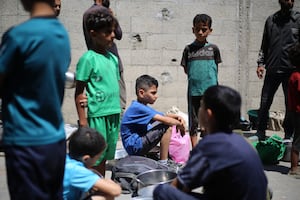
Like thousands of children in the Gaza Strip, Ahmad is not only wounded by the physical violence of Israel's war but is also battling the silent, lingering pain of trauma and loss. What makes survival possible, in many cases, is something both fierce and fragile: the unwavering love of parents who refuse to let their children surrender to despair.

Ahmad’s mother calls him “my hero” and tells him that one day, he will walk again. She speaks of prosthetic limbs and restored dreams, feeding hope even where there is deep exhaustion. “Sometimes her words give me strength,” Ahmad says. “Other times, I feel helpless. But they never leave me. They always try to lift me up.”

Sight lost

In another part of Gaza, Mohammad Emad Ghanem, 11, performs the same heartbreaking ritual every morning. After waking up, he covers his left eye with his hand and tries desperately to see through his right. He lost that eye in an explosion several months ago.

“He still tests himself every day, hoping his sight might come back,” his father, Emad Ghanem, told The National. “He’s just a child, and yet he understands everything. He knows what it means to be different, to feel alone.”

Before the war, Mohammad’s life was filled with laughter, games and school. Now, his parents spend hours each day reminding him that his injury does not define him, that he is no less capable or worthy than any other child.

“We keep telling him that one day he’ll travel, get treatment, and regain his sight,” Emad says. “We’re planting in him the belief that no injury will stop him from achieving his dreams.”

Mohammad Emad Ghanem lost his right eye in an explosion in Gaza. Handout

Mohammad Khaled Hijazi, eight, was also playing near his destroyed home in Jabalia refugee camp when an unexploded ordnance detonated, sending shrapnel into his right eye. His father, Khaled, remembers the moment vividly, not so much the explosion itself but what came afterwards: the silence, the questions, and the quiet ache of a son asking things no parent can easily answer.

“Dad, when will I see with both eyes again?”

“Will I be like my cousins and my friends again?”

“Every time he asks, my heart breaks,” Khaled said. “But I always answer: ‘One day, you will.’”

Despite their own trauma and daily hardship, Khaled and his wife have committed themselves to nurturing their son’s confidence and self-worth. They refuse to let him be swallowed by self-pity or shame.

“Just a few days ago, he asked me: ‘What’s the farthest thing you can see on the street?’” Khaled recalls. “I pointed to a red car. He said: ‘I can see it too!’ And he smiled. That moment, it shook me. It reminded me how fragile and brave he is.”

In a place where food is scarce, water is limited, and electricity is unreliable, emotional survival can be harder than physical endurance. Parents in Gaza are not just providers, they are emotional anchors, counsellors and protectors against a world their children can no longer fully make sense of.

The loss of a limb, an eye, a sibling, these are wounds that reshape a child's entire future. But behind every child trying to cope is a parent working just as hard, often silently, to carry their pain and remind them that life still has meaning.

“We know we can’t bring back what’s lost,” says Emad Ghanem, “but we can be there. Every single day. We can keep telling our children that they are not broken, that they are strong, that they are loved.”

“It's not an easy task to find yourself trying to convince your child that tomorrow will be better, given what we're actually experiencing, but they are children, and they deserve hope,” Khaled Hijazi said.


HWJN
%3Cp%3EDirector%3A%20Yasir%20Alyasiri%3C%2Fp%3E%0A%3Cp%3EStarring%3A%20Baraa%20Alem%2C%20Nour%20Alkhadra%2C%20Alanoud%20Saud%3C%2Fp%3E%0A%3Cp%3ERating%3A%203%2F5%3C%2Fp%3E%0A%3Cp%3E%3C%2Fp%3E%0A
How to help

Send “thenational” to the following numbers or call the hotline on: 0502955999
2289 – Dh10
2252 – Dh 50
6025 – Dh20
6027 – Dh 100
6026 – Dh 200

MATCH INFO

Karnatake Tuskers 114-1 (10 ovs)

Charles 57, Amla 47

Bangla Tigers 117-5 (8.5 ovs)

Fletcher 40, Moores 28 no, Lamichhane 2-9

Bangla Tiger win by five wickets

MATCH INFO

Day 1 at Mount Maunganui

England 241-4

Denly 74, Stokes 67 not out, De Grandhomme 2-28

New Zealand 

Yet to bat

The five pillars of Islam

1. Fasting 

2. Prayer 

3. Hajj 

4. Shahada 

5. Zakat 

Zakat definitions

Zakat: an Arabic word meaning ‘to cleanse’ or ‘purification’.

Nisab: the minimum amount that a Muslim must have before being obliged to pay zakat. Traditionally, the nisab threshold was 87.48 grams of gold, or 612.36 grams of silver. The monetary value of the nisab therefore varies by current prices and currencies.

Zakat Al Mal: the ‘cleansing’ of wealth, as one of the five pillars of Islam; a spiritual duty for all Muslims meeting the ‘nisab’ wealth criteria in a lunar year, to pay 2.5 per cent of their wealth in alms to the deserving and needy.

Zakat Al Fitr: a donation to charity given during Ramadan, before Eid Al Fitr, in the form of food. Every adult Muslim who possesses food in excess of the needs of themselves and their family must pay two qadahs (an old measure just over 2 kilograms) of flour, wheat, barley or rice from each person in a household, as a minimum.

Three ways to limit your social media use

Clinical psychologist, Dr Saliha Afridi at The Lighthouse Arabia suggests three easy things you can do every day to cut back on the time you spend online.

1. Put the social media app in a folder on the second or third screen of your phone so it has to remain a conscious decision to open, rather than something your fingers gravitate towards without consideration.

2. Schedule a time to use social media instead of consistently throughout the day. I recommend setting aside certain times of the day or week when you upload pictures or share information. 

3. Take a mental snapshot rather than a photo on your phone. Instead of sharing it with your social world, try to absorb the moment, connect with your feeling, experience the moment with all five of your senses. You will have a memory of that moment more vividly and for far longer than if you take a picture of it.

88 Video's most popular rentals

Avengers 3: Infinity War: an American superhero film released in 2018 and based on the Marvel Comics story.  

Sholay: a 1975 Indian action-adventure film. It follows the adventures of two criminals hired by police to catch a vagabond. The film was panned on release but is now considered a classic.

Lucifer: is a 2019 Malayalam-language action film. It dives into the gritty world of Kerala’s politics and has become one of the highest-grossing Malayalam films of all time.

GAC GS8 Specs

Engine: 2.0-litre 4cyl turbo

Power: 248hp at 5,200rpm

Torque: 400Nm at 1,750-4,000rpm

Transmission: 8-speed auto

Fuel consumption: 9.1L/100km

On sale: Now

Price: From Dh149,900

FIXTURES

December 28
Stan Wawrinka v Pablo Carreno Busta, 5pm
Milos Raonic v Dominic Thiem, no earlier then 7pm

December 29 - semi-finals
Rafael Nadal v Stan Wawrinka / Pablo Carreno Busta, 5pm
Novak Djokovic v Milos Raonic / Dominic Thiem, no earlier then 7pm

December 30
3rd/4th place play-off, 5pm
Final, 7pm

Updated: July 23, 2025, 1:57 PM