
US B-2 bombers are said to have been used in the attacks on Iran. Reuters

How did US carry out strikes on Iranian nuclear sites?


  • English
  • Arabic

US B-2 bombers and Washington's “bunker-buster” bombs were involved in the attacks on Iran's nuclear sites on Sunday, US officials have said.

Those bunker-busters were widely seen as the best chance of damaging or destroying the Fordow nuclear enrichment site, as it is deep underground. Israel's military is believed not to possess weapons capable of disabling the facility.

The US is also the only military capable of dropping the bombs. The Pentagon revealed on Sunday that B2 bomber planes took off from Whiteman Air Force Base in Missouri for the 18-hour mission. They refuelled in mid-air and did not take off from military bases in the Middle East or the Indian Ocean.
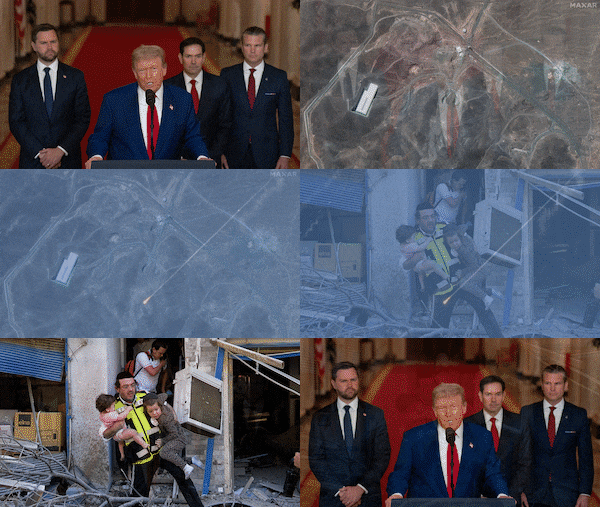
Gen Dan Caine, Chairman of the Joint Chiefs of Staff, said the US attack went largely undetected by Iran's military. He said it was probably the largest B2 bomber strike in US history.

“Bunker buster” is a broad term used to describe bombs that are designed to penetrate deep below the surface before exploding. In this case, it refers to the latest GBU-57 A/B Massive Ordnance Penetrator bomb in the American arsenal. The roughly 30,000 pound (13,600kg) precision-guided bomb is designed to attack deeply buried and hardened bunkers and tunnels, according to the US Air Force.

It is believed to be able to burrow about 60 metres below the surface before exploding, and the bombs can be dropped one after another, effectively drilling deeper and deeper with each successive explosion. It was not clear how many were used in the Sunday morning attack.

The bomb carries a conventional warhead, but the International Atomic Energy Agency has confirmed that Iran is producing highly enriched uranium at Fordow, raising the possibility that nuclear material could be released into the area if it was the GBU-57 A/B that was used to hit the site. However, Israeli strikes at another Iranian nuclear site, Natanz, on a centrifuge centre have caused contamination only at the site itself, not the surrounding area, the IAEA has said. US warplanes also hit Natanz on Sunday.

In theory, the GBU-57 A/B could be dropped by any bomber capable of carrying the weight, but at the moment the US has only configured and programmed its B-2 Spirit stealth bomber to deliver the bomb, according to the air force.

The B-2 is only flown by the US air force, and is built by Northrop Grumman.

According to the manufacturer, the B-2 can carry a payload of 40,000 pounds (18,000kg) but the US Air Force has said it has successfully tested the B-2 loaded with two GBU-57 A/B bunker busters – a total weight of some 60,000 pounds (27,200kg).

The strategic long-range heavy bomber has a range of about 11,000 kilometres without refuelling, and 18,500 kilometres with one refuelling, and can reach any point in the world within hours, according to Northrop Grumman.


Conflict, drought, famine

Estimates of the number of deaths caused by the famine range from 400,000 to 1 million, according to a document prepared for the UK House of Lords in 2024.
It has been claimed that the policies of the Ethiopian government, which took control after deposing Emperor Haile Selassie in a military-led revolution in 1974, contributed to the scale of the famine.
Dr Miriam Bradley, senior lecturer in humanitarian studies at the University of Manchester, has argued that, by the early 1980s, “several government policies combined to cause, rather than prevent, a famine which lasted from 1983 to 1985. Mengistu’s government imposed Stalinist-model agricultural policies involving forced collectivisation and villagisation [relocation of communities into planned villages].
The West became aware of the catastrophe through a series of BBC News reports by journalist Michael Buerk in October 1984 describing a “biblical famine” and containing graphic images of thousands of people, including children, facing starvation.

Band Aid

Bob Geldof, singer with the Irish rock group The Boomtown Rats, formed Band Aid in response to the horrific images shown in the news broadcasts.
With Midge Ure of the band Ultravox, he wrote the hit charity single Do They Know it’s Christmas in December 1984, featuring a string of high-profile musicians.
Following the single’s success, the idea to stage a rock concert evolved.
Live Aid was a series of simultaneous concerts that took place at Wembley Stadium in London, John F Kennedy Stadium in Philadelphia, the US, and at various other venues across the world.
The combined event was broadcast to an estimated worldwide audience of 1.5 billion.

The specs

Engine: 2.0-litre 4cyl turbo

Power: 261hp at 5,500rpm

Torque: 405Nm at 1,750-3,500rpm

Transmission: 9-speed auto

Fuel consumption: 6.9L/100km

On sale: Now

Price: From Dh117,059

RACE CARD

5pm: Maiden (PA) Dh80,000 1,400m
5.30pm: Maiden (PA) Dh80,000 1,200m
6pm: Arabian Triple Crown Round-1 (PA) Listed Dh230,000 1,600m
6.30pm: HH The President’s Cup (PA) Group 1 Dh2.5million 2,200m
7pm: HH The President’s Cup (TB) Listed Dh380,000 1,400m
7.30pm: Wathba Stallions Cup (PA) Handicap Dh70,000 1,200m.

Abu Dhabi GP starting grid

1 Lewis Hamilton (Mercedes)

2 Valtteri Bottas (Mercedes)

3 Sebastian Vettel (Ferrari)

4 Kimi Raikkonen (Ferrari)

5 Daniel Ricciardo (Red Bull)

6 Max Verstappen (Red Bull)

7 Romain Grosjean (Haas)

8 Charles Leclerc (Sauber)

9 Esteban Ocon (Force India)

10 Nico Hulkenberg (Renault)

11 Carlos Sainz (Renault)

12 Marcus Ericsson (Sauber)

13 Kevin Magnussen (Haas)

14 Sergio Perez (Force India)

15 Fernando Alonso (McLaren)

16 Brendon Hartley (Toro Rosso)

17 Pierre Gasly (Toro Rosso)

18 Stoffe Vandoorne (McLaren)

19 Sergey Sirotkin (Williams)

20 Lance Stroll (Williams)

Updated: June 22, 2025, 2:33 PM