
Iran said on Saturday it has not yet decided whether to take part in Sunday’s latest round of talks with the US, leaving the door open to participation despite the recent Israeli military escalation.
“It is still unclear what decision we will make,” Esmaeil Baghaei, the representative for Iran’s Ministry of Foreign Affairs told state-run media.
Hours later, Foreign Minister Abbas Araghchi told the EU Foreign Policy Chief Kaya Kallas that he believes Israel's actions were the result of Washington's support and that continuing nuclear talks is "unjustifiable".
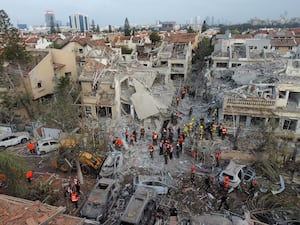
The US hopes that talks with Tehran about its nuclear programme will continue, despite Israel's attacks on Iran that have called the merit of negotiations into question.
Following Friday's strikes, Iran said it was withdrawing from the sixth round of nuclear negotiations that were to take place in Oman on Sunday with US special envoy to the Middle East envoy Steve Witkoff.
But Mr Baghaei suggested that his government is still open to participating, despite saying that Israel’s actions “effectively rendered talks meaningless”.
The talks were supposed to forestall military action against Iran by forcing it to give up all uranium enrichment capabilities and abandon its drive to develop a nuclear weapon. For weeks, US President Donald Trump sounded optimistic that a deal could be achieved, while also threatening dire consequences for Iran if it did not reach an agreement.
Ultimately, Israel rendered those talks moot by launching a “pre-emptive” strike against Iran's military leaders and its nuclear sites. Despite those actions, Mr Trump insisted Iran possibly has a “second chance” to come to the negotiating table.
Difficult position
Mr Baghaei accused the US of being somewhat responsible for the attacks that killed several high-ranking Iranian military officials and dozens of civilians.
“It is inconceivable for Iran – and indeed for anyone in the world – that the Zionist regime could have carried out such a reckless and aggressive act of war in the region without the co-operation, co-ordination, or at the very least the conscious green light of the US.
“We hold the US government responsible for the consequences of this reckless and unlawful act by the Zionist regime,” he added.
Iran finds itself in a difficult position: walking away from the talks would suggest Israel has proven Tehran is not serious about a nuclear deal, while attending could make it appear weak after the Israeli assault.
The UN nuclear watchdog's 35-nation board of governors passed a resolution on June 12 formally declaring Iran in breach of its non-proliferation obligations for the first time in almost 20 years, a move Tehran claimed was “clearly designed to produce a crisis”. Tehran also said it would open a new uranium enrichment site.
Hours later, Israel launched strikes on Iran, prompting Tehran to retaliate by firing dozens of missiles towards Israel, killing at least three people and injuring more than 150.

Sole survivors
- Cecelia Crocker was on board Northwest Airlines Flight 255 in 1987 when it crashed in Detroit, killing 154 people, including her parents and brother. The plane had hit a light pole on take off
- George Lamson Jr, from Minnesota, was on a Galaxy Airlines flight that crashed in Reno in 1985, killing 68 people. His entire seat was launched out of the plane
- Bahia Bakari, then 12, survived when a Yemenia Airways flight crashed near the Comoros in 2009, killing 152. She was found clinging to wreckage after floating in the ocean for 13 hours.
- Jim Polehinke was the co-pilot and sole survivor of a 2006 Comair flight that crashed in Lexington, Kentucky, killing 49.
What sanctions would be reimposed?
Under ‘snapback’, measures imposed on Iran by the UN Security Council in six resolutions would be restored, including:
- An arms embargo
- A ban on uranium enrichment and reprocessing
- A ban on launches and other activities with ballistic missiles capable of delivering nuclear weapons, as well as ballistic missile technology transfer and technical assistance
- A targeted global asset freeze and travel ban on Iranian individuals and entities
- Authorisation for countries to inspect Iran Air Cargo and Islamic Republic of Iran Shipping Lines cargoes for banned goods
Four tips to secure IoT networks
Mohammed Abukhater, vice president at FireEye in the Middle East, said:
- Keep device software up-to-date. Most come with basic operating system, so users should ensure that they always have the latest version
- Besides a strong password, use two-step authentication. There should be a second log-in step like adding a code sent to your mobile number
- Usually smart devices come with many unnecessary features. Users should lock those features that are not required or used frequently
- Always create a different guest network for visitors
Benefits of first-time home buyers' scheme
- Priority access to new homes from participating developers
- Discounts on sales price of off-plan units
- Flexible payment plans from developers
- Mortgages with better interest rates, faster approval times and reduced fees
- DLD registration fee can be paid through banks or credit cards at zero interest rates
What is Reform?
Reform is a right-wing, populist party led by Nigel Farage, a former MEP who won a seat in the House of Commons last year at his eighth attempt and a prominent figure in the campaign for the UK to leave the European Union.
It was founded in 2018 and originally called the Brexit Party.
Many of its members previously belonged to UKIP or the mainstream Conservatives.
After Brexit took place, the party focused on the reformation of British democracy.
Former Tory deputy chairman Lee Anderson became its first MP after defecting in March 2024.
The party gained support from Elon Musk, and had hoped the tech billionaire would make a £100m donation. However, Mr Musk changed his mind and called for Mr Farage to step down as leader in a row involving the US tycoon's support for far-right figurehead Tommy Robinson who is in prison for contempt of court.
What the law says
Micro-retirement is not a recognised concept or employment status under Federal Decree Law No. 33 of 2021 on the Regulation of Labour Relations (as amended) (UAE Labour Law). As such, it reflects a voluntary work-life balance practice, rather than a recognised legal employment category, according to Dilini Loku, senior associate for law firm Gateley Middle East.
“Some companies may offer formal sabbatical policies or career break programmes; however, beyond such arrangements, there is no automatic right or statutory entitlement to extended breaks,” she explains.
“Any leave taken beyond statutory entitlements, such as annual leave, is typically regarded as unpaid leave in accordance with Article 33 of the UAE Labour Law. While employees may legally take unpaid leave, such requests are subject to the employer’s discretion and require approval.”
If an employee resigns to pursue micro-retirement, the employment contract is terminated, and the employer is under no legal obligation to rehire the employee in the future unless specific contractual agreements are in place (such as return-to-work arrangements), which are generally uncommon, Ms Loku adds.
More on animal trafficking
Who's who in Yemen conflict
Houthis: Iran-backed rebels who occupy Sanaa and run unrecognised government
Yemeni government: Exiled government in Aden led by eight-member Presidential Leadership Council
Southern Transitional Council: Faction in Yemeni government that seeks autonomy for the south
Habrish 'rebels': Tribal-backed forces feuding with STC over control of oil in government territory
