

Live updates: Follow the latest on Israel-Gaza
Each time Shadi Quran recounted a detail about his 17 and a half years in an Israeli prison, his wife clutched him harder and grimaced with horror.
The couple were reunited in Ramallah on Saturday after Israel released 183 Palestinians in exchange for three Israeli hostages freed by Hamas in Gaza earlier in the day as part of a ceasefire deal. Mr Quran was among 32 detainees sent to the main Palestinian city in the occupied West Bank, while most of the others were returned to Gaza and one was sent into exile through Egypt.
“The conditions were very, very hard. We were targeted, beaten, insulted – they didn’t leave anything out,” he said, speaking softly. His voice was almost drowned out by the din of celebrations at the Mahmoud Darwish Museum, where hundreds of people had gathered to welcome the fourth batch of detainees to be freed under the deal.
Despite looking exhausted, Mr Quran, from the West Bank town of Tulkarm, appeared to be in better shape than most his fellow former detainees who tumbled out of a Red Cross bus wearing grey prison tracksuits and with shaven heads. He had been incarcerated for planning acts of terror, shooting at the Israeli military and planting an explosive device, according to Israeli media reports.
The National saw one man who had to be carried straight to an ambulance. Some had lost patches of hair. All looked gaunt and had no colour in their faces. One family, after about a minute of embracing a middle-aged man, noticed that he was not wearing shoes.

Inside the nearby Ramallah Cultural Palace, where some of the detainees were reunited with their families, Ramallah mayor Issa Kassis stood taking in the scenes of joy around him.
“It means the world to us when our brothers and sisters are released, when justice is settled in Palestine,” he told The National. “We hope that the world learns that we should not describe these people as ‘prisoners’. They are just patriots who fight for their land.”
The Palestinian Prisoners' Club issued a statement saying that a number of the detainees showed signs of beatings, skin diseases resulting from unsanitary conditions, and starvation, and Mr Kassis also voiced concern about their condition.
“We saw Israeli prisoners released from Gaza in an excellent shape, as the world has seen as well. Now look at ours. Let the camera say it all, so that people can see what is going on,” Mr Kassis said.
“They are in a bad shape because they are being treated brutally, as you can see, in every way possible. It’s not just the food, it’s the bruises on their skin. It’s painful to see and yet you see people smiling. They’re back in our fold now and we will take care of them.”
-
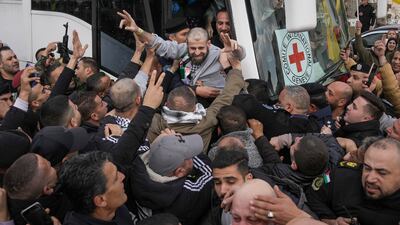
Palestinians are greeted by a crowd as they exit a Red Cross bus in the occupied West Bank city of Ramallah on February 1, after being released from Israeli prisons as part of a ceasefire agreement between Israel and Hamas. AP -
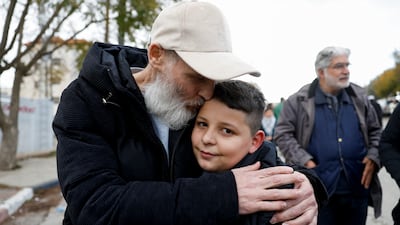
A freed Palestinian detainee hugs a boy after arriving in Ramallah, in the occupied West Bank. Reuters -

A Palestinian detainee released by Israel is hugged by relatives as he steps down from a Red Cross bus in Ramallah. AFP -
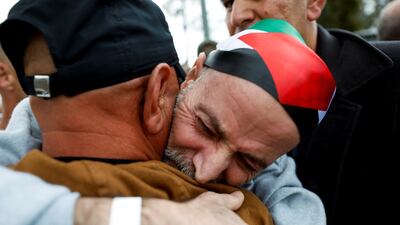
A freed Palestinian detainee is hugged in Ramallah. Reuters -
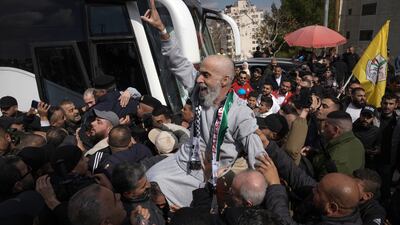
A freed Palestinian detainee is held aloft after arriving in Ramallah. AP -
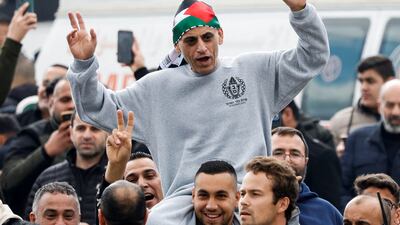
A freed Palestinian detainee is carried on another man's shoulders in Ramallah. Reuters -
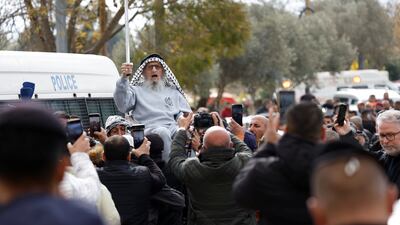
A Palestinian man celebrates his release from an Israeli jail, in Ramallah. Reuters -
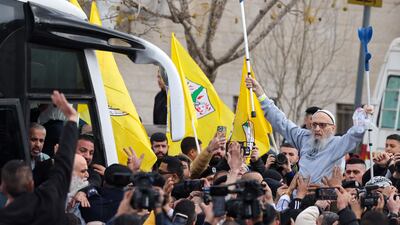
A Palestinian former detainee waves a pair of crutches in the air as he is cheered by the crowd greeting him in Ramallah. AFP -
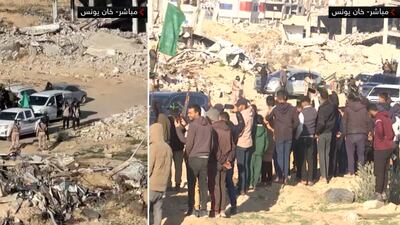
Preparations are made for the release of Israeli hostages in Khan Younis, southern Gaza, on February 1. Sky News Arabia screengrab -
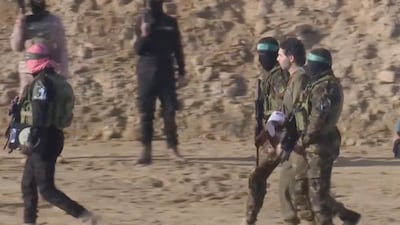
Israeli hostage Ofer Kalderon, held in Gaza since October 7, 2023, is accompanied by Hamas fighters to his release on February 1 as part of a ceasefire and a hostages for detainees swap between Hamas and Israel in Khan Younis, southern Gaza Strip. Reuters -
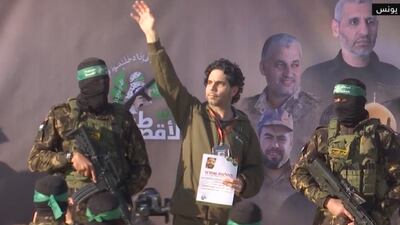
Ofer Kalderon is released in Khan Younis. Sky News Arabia screengrab -
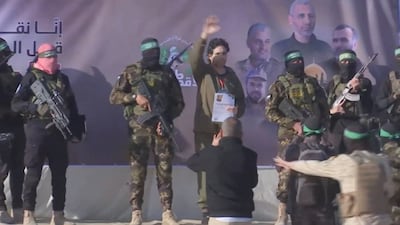
Ofer Kalderon is released in Khan Younis. Reuters -
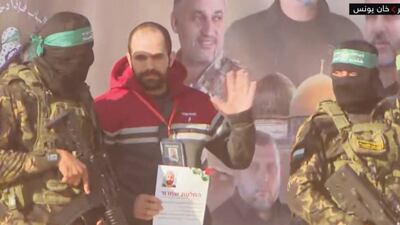
Israeli hostage Yarden Bibas is released in Khan Younis on February 1. Sky News Arabia screengrab -
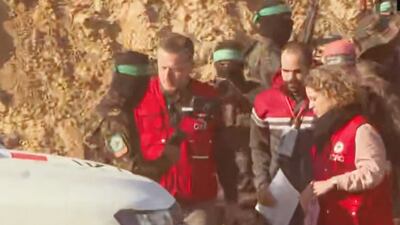
Screengrab of hostages being released in Khan Younis. Sky News Arabia -
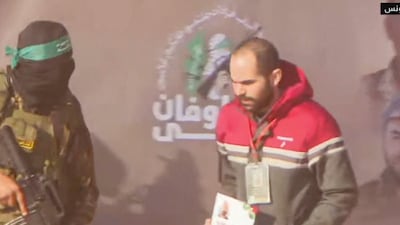
Yarden Bibas is released in Khan Younis, Gaza. Sky News Arabia screengrab -

Hostages are released in Khan Younis, Gaza. Sky News Arabia screengrab -
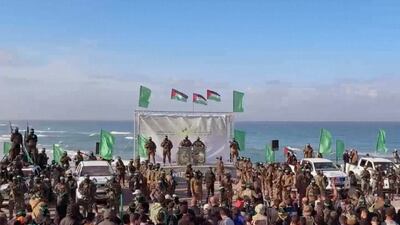
A stage is set up near Gaza port for the release Israeli-American hostage Keith Siegel. Sky News Arabia screengrab -
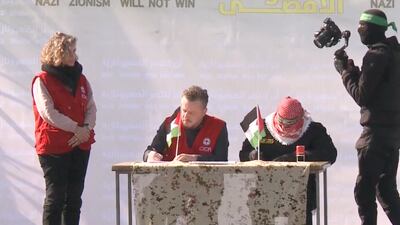
Paperwork is signed for the release of Keith Siegel in Gaza. Screengrab Sky News Arabia -

Mr Siegel is released by Hamas militants. Reuters


The hostage-prisoner exchange on Saturday went off more smoothly than the first three that followed the start of the ceasefire on January 19, and was a stark contrast to the one two days earlier, when Israeli authorities delayed the release of detainees in protest against the chaotic conditions under which the Israeli hostages were freed.
In Gaza, the hostages had been handed over to the Red Cross by late Saturday morning. Hamas stuck to its theatrics and ceremony, with the hostages brought up on to a stage to wave at cameras before Red Cross officials signed their certificates of release. However, the crowds of onlookers was far smaller, far less rowdy and kept further away from the hostages.
In the West Bank, the cheering crowds that had previously surrounded the buses and held up their passage to the drop-off point were absent. Israeli forces fired tear gas and warned people not to celebrate, as they have done before, but that did not stop hundreds eventually turning up at the museum, where Palestinian Authority police had set up cordons and were out in force.
The PA was nowhere to be seen during the earlier releases as Ramallah's suburbs, barely a five-minute drive from the government district, were covered in the flags of Hamas, Islamic Jihad and even Hezbollah, a sign of the challenge posed to President Mahmoud Abbas's Fatah faction, which dominates the PA, by the surging popularity of rival groups.
Although the intensity of the celebrations have not decreased, the PA has gradually exerted more control over the releases. On Saturday, only Fatah flags were seen around the museum. Its relatively isolated hilltop location also made it easier for the PA forces to exert control, although they mingled with the crowd and joined in the celebrations.

