



Live updates: Follow the latest on Israel-Gaza
Israeli authorities said 19 people in central Israel's Sharon region were injured on Saturday after projectiles were launched from Lebanon into Israeli territory.
The early morning strike on Tira, a predominantly Arab town about 25km from Tel Aviv, was one of several barrages fired from Lebanon. The Israeli military said that sirens sounded in several areas of central Israel after the projectiles were fired. Some rockets and drones had been intercepted, it said.
“A fallen projectile was most likely identified in the area,” the army said, noting that the incident was under investigation.
The national ambulance service and local media said the injuries in Tira ranged from mild to moderate, while two other people suffered stress symptoms.
Lebanon’s Iran-backed Hezbollah claimed responsibility for firing missiles towards the 8200 military intelligence unit base in Glilot on the edge of Tel Aviv and for attacking central Israel's Palmachim Air Base with explosive drones, saying they “scored precise hits on targets”.
Hezbollah said the Saturday dawn missile attack was in retaliation for the “massacres” that are being committed by Israel. Israel's military has not confirmed either base was targeted or hit.
A coalition of pro-Iran groups in Iraq also said it carried out four drone attacks on the Israeli resort of Eilat after Israel said it intercepted three drones approaching from the east. The Islamic Resistance in Iraq said it was behind the attacks on what it called “four vital targets” in the resort on Israel's Red Sea coast, all conducted within one hour.
The attacks came after Israel conducted dozens of air strikes across Lebanon's north-eastern farming villages on Friday. In Lebanon’s Bekaa Valley, Israel carried out a series of air strikes on Friday, killing at least 52 people and driving more families to flee. Thick plumes of smoke were seen over the horizon.
The Islamic Resistance in Iraq also said it had launched drones at a “vital target” in northern Israel. On Thursday, rocket fire from Lebanon killed seven people in Metula, in northern Israel, including four Thai farmers.
-

The southern Lebanese village of Al Taybeh is shrouded by smoke during an air strike as Israeli forces seek out Hezbollah. AFP -
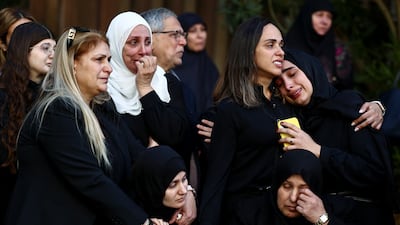
The sister, mother and the partner of Mohammad Farhat, a major with the Lebanese Army who was killed in an Israeli strike with two other soldiers on the outskirts of the village of Yater in southern Lebanon, attend an official memorial in Beirut. Reuters -
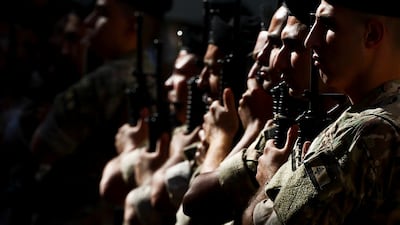
Lebanese Army soldiers take part in an official ceremony to pay tribute after the death of Maj Mohammad Farhat. Reuters -
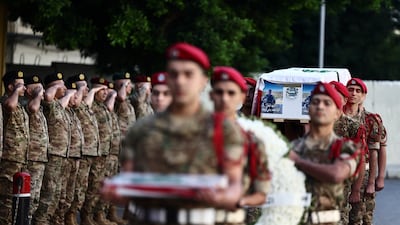
Lebanese Army soldiers carry the coffin of Maj Mohammad Farhat during an official ceremony to pay tribute in Beirut, Lebanon. Reuters -
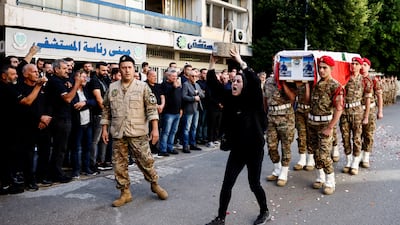
Emotions ran high at a memorial for Lebanese Army Maj Mohammad Farhat, who was killed in an Israeli strike with two other soldiers on the outskirts of the village of Yater in southern Lebanon. Reuters -
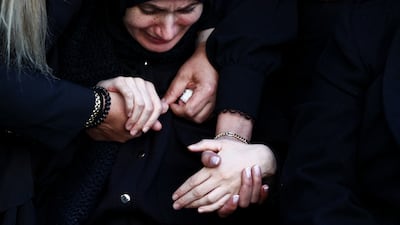
The relatives of Maj Mohammad Farhat are comforted by friends at a memorial in Beirut. Reuters -

The sister of Maj Mohammad Farhat at the official memorial to her brother in Beirut. Reuters -

Mourners at the official ceremony to pay tribute to Maj Mohammad Farhat of the Lebanese Army, who was killed in an Israeli strike with two other soldiers on the outskirts of the village of Yater in southern Lebanon. Reuters


Fighting in Lebanon has escalated in recent weeks between Israeli forces and the Hezbollah group.
According to Israeli official figures, at least 63 people have been killed on the Israeli side since cross-border exchanges with Hezbollah started in October last year after the deadly attack on southern Israel by Hamas. The year-long cross-border fighting boiled over on October 1, when Israeli forces launched a ground invasion of southern Lebanon for the first time since 2006.
Since the conflict between Israel and Hezbollah began, more than 2,897 people have been killed and 13,150 wounded in Lebanon, the Health Ministry said, not including Friday's casualties. Health authorities say that a quarter of those killed were women and children.
UN agencies estimate that Israel’s ground invasion and bombardment of Lebanon has displaced 1.4 million people. Residents of Israel’s northern communities near Lebanon, about 60,000 people, have also been displaced for more than a year.
The UN peacekeeping chief said the UN force, Unifil, is determined to stay in southern Lebanon, not only because of its mandate monitoring attacks by Israel and Hezbollah but because the departure of peacekeepers would likely mean UN compounds would be taken over by one of the warring parties.
“That would be very bad for many reasons, including the perception of impartiality and neutrality of the United Nations,” the UN's Jean-Pierre Lacroix said on Friday.
At the start of Israel’s latest offensive last month, Israel asked the UN peacekeeping force to pull back 5km from the Lebanese border for their safety, but the UN refused.
“Unifil peacekeepers are staying,” Mr Lacroix said. “They’re holding the line and they’re determined to continue doing what they’re mandated to do.”

