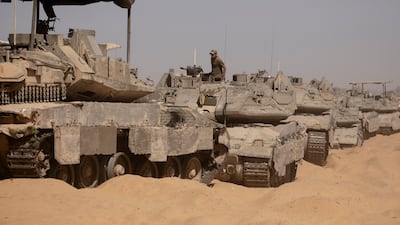
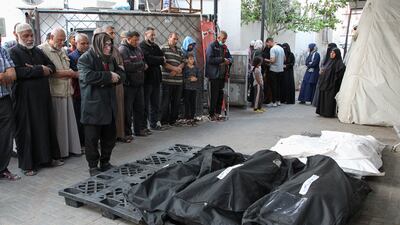
The aftermath of Israeli bombing in Rafah. The use by the military of AI systems to target Hamas has come under question. AFP

Israel's AI targeting of Gaza criticised for potential analytical errors


Thomas Harding
  • English
  • Arabic

Live updates: Follow the latest on Israel-Gaza

Technology experts have warned Israel's military of potential “extreme bias error” in relying on Big Data for targeting people in Gaza while using artificial intelligence programmes.

The Israeli military has reportedly to be using two AI systems, Gospel and Lavender, to track down Hamas operatives and speed up missile strikes but they are controversial, with some suggesting they have contributed to the high number civilian casualties, with more than 34,800 Palestinians killed.

Big Data, defined as large, diverse sets of information that grow at ever-increasing rates, has now become so widespread and powerful with the rise of AI that if not “in the not too distant future, no one will be able to escape digital surveillance”, Dr Miah Hammond-Errey told a Rusi think tank webinar.

Israel’s use of powerful AI systems has led its military to enter territory for advanced warfare not previously witnessed at such a scale between soldiers and machines.

The Lavender system is understood to have processed huge amounts of personal data from Gaza, allowing it to quickly militant enemy profiles, with up to 37,000 Palestinian men linked by the system to Hamas or Palestinian Islamic Jihad.

It is also alleged that Israeli strike operators, using AI, are allowed to kill up to 20 civilians per attack if the target is deemed an appropriate rank.

Unverified reports say the AI systems had “extreme bias error, both in the targeting data that's being used, but then also in the kinetic action”, Ms Hammond-Errey said in response to a question from The National. Extreme bias error can occur when a device is calibrated incorrectly, so it miscalculates measurements.

The AI expert and director of emerging technology at the University of Sydney suggested broad data sets “that are highly personal and commercial” mean that armed forces “don't actually have the capacity to verify” targets and that was potentially “one contributing factor to such large errors”.

She said it would take “a long time for us to really get access to this information”, if ever, “to assess some of the technical realities of the situation”, as the fighting in Gaza continues.

The first phase of Israeli operations in Gaza in November

Prof Sir David Omand, former head of Britain’s GCHQ surveillance centre, urged against “jumping to conclusions” over Israel’s AI use, as its military had not given independent access to its system.

“We just have to be a bit careful before assuming these almost supernatural powers to large data sets on what has been going on in Gaza, and just remember that human beings are setting the rules of engagement,” he said.

“If things are going wrong, it’s because human beings have the wrong rules, not because the machines are malfunctioning.”

Israeli’s use of Lavender and Gospel “would likely form a test case for how the international community and tech companies respond to the use of AI”.

Dr Hammond-Errey, author of Big Data, Emerging Technologies and Intelligence, argues that for national security agencies the “Big Data landscape offers the potential for this invasive targeting and surveillance of individuals”, not only by states but others not governed by rules.

“If we aren't there already, in the not-too-distant future no one will be able to escape digital surveillance.”

Big Data could give armies “military dominance”, as it offers “imperfect global situational awareness but on a scale previously not considered”, especially when connected to space targeting systems.

Aligned with AI, Big Data can compile “comprehensive profiles” of people, institutions, political groups and nation states that “can be made remotely and very quickly”.

Dr Hammond-Errey also warned that Big Data had been used around the world to target individuals and specific groups, exploiting “individual psychological weaknesses” as well as interfering with elections.

List of alleged parties


May 12, 2020: PM and his wife Carrie attend 'work meeting' with at least 17 staff 

May 20, 2020: They attend 'bring your own booze party'

Nov 27, 2020: PM gives speech at leaving party for his staff 

Dec 10, 2020: Staff party held by then-education secretary Gavin Williamson 

Dec 13, 2020: PM and his wife throw a party

Dec 14, 2020: London mayoral candidate Shaun Bailey holds staff event at Conservative Party headquarters 

Dec 15, 2020: PM takes part in a staff quiz 

Dec 18, 2020: Downing Street Christmas party 

Small%20Things%20Like%20These
%3Cp%3EDirector%3A%20Tim%20Mielants%3Cbr%3ECast%3A%20Cillian%20Murphy%2C%20Emily%20Watson%2C%20Eileen%20Walsh%3Cbr%3ERating%3A%204%2F5%3C%2Fp%3E%0A
Other workplace saving schemes
  • The UAE government announced a retirement savings plan for private and free zone sector employees in 2023.
  • Dubai’s savings retirement scheme for foreign employees working in the emirate’s government and public sector came into effect in 2022.
  • National Bonds unveiled a Golden Pension Scheme in 2022 to help private-sector foreign employees with their financial planning.
  • In April 2021, Hayah Insurance unveiled a workplace savings plan to help UAE employees save for their retirement.
  • Lunate, an Abu Dhabi-based investment manager, has launched a fund that will allow UAE private companies to offer employees investment returns on end-of-service benefits.
Mobile phone packages comparison
The%20specs
%3Cp%3E%3Cstrong%3EEngine%3A%20%3C%2Fstrong%3E2.0-litre%20four-cylinder%20turbo%20hybrid%0D%3Cbr%3E%3Cstrong%3EPower%3A%20%3C%2Fstrong%3E680hp%0D%3Cbr%3E%3Cstrong%3ETorque%3A%20%3C%2Fstrong%3E1%2C020Nm%0D%3Cbr%3E%3Cstrong%3ETransmission%3A%20%3C%2Fstrong%3E9-speed%20auto%0D%3Cbr%3E%3Cstrong%3EFuel%20consumption%3A%20%3C%2Fstrong%3E7.5L%2F100km%0D%3Cbr%3E%3Cstrong%3EOn%20sale%3A%20%3C%2Fstrong%3EEarly%202024%0D%3Cbr%3E%3Cstrong%3EPrice%3A%20%3C%2Fstrong%3EFrom%20Dh530%2C000%20(estimate)%3C%2Fp%3E%0A
Who is Tim-Berners Lee?

Sir Tim Berners-Lee was born in London in a household of mathematicians and computer scientists. Both his mother, Mary Lee, and father, Conway, were early computer scientists who worked on the Ferranti 1 - the world's first commercially-available, general purpose digital computer. Sir Tim studied Physics at the University of Oxford and held a series of roles developing code and building software before moving to Switzerland to work for Cern, the European Particle Physics laboratory. He developed the worldwide web code as a side project in 1989 as a global information-sharing system. After releasing the first web code in 1991, Cern made it open and free for all to use. Sir Tim now campaigns for initiatives to make sure the web remains open and accessible to all.

The biog

Nickname: Mama Nadia to children, staff and parents

Education: Bachelors degree in English Literature with Social work from UAE University

As a child: Kept sweets on the window sill for workers, set aside money to pay for education of needy families

Holidays: Spends most of her days off at Senses often with her family who describe the centre as part of their life too

Some of Darwish's last words

"They see their tomorrows slipping out of their reach. And though it seems to them that everything outside this reality is heaven, yet they do not want to go to that heaven. They stay, because they are afflicted with hope." - Mahmoud Darwish, to attendees of the Palestine Festival of Literature, 2008

His life in brief: Born in a village near Galilee, he lived in exile for most of his life and started writing poetry after high school. He was arrested several times by Israel for what were deemed to be inciteful poems. Most of his work focused on the love and yearning for his homeland, and he was regarded the Palestinian poet of resistance. Over the course of his life, he published more than 30 poetry collections and books of prose, with his work translated into more than 20 languages. Many of his poems were set to music by Arab composers, most significantly Marcel Khalife. Darwish died on August 9, 2008 after undergoing heart surgery in the United States. He was later buried in Ramallah where a shrine was erected in his honour.

PROFILE OF SWVL

Started: April 2017

Founders: Mostafa Kandil, Ahmed Sabbah and Mahmoud Nouh

Based: Cairo, Egypt

Sector: transport

Size: 450 employees

Investment: approximately $80 million

Investors include: Dubai’s Beco Capital, US’s Endeavor Catalyst, China’s MSA, Egypt’s Sawari Ventures, Sweden’s Vostok New Ventures, Property Finder CEO Michael Lahyani

UK’s AI plan
  • AI ambassadors such as MIT economist Simon Johnson, Monzo cofounder Tom Blomfield and Google DeepMind’s Raia Hadsell
  • £10bn AI growth zone in South Wales to create 5,000 jobs
  • £100m of government support for startups building AI hardware products
  • £250m to train new AI models
Updated: July 16, 2025, 6:30 AM