

Live updates: Follow the latest on Israel-Gaza
Palestinians sheltering in Gaza's coastal Al Mawasi area have told of the severe hardship they are facing, days after Israel ordered 100,000 people to flee to the area from the southern city of Rafah.
Tens of thousands in areas in the east of Rafah, including Al Salam and Tal Al Sultan, were told to “immediately evacuate” on Monday morning.
Hours later, Israeli troops seized and closed the Rafah border crossing with Egypt, cutting off all potential exits to Gaza.
The Karam Abu Salem crossing reopened and closed again on Wednesday, Palestinian news agency Wafa reported, after allowing only one lorry of fuel into the strip.
Al Mawasi, between Rafah and Khan Younis, is already home to more than 450,000 Palestinians displaced from other parts of Gaza – and has been attacked multiple times despite being described as a “safe zone” by the Israeli army.
Ola Aboud, 45, was displaced from Gaza city to Al Mawasi with her father, sister and three children.
“The water that we receive here, and we buy, is polluted,” she told The National.
“I have become sick many times, with a pain in my abdomen and vomiting, which lasted for two days. All my family members suffered the same symptoms.
“It was already crowded with people, and it's become worse with more people coming.”
The growing number of displaced has caused prices of food to soar, she added, at a time when a full-blown famine has been declared in the north and is moving south, according to the World Food Programme.
“I hope this nightmare ends soon, and we can go back to our homes in Gaza city,” Ms Aboud added.
About 50,000 people were estimated to have fled Rafah within 48 hours of Israel's orders, Scott Anderson, the senior deputy director of UNRWA affairs in Gaza, told CNN on Wednesday.
He said Al Mawasi did not have adequate infrastructure to cater for the surge in numbers.
“It's essentially a sandy area, so there's no sewage infrastructure, there's no water infrastructure. There aren’t roads that lead into it,” Mr Anderson warned.
-
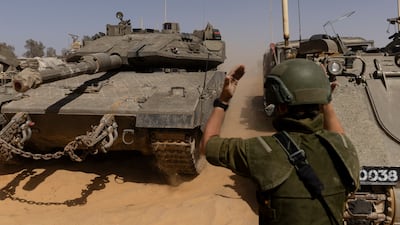
An Israeli soldier directs a tank near Israel's border with southern Gaza. Getty Images -
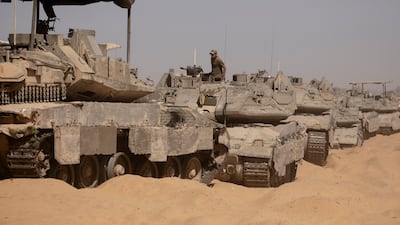
An Israeli soldier stands on a tank in southern Israel. Getty Images -
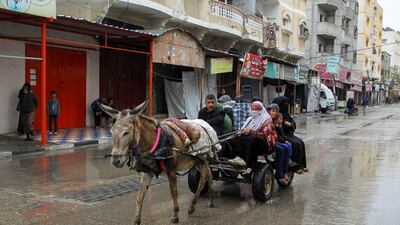
People flee the eastern parts of Rafah ahead of a threatened Israeli incursion. Reuters -
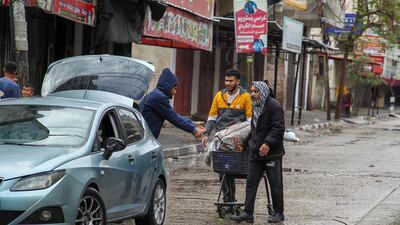
Palestinians leave ahead of a threatened assault on Rafah. Reuters -

Palestinians search for casualties in the rubble of a house destroyed in an Israeli strike in Rafah. AFP -
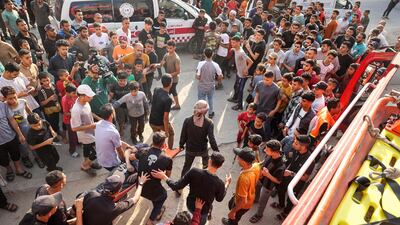
Palestinians carry an injured man who was pulled from the rubble of a house destroyed in an Israeli strike in Rafah. AFP -
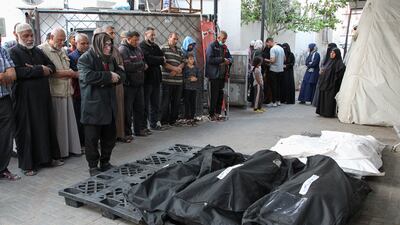
Mourners next to the bodies of Palestinians killed in an Israeli strike in southern Gaza. Reuters -
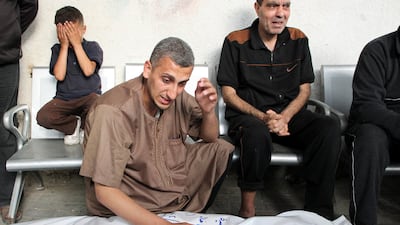
Mourners at Abu Yousef El-Najjar Hospital in Rafah. Reuters


Abu Mohammed Abu Amra, 65, arrived in Al Mawasi on Tuesday, after his home was damaged by shelling. He has collected relief assistance to buy a tent, which he says is costly.
“I haven't built a bathroom, so I need to walk to reach the nearest one. I can't walk, and it is hard for me,” he said.
Many of those fleeing Rafah have been displaced several times already and fled south as Israel pushed through northern Gaza in late October, forcing more than 1 million people from their homes.
"Rafah was never equipped to host nearly 1.5 million Palestinians. And now that space shrinks yet again and they're being asked to move yet again," Jessica Moussan, media relations adviser for the International Committee of the Red Cross, told The National.
"The constant stress, and pervasive sense of insecurity is an extra layer of suffering to the people of Gaza. No one knows what the immediate or distant future holds for them and their loved ones.
"The psychological toll of living through nearly seven months of relentless conflict – the longest in a decade – is immense."
Osama Al Hinnawi, 50, fled to Al Mawasi four months ago, and said the area was originally empty and not prepared to host displaced people.
Insects and polluted water are rife amid mounting piles of rubbish, he said, with local authorities unable to deal with the levels of waste.
Speaking to The Guardian in March, a senior aid official said water lorries were only servicing Al Mawasi once a day, with people forced to relieve themselves in the sand or sea.
“There is no real organised assistance. Sanitary conditions are appalling,” said the official.
Other aid officials, who spoke to The National anonymously, described Al Mawasi as "razed" and said the surrounding area has been completely devastated by the war.
The impact of Al Mawasi's poor infrastructure is compounded by even less aid entering Gaza than before, they said.
"A cessation of hostilities is crucial to allow uninterrupted aid distribution throughout Gaza," Ms Moussan added. "As the occupying power, Israel has a responsibility to ensure the basic needs of the civilian population are met."
In January, a compound housing employees of the International Rescue Committee and Medical Aid for Palestinians came under attack in Al Mawasi.
Four British doctors were injured in the air strike, alongside MAP staff and a bodyguard, while the compound sustained “significant damage.”
Despite the risks, Palestinians displaced several times said they had nowhere else to go.
“The Israeli army is not trusted. What if they reach us, and we are forced to move again?” said Abu Mohammed.
“I prefer to die than to move again.”

