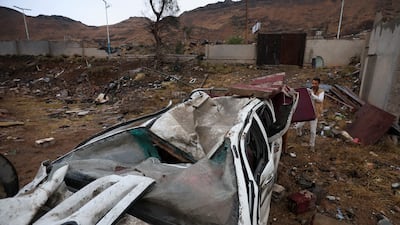
Saudi Arabia intercepted a series of missiles and drones, including over its capital, Riyadh, on Sunday as the Saudi-led coalition in Yemen continued to counter attacks by the Iran-aligned Houthi rebels.
The attacks came as authorities prepared to reopen two terminals at Riyadh’s main international airport following a deadly strike earlier this month.
The Saudi-led coalition said air defences intercepted and destroyed 10 ballistic missiles launched towards the kingdom’s southern region. It also reported intercepting a ballistic missile launched towards Riyadh and destroying a drone aimed at the capital.
The coalition fighting the Houthis separately said it had intercepted and destroyed a cruise missile launched towards Khamis Mushait in southwestern Saudi Arabia.
The Saudi Civil Defence issued warnings through its National Early Warning Platform about potential danger in Abha city and Khamis Mushait governorate. The Khamis Mushait warning was the second issued for the area on Sunday morning.
The Civil Defence later said the danger had passed, urging residents to follow safety instructions and avoid gatherings and filming.
The coalition said interceptions of two ballistic missiles on Saturday had resulted in debris falling in Makkah, Jeddah, Taif and Rabigh.
Meanwhile, Saudi Arabia was reopening two terminals at King Khalid International Airport in Riyadh on Sunday, about two weeks after the airport was closed following a Houthi missile attack that killed 13 people and injured more than 300. Terminal 1 will handle domestic flights, while Terminal 2 will serve international flights.
The Houthis repeated their threats to airlines, airport staff and travellers against using the airport. The rebels' spokesman, Yahya Saree, described the site as unsafe and said it remained a “military target”, warning that the group would continue operations against it. He said Saudi Arabia would bear responsibility for the consequences of resuming airport operations.
As the situation escalated, the US on Saturday warned its citizens against travelling to Saudi Arabia and several other countries in the region, including Bahrain, Iran, Iraq, Jordan, Lebanon, Kuwait, Oman, the UAE, Qatar, Syria, Yemen and Israel. The advisories cited the threat of terrorism.
Washington urged people to reconsider travel to Saudi Arabia because of threats including the “risk of drone and missile targeting of American interests by Iran and the Iranian-supported Houthis”, as well as armed conflict and terrorism.
“Do not travel to the Yemen border due to terrorism,” the US advisory for Saudi Arabia said.
The US warned that Houthi attacks on Saudi Arabia “have the potential to escalate rapidly beyond that immediate area”.
A Saudi-led coalition intervened in Yemen’s civil war in 2015 at the request of the internationally recognised government, after the Houthis seized the capital, Sanaa.
A UN-brokered truce in 2022 helped maintain a fragile peace between the warring sides until this year.
The coalition resumed its military campaign in Yemen in support of the internationally recognised government last month, seeking to reverse the Houthis’ advances, after the rebels moved along the Red Sea coast towards the strategic Bab Al Mandab strait.

