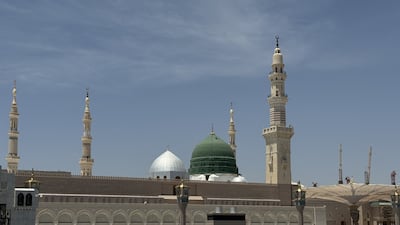

A Houthi attack on Saudi Arabia damaged power equipment supplying the Prophet's Mosque in Madinah, in the second attack in two weeks on the kingdom's holy cities.
The drone attack took place on Tuesday morning and knocked a power transformer in Madinah out of service, said the Saudi-led military coalition in Yemen.
Examination of the drone wreckage "confirmed the involvement of the terrorist Houthi militia in planning and executing this cowardly terrorist act", said the Saudi military spokesman Maj Gen Turki Al Malki.

The coalition said two weeks ago it had destroyed a Houthi drone south of Makkah before it entered prohibited airspace over the holy city. Makkah's Grand Mosque and the Prophet’s Mosque in Madinah are Islam’s two holiest sites.
Maj Gen Al Malki condemned the Houthis on Thursday for what he called their "deliberate provocation of millions of Muslims worldwide by targeting Makkah and Madinah."
Jasem Al Budaiwi, the Secretary General of the Gulf Co-operation Council, said the latest Houthi attack "crossed all red lines" and was a "grave escalation in violating the sanctity of Islamic holy sites".
The UAE's Ministry of Foreign Affairs said the attack constituted a flagrant violation of Saudi Arabia's sovereignty and a threat to its security and stability.
The attacks come as Yemen endures its heaviest fighting in years between the Houthis and government forces. The foiled strike on Makkah was the first such incident since 2017.
Saudi Arabia is providing more than 224 million riyals ($60 million) in budget support to Yemen's internationally recognised government, Saudi ambassador Mohammed Al Jabir announced on Thursday.
The assistance is “part of the kingdom's ongoing support for the brotherly Yemeni people and government amidst the current terrorist attacks perpetrated by the Houthi militia against the resources, assets, and interests of the Yemeni people”, Mr Al Jabir said on X.
He added that the funding, provided at the request of the Yemeni government, was to “ensure the steady flow of government funds, enhance fiscal policy efficiency, and boost the purchasing power of Yemeni citizens”.
Yemeni government forces fought fierce battles against Houthi fighters on several fronts in Taiz governorate on Thursday, inflicting casualties and equipment losses on the group, the state-run Saba news agency reported, citing a military source.
The Houthis, who control Yemen's capital Sanaa and much of the country's north, have carried out attacks targeting Saudi interests and shipping in the Red Sea.

The attacks have added to pressure on global oil supplies caused by the US-Israeli war on Iran and threaten the Red Sea route, an alternative for Gulf exports while traffic through the Strait of Hormuz remains largely blocked.
The Houthis seized Sanaa in 2014, prompting a Saudi-led military intervention the following year at the request of Yemen's internationally recognised government.
The civil war has killed hundreds of thousands of people, including through hunger and disease. A truce brokered by the UN in 2022 significantly reduced fighting until open hostilities resumed this summer.
More than 22 million people in Yemen require humanitarian assistance, while 5.2 million are internally displaced and 18.3 million face acute food insecurity, according to UN data from March.
The latest clashes on Thursday were concentrated in the Jabal Habashi and Maqbanah districts and the Al Aqroud front south-east of Taiz, government media said.
The fighting also spread to the Al Kadha and Jabal Han fronts, as well as the northern and eastern fronts of Taiz city, it said.
Government forces repelled Houthi attacks and forced the group's fighters to retreat after hours of heavy conflict, said the source.
On Sunday, the Houthi-run health ministry said seven people were killed and 40 injured, including children, in a strike on shops at a market in the Mawiya junction in Taiz province. Yemen's internationally recognised government said its forces had targeted a Houthi military camp and vehicles at the same junction.

