Qatar has dismissed as “misleading” Tehran’s allegation that it is holding Iranian pilots whose jets were shot down in March, in a row that comes amid efforts to de-escalate regional tensions.
The dispute dates back to March 2, when Qatar said its air force shot down two Iranian Su-24 bombers during the opening days of the Iran war.
"We categorically deny the claims circulating regarding the detention of Iranian pilots and are surprised by these misleading statements at this particular time, amid the ongoing diplomatic efforts and initiatives aimed at de-escalating tensions in the region," said Majed Al Ansari, an adviser to Qatar’s prime minister and foreign ministry spokesman.

His statement came after Iranian Foreign Minister Abbas Araghcni said Qatar was helping to exchange messages between Tehran and Washington.
“Qatar and Pakistan exchange messages between the parties and are in contact with us, but this does not mean negotiations,” Mr Araghchi told Iranian outlet Shahrara News.
Tehran says three pilots were captured by Qatari forces and remain in detention. Doha says its search-and-rescue teams recovered one pilot’s remains, which were returned to Iran, and denies holding any others.
The conflicting accounts have left the fate of the three airmen unresolved nearly six months after their aircraft were shot down.
Doha said it had contacted the pilots and then acted under its rules of engagement and international law after attempts to communicate with them failed.
“After following the rules of engagement and attempting to communicate with them without receiving a response, the necessary measures were taken to defend our territory,” Mr Al Ansari said on X.
Qatar said its search-and-rescue teams subsequently searched for the pilots’ remains, locating one and co-ordinating with Iran over the handover in accordance with international humanitarian law.
Doha also invited an Iranian team to Qatar in April to receive details of the search-and-rescue operation, but Mr Al Ansari said Iran had not responded.
'Fact-finding team'
Sardar Bagherzadeh, commander of Iran’s Missing Persons Committee, said an elite team of Iranian Air Force experts had been waiting for months to enter Qatar and conduct a field investigation.
Mr Bagherzadeh accused Qatari officials of “continuous sabotage and delay”, saying conditions had not been created for the pilots’ return to Iran.
“Instead of denying the issue and creating restrictions on the path to truth-finding, the Qatari government should allow the expert and fact-finding team” to enter Qatar, he said.
In a letter to the International Committee of the Red Cross, Mr Bagherzadeh alleged that three Iranian pilots who survived the incident were captured by Qatari forces and remain in detention.
He accused Qatar of preventing the alleged detainees from communicating with their families or Iranian officials and urged the Red Cross to visit them, assess their condition and help facilitate their release.
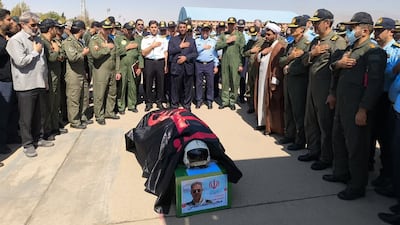
In July, Iran said it laid to rest Brig Gen Majid Kazemi, one of four aircrew members killed during the operation targeting Al Udeid in Qatar.
His remains were identified through DNA testing before being returned home, state media reported. Iran said he had been flying back to Iran after a “successful” attack on Al Udeid when his aircraft was shot down.
Mr Bagherzadeh also accused Kuwait of taking a similar approach over what he described as the fate of four Iranians captured by Kuwait, calling for the issue to be addressed.
The dispute comes amid heightened regional tensions and diplomatic efforts to reduce hostilities and resolve outstanding issues involving Iran and Gulf states. Qatar says diplomatic efforts to reduce tensions are continuing.
Iran has faced longstanding international criticism over arbitrary detention, including of foreign and dual nationals, which critics say Tehran has repeatedly used as leverage in negotiations with other governments.
The current conflict began on February 28, when the US and Israel launched a co-ordinated military campaign against Iran.
Washington said the operation targeted Iran’s nuclear and ballistic-missile capabilities and sought to reduce what it described as the threat posed by Tehran.
Iran’s supreme leader Ayatollah Ali Khamenei was killed in the opening strikes, along with other senior officials.
Iran responded with missile and drone attacks against Israel and US military positions across the Gulf and wider Middle East.
Tehran also moved to close or severely restrict traffic through the Strait of Hormuz, one of the world’s most important energy chokepoints.
The strait carries a significant share of global oil and LNG shipments, making any disruption an immediate international economic concern.

