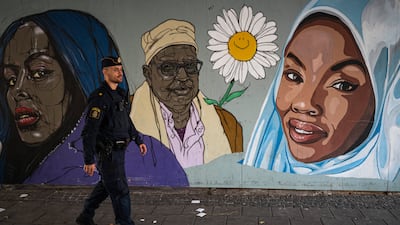

Sweden is offering residents born abroad who have the right to live in the country $37,000 to return to their countries, as part of a crackdown on migration.
The Scandinavian nation was once seen as the most welcoming to asylum seekers and took in 163,000 refugees in 2015, the second-highest per capita in Europe, but by last year that number had fallen by 96 per cent.
Migration is set to be a central issue in Sunday’s general election, and Prime Minister Ulf Kristersson's centre-right coalition is hoping its tough stance will see off a challenge from the centre-left opposition, headed by the Social Democrats.

“Improving re-migration is high on my government's agenda,” said Mr Kristersson, the leader of the Moderate Party, whose government has given the scheme a budget of $135.6 million.
The return scheme is strongly supported by the Sweden Democrats, a far-right party that is outside the government but backs it in parliament.
The party has been paying for adverts on buses that read: “Do you miss Mogadishu? The remigration grant will help you get home.” The government has also publicised the programme in multiple languages on its websites.
So far this year, 171 people have taken up the offer of cash to leave and the Sweden Democrats want to extend the offer to immigrants with Swedish citizenship, if they agree to renounce it.
The backlash against migration has in part been fuelled by gang warfare between criminals from migrant families, in particular Kurds. This has taken Sweden from being one of Europe’s safest countries to having one of its highest murder rates.

Elena Ibrahim, 42, who fled her ex-husband and religious oppression eight years ago in Sudan, says she won’t take up the offer.
“I want freedom, to be able to work and live a good life,” said Ms Ibrahim, who has remarried and works as an artist. “I will not go back.”
Mahmoud Khalfi, imam at the Stockholm Mosque, which is Sweden's largest, said the scheme and anti-immigrant rhetoric were divisive and caused anxiety among the country’s Muslim population.
Those who would have opportunities if they left – the highly educated, such as doctors or professors – can go to “London or Dubai”.
“But those with less education have no choice, they can't leave,” he said. He added that the policy “doesn't solve any problem”, and that “even if a few thousand leave, it has made it worse for those who have to stay”.
Sweden has also started tightening other rules for immigrants, including no longer awarding permanent residence permits and making immigrants reapply for them after three years. But the dramatic tightening of Sweden's migration policy has sparked concern in a healthcare sector that is ever more dependent on immigrants.

Around a third of specialist doctors and 53 per cent of nursing assistants were born abroad, according to official statistics.
Davood Javid explained that three-quarters of the 20 doctors working at the cardiology unit of the NU Hospital Group in the southern city of Trollhattan, where he is a senior specialist, were born abroad.
Originally from Iran, Dr Javid first arrived in Sweden in the 1980s. He said he and his colleagues all felt the change. “The tone has hardened in Sweden, and the debate has become highly polarised,” he said.
He started speaking out publicly after his nephew's two daughters, aged 21 and 24, were deported, having lived in Sweden for eight years while studying to become nurses.
The case received national attention as an illustration of what became known as “teenage deportations”, whereby people who came to Sweden as minors with their parents are deported as adults because they cannot meet the income requirements.
Sweden Democrats leader Jimmie Akesson said the tough stance on migration was in part due to the demands placed on the welfare system.
“What people often forget in that discussion is that those who immigrate to Sweden also have needs when it comes to welfare, health care and social care,” he said. “Statistically, they often have greater needs than those born in the country.”

