


It had been 20 years since Omid Walizadeh, a DJ inspired by Iranian music from his childhood in 1970s Tehran, had played in Paris. On Friday he returned to the French capital as hundreds of Parisians, mostly of Iranian origin, gathered to celebrate Nowruz – popularly known as the Persian New Year – in a spirit of hope despite their anguish over the escalating Iran war.
Two decades ago, Mr Walizadeh was a figure on the Los Angeles underground hip-hop scene, but he has since shifted to remixes of Persian and Middle Eastern music.
“[People] want to celebrate Nowruz. It's in our blood,” he told The National before a late-night set at the Cabaret Sauvage venue in the north of Paris. “No matter what, you have got to feel hope.”
'Sign of life'
Nowruz, which is celebrated from Afghanistan to Albania, marks both the new year and the spring equinox. It symbolises renewal – the victory of spring over winter and of life over death – explained Iranian-born activist Darya Djavahery-Farsi.
-
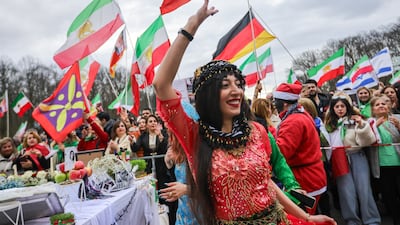
People gather to celebrate Nowruz, the Persian new year, in Berlin. Getty Images -
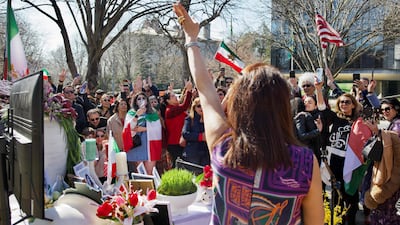
Iranian residents living in Washington, DC, gather outside the former Embassy of Iran to mark the Persian New Year. AFP -
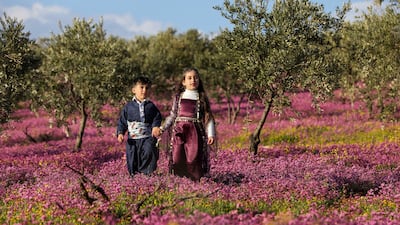
Syrian Kurd children hold each other's hands as they prepare to celebrate the spring festival of Nowruz, in Afrin, Syria. Reuters -
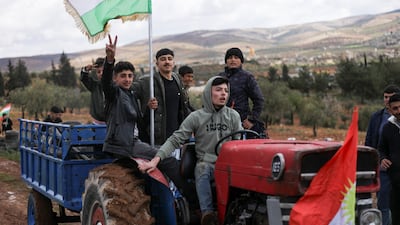
Syrian Kurds prepare to celebrate the spring festival of Nowruz, in Afrin, Syria. Reuters -
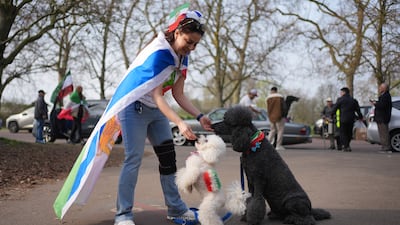
Tannaz Zadeh and her dogs join people outside the Iranian Embassy in London to celebrate the Persian New Year. PA -
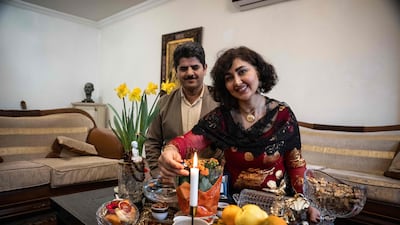
Former Kurdish fighter Saad Qazi and his wife Parang Jahani pose with their traditional costumes during the Nowruz celebrations in Erbil, the capital of Iraq's autonomous Kurdish region. AFP -
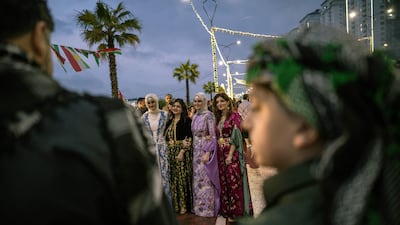
People celebrate Nowruz while wearing traditional costumes in Sulaimaniyah of Iraq's autonomous Kurdish region. AFP -
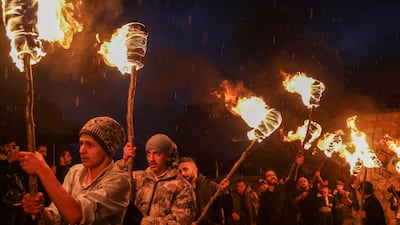
Iraqi Kurds march with torches during a procession to celebrate the Nowruz New Year festival in the town of Akre, about 100km north of Arbil. AFP -
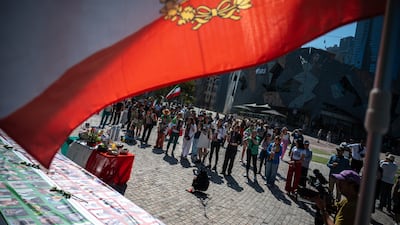
Melbourne's Iranian-Australian community gathers to mark Nowruz, the Persian New Year, during a community gathering at Federation Square in Melbourne, Australia. EPA


“Nowruz is not a holiday celebrated only in Iran,” she said. “Many people in struggle, including Kurds and Uighurs, celebrate it … To do so is also to give a sign of life.”
Ms Djavahery-Farsi was representing charities raising funds for refugees at the event organised by Mahalla, a platform that promotes music from South-West Asia and North Africa. Her charity, Panah, was launched to help Iranians fleeing state repression after the 2022 Women, Life, Freedom movement.
“Nowruz should be understood as a moment of celebration and of struggle,” she said. “The fire festival on Tuesday evening was celebrated in Tehran. People jumped over fire despite the bombs,” she said, referring to the Nowruz tradition of leaping over bonfires. “People still cherish life.”
Mixed feelings
People from across the region coming together in solidarity is an important aspect of Nowruz, said Armin Messager, from the Nouvel Horizon charity, in a short speech halfway through the festivities. “It's very difficult to dance tonight because so many people are suffering in the Middle East. Yet … we are fighting for a happier life, so if we're not dancing tonight, what's the point of fighting?”
Iran and the region regularly make headlines for the devastation that wars bring and rarely for joyful reasons. Music performance is one of the best ways to change that narrative, said Luna Ersahin, a half-Danish, half-Kurdish singer whose family comes from Corum in northern Turkey. The city is a historic bastion of Kurdish Alevis, a community whose early 20th century rebellions against state authorities were suppressed with violence. Ms Ersahin's band, AySay, combines Anatolian folk and Nordic electro-rock music.

“As someone who was born and raised in Denmark, I understand that I haven't been near these tragedies, but they're still from my blood, and I feel it,” Ms Ersahin told The National.
“But if we don't feel gratitude for what we do have, I don't think anything makes sense. This way, we create our own sense of belonging, our own communities, to be able to stand stronger against violence and degradation and dehumanisation.”

