
Europe’s security leadership was relieved by the tone from US representatives during the Munich Security Conference, but the region is not ready to concede to US demands to align on China, Benedikt Franke, CEO of the conference, told The National.
Mr Franke said the three-day meeting, which wrapped up on Sunday, provided a platform to address the most difficult conflicts and issues facing the foreign policy community.
US Secretary of State Marco Rubio delivered a closely watched speech, describing America as a “child of Europe” and speaking of a “new western century”.

Chinese Foreign Minister Wang Yi followed, warning Europe that in talks to end the Ukraine war, “if it is not on the table, it is on the menu”.
Mr Franke said Europeans are still trying to adjust to the shift in American strategy since President Donald Trump's installation last year.
He noted that ties with China are under scrutiny from the US, and German Chancellor Friedrich Merz said the growing rift stems from Washington’s rivalry with Beijing.
“I think a lot of people were feeling that the Chinese were profiting from the increasing rift in transatlantic relations, that there was a turning the head away from the US and looking for other strong partners and markets, and that China was one of the obvious choices,” he said.
“I think you see Germany having a new willingness to address these dependencies and to make itself less dependent on China. And that, in a way, frames the overall, you know, view of China in geopolitics. I think at the moment, Europe is not ready to choose.
“We want good partners in the US. We want good partners in China, and we would like both of them to be constructive players in global governance.”
Last year, US vice president JD Vance shocked those gathered in Munich with blunt criticisms, including that Europe was threatened from within. This year, Mr Rubio delivered a laundry list of demands, covering boosting defence, securing supply chains, reversing deindustrialisation, and preventing “civilisational erasure”.
Mr Franke says European leaders viewed the US call to join the same civilisational team as a point of contention. “That's fine if they need that story to keep engaging with us in Europe but we are a diverse continent,” he said. “We are diverse people and will not make up a fake narrative just to please anyone.”
Asked whether Mr Trump should visit next year's edition, Mr Franke said the invitation was always there. “We keep inviting US presidents to this conference,” he said. “It's the Americans decision who they send. Everyone will be welcome.”
Regional Nato
Looking beyond Europe for new relationships is one of the post-Vance themes stressed by national leaders. The Munich Security Conference operated a year-long Middle East Consultation Group, which produced a report highlighting discussions on different models for peaceful coexistence in the context of the October 7 attacks and the Gaza war.
-

The National's Editor-in-Chief Mina Al-Oraibi and Syrian Foreign Minister Asaad Al Shibani at a panel discussion on Syria's post-revolution future during the 62nd Munich Security Conference. The National -
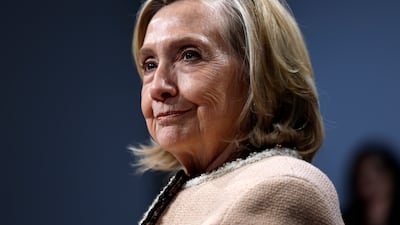
Hillary Clinton moderates the panel discussion 'Girls Just Want to Have Fundamental Rights: Fighting the Global Pushback' at the conference. Getty images -
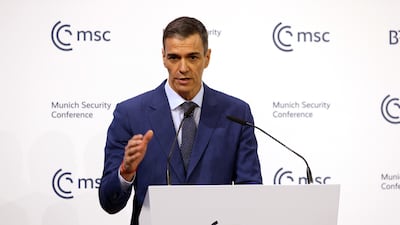
Pedro Sanchez, Spain's Prime Minister. Bloomberg -
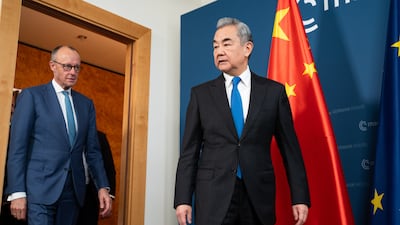
Friedrich Merz, the Chancellor of Germany, left, welcomes Chinese Foreign Minister Wang Yi. EPA -
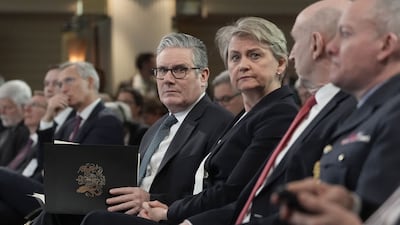
From left, Britain's Prime Minister Keir Starmer, Foreign Secretary Yvette Cooper and Defence Secretary John Healey. AFP -
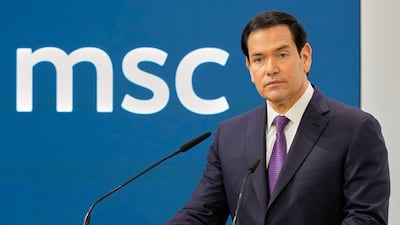
US Secretary of State Marco Rubio speaks. AFP -
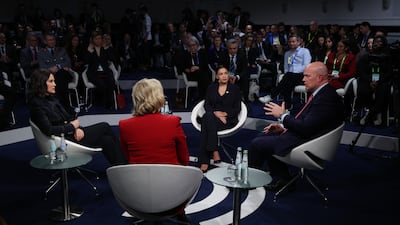
Michigan Governor Gretchen Whitmer, left, and Alexandria Ocasio-Cortez, centre, US representative for New York's 14th congressional district, listen as US ambassador to Nato Matthew Whitaker speaks during a townhall panel on US foreign policy. Getty Images -
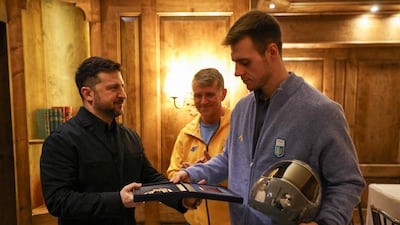
Ukrainian President Volodymyr Zelenskyy, left, awards Ukrainian skeleton athlete Vladyslav Heraskevych a medal as they meet in Munich. AFP -
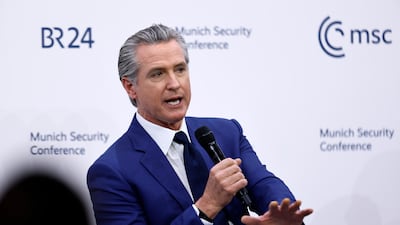
Gavin Newsom, Governor of California, attends the panel discussion 'Playing With Fire: The Need for Decisive Climate Action'. Getty Images -
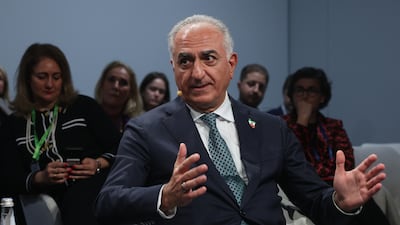
Reza Pahlavi, the exiled son of Iran's last monarch, speaks with international journalist Christiane Amanpour during a panel discussion on the future of Iran. Getty images -
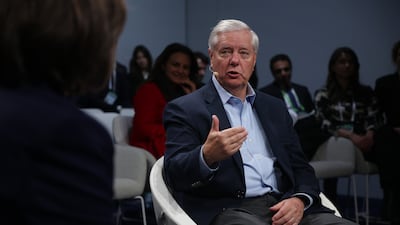
US Senator Lindsey Graham speaks during the panel discussion on the future of Iran. Getty Images -
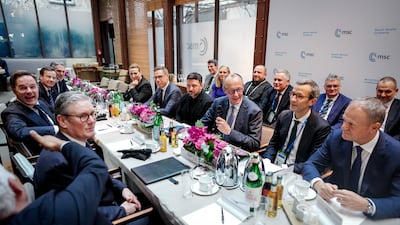
Clockwise from left, Prime Minister Keir Starmer of Britain, Nato Secretary General Mark Rutte, Prime Minister Ulf Kristersson of Sweden, Dick Schoof, Prime Minister of the Netherlands, Prime Minister Mette Frederiksen of Finland, Finnish President Alexander Stubb, Ukrainian President Volodymyr Zelenskyy, German Chancellor Friedrich Merz, Germany's political director in the Ministry of Foreign Affairs Gunter Sautter and Polish Prime Minister Donald Tusk attend a 'Berlin format' meeting at the Munich Security Conference. Getty Images -
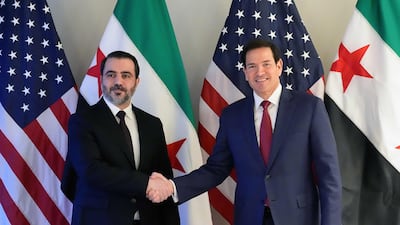
US Secretary of State Marco Rubio, right, and Syrian Foreign Minister Asaad Al Shibani. AFP -
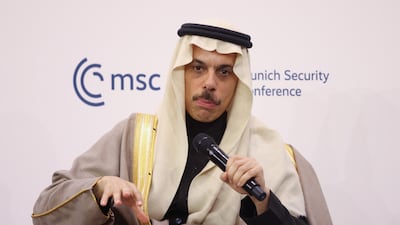
Saudi Foreign Minister Prince Faisal bin Farhan takes part in a discussion. Bloomberg -
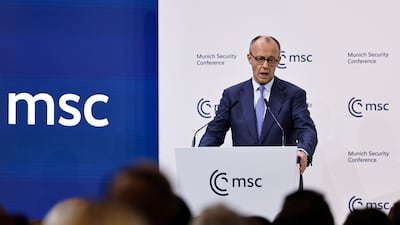
German Chancellor Friedrich Merz. Getty Images -
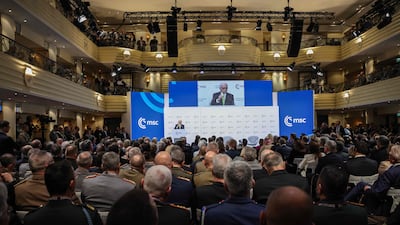
Munich Security Conference chairman Wolfgang Ischinger gives a speech. AFP -
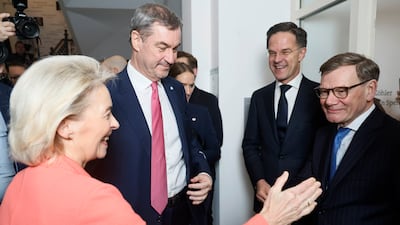
From left: President of the European Commission Ursula von der Leyen, Bavaria's Minister President Markus Soeder, Secretary General of Nato Mark Rutte and Germany's Foreign Minister Johann Wadephul. Getty Images


The work will move to a new phase in a different format, Mr Franke revealed. “It's much more about the architecture, moving towards an architecture for peace and of peace in the region, and coming up in an ideal world, there would be a Nato like organisation within and around the Middle East,” he said. “Those countries would co-operate bilaterally and multilaterally on each other's security.”
The conference also saw US representative roll out ideas on Mr Trump's Board of Peace for Gaza, which the Europeans have largely boycotted. The implications for the future of the UN was not lost on the leaders.
“We Europeans haven't come up with our own plan, and that we or has the UN, nor has the UN,” he said. “It breaks my heart that the UN is so invisible. If the Gaza peace board further reduces the significance of the UN, then I think that is a huge problem we need to talk about, and it was talked about here on our stages.”

