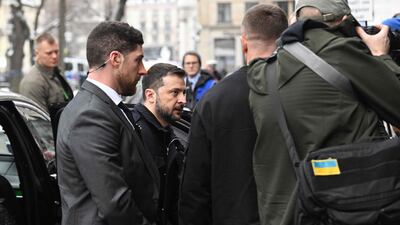
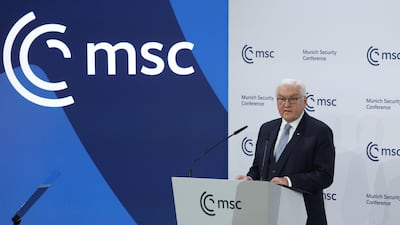
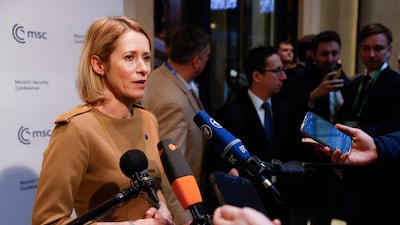
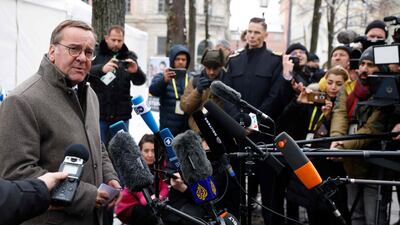
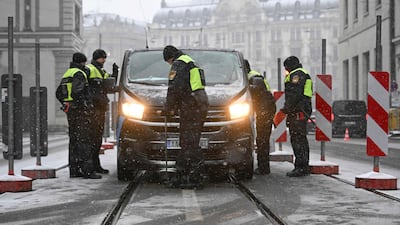
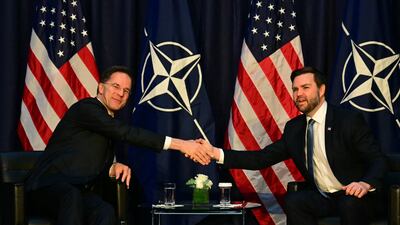
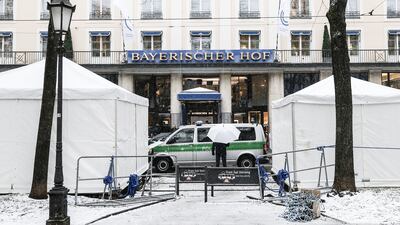
German Chancellor Olaf Scholz challenged the US to resist the temptation to meddle in next week's elections, in a speech on Saturday that sought to pick up the pieces from a broadside against Europe from US Vice President JD Vance.
Not only did Mr Vance use the Munich Security Conference to condemn European mass migration, he also met Alice Weidel, co-leader of the far-right and anti-immigrant Alternative for Germany party, nine days before a German election. US President Donald Trump called the speech brilliant and said he agreed with it even as it was reverberating across the European leadership.
“We will not accept outsiders interfering in our democracy, in our elections and in the democratic opinion-forming process in favour of this party,” Mr Scholz said on Saturday in Munich. “That’s just not done, certainly not amongst friends and allies. We resolutely reject this.
Watch: US Vice President JD Vance warns against silencing dissent
“Where our democracy goes from here is for us to decide.”
Mr Scholz and Ukrainian President Volodymyr Zelenskyy led the list of speakers on the second day of the annual security forum. “There will only be peace if Ukraine's sovereignty is secured,” Mr Scholz said. “A dictated peace will therefore never find our support.
“We will also not accept any solution that leads to a decoupling of European and American security. Only one person would benefit from this: President Putin.”
Mr Zelenskyy hit out at Mr Trump's trust in talks with Russian President Vladimir Putin, predicting a betrayal would lead to the US leader standing in Red Square in May to mark the 80th anniversary of the end of the Second World War. Mr Zelenskyy said not allowing his country into the Brussels-headquartered Nato was a first-order mistake.
“If not Brussels, then Moscow, that's your decision,” he said. “I will not take Nato membership off the table but right now the most powerful member of Nato is Putin because he is able to veto at his whim.”
Mr Zelenskyy wants a seat at the table, a demand that is backed up by the Europeans. Later this month marks the third anniversary of the war caused by Russia's invasion of Ukraine.
Mr Zelenskyy said that his country wants security guarantees before any talks with Russia. Meeting Mr Vance in Munich, Mr Zelenskyy also said he would only meet Mr Putin after a common plan is negotiated with Mr Trump.
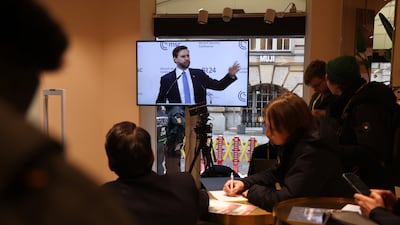
Mr Vance's broadside against European allies over the rise of immigration and the lack of space for extremist politicians questioned their democracies and raised questions about Washington's commitment to the region's defence.
“The threat that I worry the most about vis-a-vis Europe is not Russia. It's not China. It's not any other external actor,” Mr Vance said on Friday. “What I worry about is the threat from within – the retreat of Europe from some of its most fundamental values, values shared with the United States of America.”
The future course of Ukraine's war against Russian's invasion has preoccupied delegates at the conference days after Mr Trump spoke by phone with Mr Putin to set up peace talks. The two leaders plan to meet to negotiate a peace deal in the months ahead.
Facing a general election next week that is likely to see a new chancellor take over, Mr Scholz added higher defence spending in Germany and Europe is necessary and the country's debt rules need an overhaul for that. “Anyone who claims that this can be saved by making a small cut here or there from the current budget is not telling the citizens the truth.”
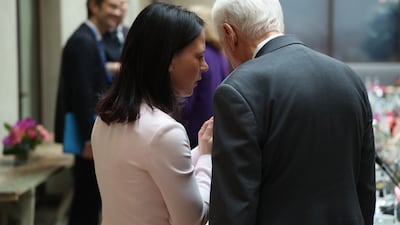
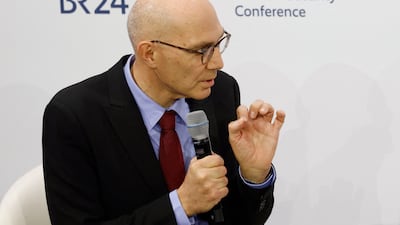
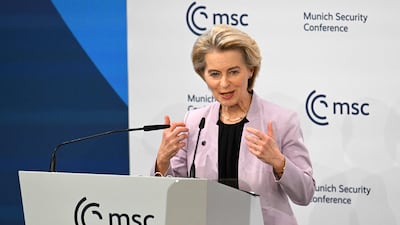
Munich Security Conference – in pictures
Key facilities
- Olympic-size swimming pool with a split bulkhead for multi-use configurations, including water polo and 50m/25m training lanes
- Premier League-standard football pitch
- 400m Olympic running track
- NBA-spec basketball court with auditorium
- 600-seat auditorium
- Spaces for historical and cultural exploration
- An elevated football field that doubles as a helipad
- Specialist robotics and science laboratories
- AR and VR-enabled learning centres
- Disruption Lab and Research Centre for developing entrepreneurial skills
What is the definition of an SME?
SMEs in the UAE are defined by the number of employees, annual turnover and sector. For example, a “small company” in the services industry has six to 50 employees with a turnover of more than Dh2 million up to Dh20m, while in the manufacturing industry the requirements are 10 to 100 employees with a turnover of more than Dh3m up to Dh50m, according to Dubai SME, an agency of the Department of Economic Development.
A “medium-sized company” can either have staff of 51 to 200 employees or 101 to 250 employees, and a turnover less than or equal to Dh200m or Dh250m, again depending on whether the business is in the trading, manufacturing or services sectors.
Venom
Director: Ruben Fleischer
Cast: Tom Hardy, Michelle Williams, Riz Ahmed
Rating: 1.5/5
Evacuations to France hit by controversy
- Over 500 Gazans have been evacuated to France since November 2023
- Evacuations were paused after a student already in France posted anti-Semitic content and was subsequently expelled to Qatar
- The Foreign Ministry launched a review to determine how authorities failed to detect the posts before her entry
- Artists and researchers fall under a programme called Pause that began in 2017
- It has benefited more than 700 people from 44 countries, including Syria, Turkey, Iran, and Sudan
- Since the start of the Gaza war, it has also included 45 Gazan beneficiaries
- Unlike students, they are allowed to bring their families to France
ALRAWABI%20SCHOOL%20FOR%20GIRLS
%3Cp%3ECreator%3A%20Tima%20Shomali%3C%2Fp%3E%0A%3Cp%3EStarring%3A%C2%A0Tara%20Abboud%2C%C2%A0Kira%20Yaghnam%2C%20Tara%20Atalla%3C%2Fp%3E%0A%3Cp%3ERating%3A%204%2F5%3C%2Fp%3E%0A
Ten tax points to be aware of in 2026
1. Domestic VAT refund amendments: request your refund within five years
If a business does not apply for the refund on time, they lose their credit.
2. E-invoicing in the UAE
Businesses should continue preparing for the implementation of e-invoicing in the UAE, with 2026 a preparation and transition period ahead of phased mandatory adoption.
3. More tax audits
Tax authorities are increasingly using data already available across multiple filings to identify audit risks.
4. More beneficial VAT and excise tax penalty regime
Tax disputes are expected to become more frequent and more structured, with clearer administrative objection and appeal processes. The UAE has adopted a new penalty regime for VAT and excise disputes, which now mirrors the penalty regime for corporate tax.
5. Greater emphasis on statutory audit
There is a greater need for the accuracy of financial statements. The International Financial Reporting Standards standards need to be strictly adhered to and, as a result, the quality of the audits will need to increase.
6. Further transfer pricing enforcement
Transfer pricing enforcement, which refers to the practice of establishing prices for internal transactions between related entities, is expected to broaden in scope. The UAE will shortly open the possibility to negotiate advance pricing agreements, or essentially rulings for transfer pricing purposes.
7. Limited time periods for audits
Recent amendments also introduce a default five-year limitation period for tax audits and assessments, subject to specific statutory exceptions. While the standard audit and assessment period is five years, this may be extended to up to 15 years in cases involving fraud or tax evasion.
8. Pillar 2 implementation
Many multinational groups will begin to feel the practical effect of the Domestic Minimum Top-Up Tax (DMTT), the UAE's implementation of the OECD’s global minimum tax under Pillar 2. While the rules apply for financial years starting on or after January 1, 2025, it is 2026 that marks the transition to an operational phase.
9. Reduced compliance obligations for imported goods and services
Businesses that apply the reverse-charge mechanism for VAT purposes in the UAE may benefit from reduced compliance obligations.
10. Substance and CbC reporting focus
Tax authorities are expected to continue strengthening the enforcement of economic substance and Country-by-Country (CbC) reporting frameworks. In the UAE, these regimes are increasingly being used as risk-assessment tools, providing tax authorities with a comprehensive view of multinational groups’ global footprints and enabling them to assess whether profits are aligned with real economic activity.
Contributed by Thomas Vanhee and Hend Rashwan, Aurifer
Dr Afridi's warning signs of digital addiction
Spending an excessive amount of time on the phone.
Neglecting personal, social, or academic responsibilities.
Losing interest in other activities or hobbies that were once enjoyed.
Having withdrawal symptoms like feeling anxious, restless, or upset when the technology is not available.
Experiencing sleep disturbances or changes in sleep patterns.
What are the guidelines?
Under 18 months: Avoid screen time altogether, except for video chatting with family.
Aged 18-24 months: If screens are introduced, it should be high-quality content watched with a caregiver to help the child understand what they are seeing.
Aged 2-5 years: Limit to one-hour per day of high-quality programming, with co-viewing whenever possible.
Aged 6-12 years: Set consistent limits on screen time to ensure it does not interfere with sleep, physical activity, or social interactions.
Teenagers: Encourage a balanced approach – screens should not replace sleep, exercise, or face-to-face socialisation.
Source: American Paediatric Association
((Disclaimer))
The Liechtensteinische Landesbank AG (“Bank”) assumes no liability or guarantee for the accuracy, balance, or completeness of the information in this publication. The content may change at any time due to given circumstances, and the Liechtensteinische Landesbank AG is under no obligation to update information once it has been published. This publication is intended for information purposes only and does not constitute an offer, a recommendation or an invitation by, or on behalf of, Liechtensteinische Landesbank (DIFC Branch), Liechtensteinische Landesbank AG, or any of its group affiliates to make any investments or obtain services. This publication has not been reviewed, disapproved or approved by the United Arab Emirates (“UAE”) Central Bank, Dubai Financial Services Authority (“DFSA”) or any other relevant licensing authorities in the UAE. It may not be relied upon by or distributed to retail clients. Liechtensteinische Landesbank (DIFC Branch) is regulated by the DFSA and this advertorial is intended for Professional Clients (as defined by the DFSA) who have sufficient financial experience and understanding of financial markets, products or transactions and any associated risks.