


Europe has declared itself “back in business” in the space race, after a two-year launcher crisis that sent some manufacturers fleeing to Elon Musk's SpaceX.
The new Ariane 6 rocket made its maiden flight from French Guiana late on Tuesday, taking a fleet of satellites into Earth orbit.
Although it suffered a glitch that meant a mid-air restart did not work as planned, the launch was hailed as a milestone by European space bosses.
“Europe is back. This powers Europe back into space,” said Josef Aschbacher, the director general of the European Space Agency, who said a second launch is planned for later this year.
ESA's Ariane 6 rocket takes off – in pictures
-
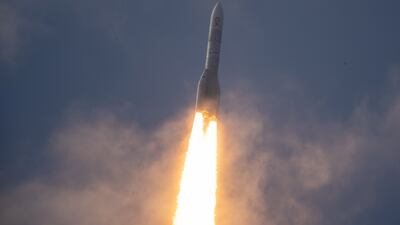
Europe's Ariane 6 rocket takes off, in Kourou, French Guiana. Reuters -
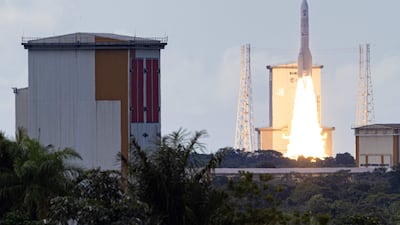
The European Space Agency satellite launcher successfully blasted off for the first time on Tuesday, releasing satellites into orbit and restoring the continent's independent access to space. AFP -
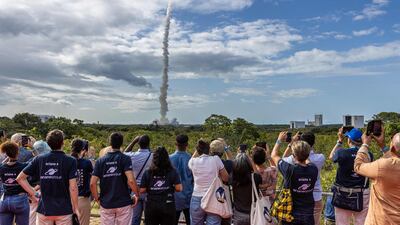
Spectators watch as the Ariane 6 rocket takes off. AFP -

Engineers and managers monitor the parameters of the Ariane 6 launcher in The Jupiter Room at The Guiana Space Centre. AFP -
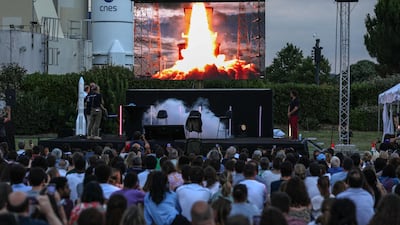
A crowd watches the launch of the Ariane 6 rocket from Kourou in French Guiana, known as Europe's Spaceport. AFP -
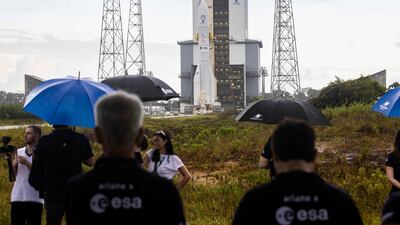
Members of the media gather as Ariane 6 moves to the launch pad in Kourou. AFP -

The Ariane 6 rocket prior to its maiden launch. AFP


Europe has lacked options to launch its own spacecraft since ties were severed with Russia in 2022, when it invaded Ukraine.
The older Ariane 5 launcher flew its last mission last year, and the ESA has struggled to get the next generation of rockets off the ground.
Originally due to have its maiden flight in 2020, Ariane 6 was delayed by several years, partly due to the Covid-19 pandemic.
Musk competition
Only last month, the weather-monitoring service Eumetsat lost patience with the Ariane programme and hired SpaceX to launch its next satellite.
Although the ESA has also turned to Mr Musk's Falcon 9 rockets, Mr Aschbacher lashed out at the meteorologists for a decision he called “difficult to understand”.
“It was surprising that the decision was made before the launch has occurred,” he said after the Ariane 6 mission took off on Tuesday.

Mr Musk's SpaceX is the dominant player in the launch market and its superheavy rocket Starship is intended to one day carry people to the Moon or Mars.
The reusable Falcon 9 takes off dozens of times a year and upended a market once dominated by the defence industry, leaving Europe battling to catch up.
Philippe Baptiste, the president of the French space agency, CNES, which built the Ariane 6 launch facilities, said he stood by his view that using SpaceX for the weather satellite was a sign of “naivety”.
“We are talking about Europe's sovereignty, European access to space. You are not a space player if you don't have access to space,” he said.
“We are back in space, we are back in business.”

The three-stage Ariane 6 rocket is a joint venture between the pan-European Airbus and France's Safran, with parts made by hundreds of European companies.
France, Germany and Italy last year agreed to boost funding for Ariane and its sister launcher Vega C, which handles smaller payloads, amid shortfalls of more than €300 million ($324.7 million).
Tuesday's Ariane 6 flight, known as VA262, took off from Kourou in French Guiana at 4pm local time and released its first set of satellites an hour later.
The launch was declared a success although ESA reported an “unexpected result” in tests of the rocket's on-board technology.
Ariane 6 is designed to be able to restart its engine, known as Vinci, while in space, but this did not happen after a power unit shut down.

“We don't know why it stopped,” said Martin Sion, the chief executive of Arianegroup, who said the launch itself had been the main objective. “All the rest of the mission was according to plan.”
The next launch is planned for December. Arianespace says it already has an order book for a “wide range of missions into multiple orbits”.
The space push comes with French and EU officials eager to carve out a defence and industrial role for Europe that is independent of the US and China.
It also comes with European officials openly discussing the possibility of Donald Trump returning as US president, potentially putting relations under strain.

