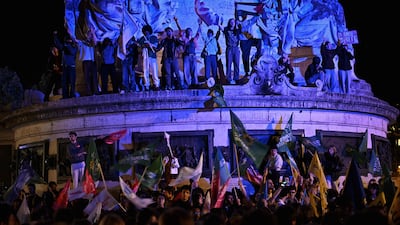
A demonstration against the far right and racism in Place de la Republique in central Paris. Bloomberg

Far-right surge to ease European pressure on Israel after Macron weakened


Sunniva Rose
  • English
  • Arabic

Far-right advances in the recent European election are set to strengthen relations with the Israeli government of Prime Minister Benjamin Netanyahu while a weaker France may reduce further the EU's diplomatic footprint in the Middle East, observers have said.

Centrist President Emmanuel Macron had attempted a delicate balancing act of both showing solidarity with Israel while also engaging with Arab partners over measures to guarantee Palestinian rights in the region.

Few were convinced such efforts did much to influence Israeli or Palestinian leadership, but Mr Macron appeared to be one of the European leaders most willing to engage political capital in trying to solve the conflict.

With Mr Macron now busy with snap elections scheduled for June 30, he is unlikely to be as involved as before in discussions in Brussels, including EU foreign policy.

“France now has other things to worry about than the Middle East conflict, and the far right is a step away from power. That might change the balance within Europe,” said Dan Sobovitz, an Israeli Brussels-based communications specialist.

Speaking to reporters on the sidelines of a G7 leaders summit in Italy, EU Council president Charles Michel said the impact of the European election results “must not be underestimated”.

“We have a need at the European Council to clarify what are the orientations we have in the future,” Mr Michel said, responding to a question from The National. Strategic orientations of the EU are determined by the council.

“International law, international humanitarian law, no double standards – these are fundamental principles, and I'm confident that leaders will stick to these principles.

“If we are sincere – and we are sincere – if we believe in international law, if we think that it must prevail, then we must act in consistency with our convictions.”

Political turmoil

The Rassemblement National, a French far-right party, took more than 30 per cent of the vote, way ahead of Mr Macron's centrist group at 14.6 per cent.

Mr Macron then announced snap elections for June 30 in a shock move widely viewed as a gamble to destabilise the RN, causing an open crisis within right-wing party Les Republicains.

Its president Eric Ciotti has refused to accept his exclusion from the party after calls to resign following his decision to form an alliance with the RN – a move that mainstream parties have always avoided for historic reasons linked to its anti-Semitic past.

In a press conference, Mr Macron said he wanted to avoid the RN's Marine Le Pen becoming president in 2027. He pushed back against suggestions he may step down from power should his group lose again in the legislative election at the end of the month.

“I hope that when the time comes, men and women of goodwill – who will have been able to say no to the extremes – will come together, will put themselves in a position to build a shared, sincere project that is useful to the country,” Mr Macron said.

Should the RN win again, Mr Macron will be under pressure to appoint a new prime minister either from the party or favourable to it.

French President Emmanuel Macron holds a press conference about his decision to dissolve parliament, in Paris. EPA

This may open the door to warmer relations with the Israeli government due to RN president Jordan Bardella's pro-Israel and anti-Islam views.

The proximity between the current Israeli government and the RN is not ideological, said Mr Sobovitz, a former adviser to European Commission vice president Maros Sefcovic.

Rather, “they perceive each other as having a common enemy. Islamophobia brings them together”, Mr Sobovitz told The National.

Relations have been heating up in the past years as the party attempts to break with the legacy of its founder, Holocaust denier Jean-Marie Le Pen.

Other EU countries with populist parties in power, such as Hungary and recently Poland, have also sought to strengthen ties with Israel.

Israeli attacks

Senior Israeli officials took to social media to celebrate the electoral setbacks of European leaders viewed as pro-Palestinian such as Belgian Prime Minister Alexander De Croo, a liberal, and his Spanish counterpart Pedro Sanchez, a socialist.

Israeli Diaspora Minister Amichai Chikli appeared to make fun of Mr De Croo's tears after he resigned following the European election, writing on X: “Apparently supporting terror doesn’t resonate with the Belgian people.”

Foreign Minister Israel Katz published photos of Mr Sanchez with a broken egg trickling down his face, claiming he had faced a “resounding defeat”.

Socialists in Spain came second in Sunday's vote, behind the conservatives, a notable setback compared to their 2019 landslide victory.

There was no official response to the posts, though Spain's Foreign Minister Jose Manuel Albares has in the past said similar attacks were “despicable” and repeated Spain's condemnation of Hamas.

They have caused shock among some for their breach of diplomatic protocol.

“It's a terrible lack of professionalism. It only isolates Israel further,” said Mr Sobovitz.

The far right's electoral gains across Europe are expected to translate into a stronger opposition role in the European Parliament, where conservatives and socialists remain the strongest blocs.

Parliament approves laws and top jobs and can also issue non-binding resolutions on international affairs that signal how the continent positions itself on certain issues, but cannot put forward legislation.

That can only be done at the level of the European Commission and the European council, where heads of state meet.

Despite some EU leaders calling for sanctions against Israel over possible human rights offences in Gaza, the council has signalled it is not interested due to a lack of consensus.

Many countries, including Germany, Hungary and the Czech Republic, reject language that may seem critical of Israel.

European Parliament election results – in pictures

  • Students shout holding a sign reading "no room for fascists" during a protest against the rise of far right parties in Paris, a day after the European Parliament elections. AFP
    Students shout holding a sign reading "no room for fascists" during a protest against the rise of far right parties in Paris, a day after the European Parliament elections. AFP
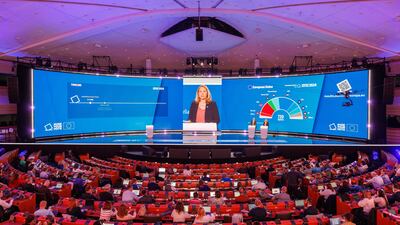
  • European Parliament representative Delphine Collard presents the election results in Brussels. EPA
    European Parliament representative Delphine Collard presents the election results in Brussels. EPA
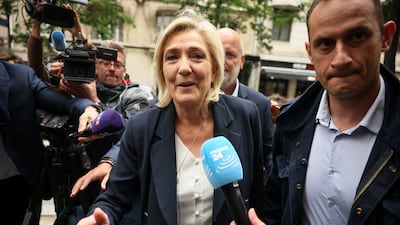
  • French far-right leader Marine Le Pen arrives at the National Rally party headquarters in Paris. AP
    French far-right leader Marine Le Pen arrives at the National Rally party headquarters in Paris. AP
  • European Commission President Ursula von der Leyen receives flowers from Christian Democratic Union party leader Friedrich Merz in Berlin. AP
    European Commission President Ursula von der Leyen receives flowers from Christian Democratic Union party leader Friedrich Merz in Berlin. AP
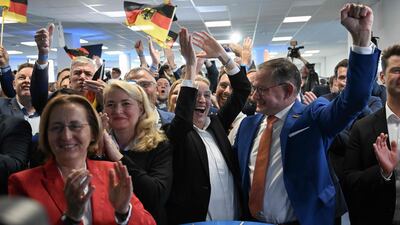
  • Members of the Alternative for Germany (AfD) party cheer after first exit polls in Berlin. AFP
    Members of the Alternative for Germany (AfD) party cheer after first exit polls in Berlin. AFP
  • A protest on Republique square in central Paris against French far-right party Rassemblement National. AFP
    A protest on Republique square in central Paris against French far-right party Rassemblement National. AFP
  • German Chancellor Olaf Scholz arrives to attend a meeting with the leadership of his social democratic SPD party in Berlin. AFP
    German Chancellor Olaf Scholz arrives to attend a meeting with the leadership of his social democratic SPD party in Berlin. AFP
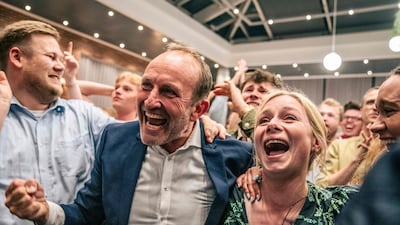
  • Sigrid Friis and Martin Lidegaard of the Social Liberal Party at an election party in Copenhagen, Denmark. AFP
    Sigrid Friis and Martin Lidegaard of the Social Liberal Party at an election party in Copenhagen, Denmark. AFP
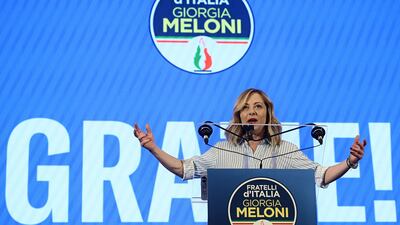
  • Italy's Prime Minister Giorgia Meloni, leader of the far-right party Brothers of Italy, speaks after the results in Rome. AFP
    Italy's Prime Minister Giorgia Meloni, leader of the far-right party Brothers of Italy, speaks after the results in Rome. AFP
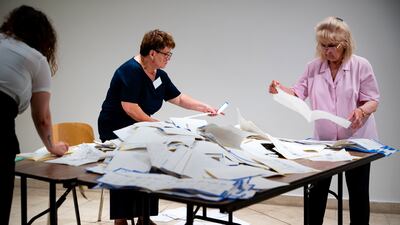
  • Election officials count the votes in the city of Gyor, north-western Hungary. EPA
    Election officials count the votes in the city of Gyor, north-western Hungary. EPA
  • France's President Emmanuel Macron calls a snap general election for June 30. AFP
    France's President Emmanuel Macron calls a snap general election for June 30. AFP

The likelihood of punitive measures in the near future has further decreased as Mr Sanchez, the lead pro-Palestinian voice in the EU, appears weakened by the European election.

According to rumours in Brussels, European Commission President Ursula von der Leyen and European Parliament chief Roberta Metsola are on track for second terms.

The German and Maltese politicians travelled together to Israel after the October 7 attacks in what was widely viewed as a strong show of support for the country.

The European Council's top job could possibly go to former Portuguese prime minister Antonio Costa and the top diplomat posting to Estonian Prime Minister Kaja Kallas.

Ms Kallas has gained prominence with her anti-Russia views but has stayed quiet on the Middle East.

The top diplomat job is a tough one, with EU countries often failing to show unity on foreign policy issues, including the Gaza war.

Outgoing foreign policy chief Josep Borrell has often put out statements in his own name condemning Israeli military action when consensus could not be achieved among the bloc's 27 members.

“Populism both in Israel and in Europe is further fuelling divisions. If both Israel and Palestine perceive the new high-representative as weak, they won't listen,” said Mr Sobovitz.


Company Profile

Name: Thndr
Started: 2019
Co-founders: Ahmad Hammouda and Seif Amr
Sector: FinTech
Headquarters: Egypt
UAE base: Hub71, Abu Dhabi
Current number of staff: More than 150
Funds raised: $22 million

Results
%3Cp%3E%3Cstrong%3EStage%203%3A%3C%2Fstrong%3E%3Cbr%3E1.%20Einer%20Rubio%20(COL)%20Movistar%20Team%20-%204h51%E2%80%9924%E2%80%9D%3Cbr%3E2.%20Remco%20Evenepoel%20(BEL)%20Soudal%20Quick-Step%20-%2014%22%3Cbr%3E3.%20Adam%20Yates%20(GBR)%20UAE%20Team%20Emirates%20-%2015%22%3Cbr%3E%3Cstrong%3EGeneral%20classifications%3A%3C%2Fstrong%3E%3Cbr%3E1.%20Remco%20Evenepoel%20(BEL)%20Soudal%20Quick-Step%3Cbr%3E2.%20Lucas%20Plapp%20(AUS)%20Ineos%20Grenaders)%20-%207%22%3Cbr%3E3.%20Pello%20Bilbao%20(ESP)%20Bahrain%20Victorious%20-%2011%22%3C%2Fp%3E%0A
WOMAN AND CHILD

Director: Saeed Roustaee

Starring: Parinaz Izadyar, Payman Maadi

Rating: 4/5

How will Gen Alpha invest?

Mark Chahwan, co-founder and chief executive of robo-advisory firm Sarwa, forecasts that Generation Alpha (born between 2010 and 2024) will start investing in their teenage years and therefore benefit from compound interest.

“Technology and education should be the main drivers to make this happen, whether it’s investing in a few clicks or their schools/parents stepping up their personal finance education skills,” he adds.

Mr Chahwan says younger generations have a higher capacity to take on risk, but for some their appetite can be more cautious because they are investing for the first time. “Schools still do not teach personal finance and stock market investing, so a lot of the learning journey can feel daunting and intimidating,” he says.

He advises millennials to not always start with an aggressive portfolio even if they can afford to take risks. “We always advise to work your way up to your risk capacity, that way you experience volatility and get used to it. Given the higher risk capacity for the younger generations, stocks are a favourite,” says Mr Chahwan.

Highlighting the role technology has played in encouraging millennials and Gen Z to invest, he says: “They were often excluded, but with lower account minimums ... a customer with $1,000 [Dh3,672] in their account has their money working for them just as hard as the portfolio of a high get-worth individual.”

Ten tax points to be aware of in 2026

1. Domestic VAT refund amendments: request your refund within five years

If a business does not apply for the refund on time, they lose their credit.

2. E-invoicing in the UAE

Businesses should continue preparing for the implementation of e-invoicing in the UAE, with 2026 a preparation and transition period ahead of phased mandatory adoption. 

3. More tax audits

Tax authorities are increasingly using data already available across multiple filings to identify audit risks. 

4. More beneficial VAT and excise tax penalty regime

Tax disputes are expected to become more frequent and more structured, with clearer administrative objection and appeal processes. The UAE has adopted a new penalty regime for VAT and excise disputes, which now mirrors the penalty regime for corporate tax.

5. Greater emphasis on statutory audit

There is a greater need for the accuracy of financial statements. The International Financial Reporting Standards standards need to be strictly adhered to and, as a result, the quality of the audits will need to increase.

6. Further transfer pricing enforcement

Transfer pricing enforcement, which refers to the practice of establishing prices for internal transactions between related entities, is expected to broaden in scope. The UAE will shortly open the possibility to negotiate advance pricing agreements, or essentially rulings for transfer pricing purposes. 

7. Limited time periods for audits

Recent amendments also introduce a default five-year limitation period for tax audits and assessments, subject to specific statutory exceptions. While the standard audit and assessment period is five years, this may be extended to up to 15 years in cases involving fraud or tax evasion. 

8. Pillar 2 implementation 

Many multinational groups will begin to feel the practical effect of the Domestic Minimum Top-Up Tax (DMTT), the UAE's implementation of the OECD’s global minimum tax under Pillar 2. While the rules apply for financial years starting on or after January 1, 2025, it is 2026 that marks the transition to an operational phase.

9. Reduced compliance obligations for imported goods and services

Businesses that apply the reverse-charge mechanism for VAT purposes in the UAE may benefit from reduced compliance obligations. 

10. Substance and CbC reporting focus

Tax authorities are expected to continue strengthening the enforcement of economic substance and Country-by-Country (CbC) reporting frameworks. In the UAE, these regimes are increasingly being used as risk-assessment tools, providing tax authorities with a comprehensive view of multinational groups’ global footprints and enabling them to assess whether profits are aligned with real economic activity. 

Contributed by Thomas Vanhee and Hend Rashwan, Aurifer

Mercer, the investment consulting arm of US services company Marsh & McLennan, expects its wealth division to at least double its assets under management (AUM) in the Middle East as wealth in the region continues to grow despite economic headwinds, a company official said.

Mercer Wealth, which globally has $160 billion in AUM, plans to boost its AUM in the region to $2-$3bn in the next 2-3 years from the present $1bn, said Yasir AbuShaban, a Dubai-based principal with Mercer Wealth.

Within the next two to three years, we are looking at reaching $2 to $3 billion as a conservative estimate and we do see an opportunity to do so,” said Mr AbuShaban.

Mercer does not directly make investments, but allocates clients’ money they have discretion to, to professional asset managers. They also provide advice to clients.

“We have buying power. We can negotiate on their (client’s) behalf with asset managers to provide them lower fees than they otherwise would have to get on their own,” he added.

Mercer Wealth’s clients include sovereign wealth funds, family offices, and insurance companies among others.

From its office in Dubai, Mercer also looks after Africa, India and Turkey, where they also see opportunity for growth.

Wealth creation in Middle East and Africa (MEA) grew 8.5 per cent to $8.1 trillion last year from $7.5tn in 2015, higher than last year’s global average of 6 per cent and the second-highest growth in a region after Asia-Pacific which grew 9.9 per cent, according to consultancy Boston Consulting Group (BCG). In the region, where wealth grew just 1.9 per cent in 2015 compared with 2014, a pickup in oil prices has helped in wealth generation.

BCG is forecasting MEA wealth will rise to $12tn by 2021, growing at an annual average of 8 per cent.

Drivers of wealth generation in the region will be split evenly between new wealth creation and growth of performance of existing assets, according to BCG.

Another general trend in the region is clients’ looking for a comprehensive approach to investing, according to Mr AbuShaban.

“Institutional investors or some of the families are seeing a slowdown in the available capital they have to invest and in that sense they are looking at optimizing the way they manage their portfolios and making sure they are not investing haphazardly and different parts of their investment are working together,” said Mr AbuShaban.

Some clients also have a higher appetite for risk, given the low interest-rate environment that does not provide enough yield for some institutional investors. These clients are keen to invest in illiquid assets, such as private equity and infrastructure.

“What we have seen is a desire for higher returns in what has been a low-return environment specifically in various fixed income or bonds,” he said.

“In this environment, we have seen a de facto increase in the risk that clients are taking in things like illiquid investments, private equity investments, infrastructure and private debt, those kind of investments were higher illiquidity results in incrementally higher returns.”

The Abu Dhabi Investment Authority, one of the largest sovereign wealth funds, said in its 2016 report that has gradually increased its exposure in direct private equity and private credit transactions, mainly in Asian markets and especially in China and India. The authority’s private equity department focused on structured equities owing to “their defensive characteristics.”

Top investing tips for UAE residents in 2021

Build an emergency fund: Make sure you have enough cash to cover six months of expenses as a buffer against unexpected problems before you begin investing, advises Steve Cronin, the founder of DeadSimpleSaving.com.

Think long-term: When you invest, you need to have a long-term mindset, so don’t worry about momentary ups and downs in the stock market.

Invest worldwide: Diversify your investments globally, ideally by way of a global stock index fund.

Is your money tied up: Avoid anything where you cannot get your money back in full within a month at any time without any penalty.

Skip past the promises: “If an investment product is offering more than 10 per cent return per year, it is either extremely risky or a scam,” Mr Cronin says.

Choose plans with low fees: Make sure that any funds you buy do not charge more than 1 per cent in fees, Mr Cronin says. “If you invest by yourself, you can easily stay below this figure.” Managed funds and commissionable investments often come with higher fees.

Be sceptical about recommendations: If someone suggests an investment to you, ask if they stand to gain, advises Mr Cronin. “If they are receiving commission, they are unlikely to recommend an investment that’s best for you.”

Get financially independent: Mr Cronin advises UAE residents to pursue financial independence. Start with a Google search and improve your knowledge via expat investing websites or Facebook groups such as SimplyFI. 

UAE squad

Esha Oza (captain), Al Maseera Jahangir, Emily Thomas, Heena Hotchandani, Indhuja Nandakumar, Katie Thompson, Lavanya Keny, Mehak Thakur, Michelle Botha, Rinitha Rajith, Samaira Dharnidharka, Siya Gokhale, Sashikala Silva, Suraksha Kotte, Theertha Satish (wicketkeeper) Udeni Kuruppuarachchige, Vaishnave Mahesh.

UAE tour of Zimbabwe

All matches in Bulawayo
Friday, Sept 26 – First ODI
Sunday, Sept 28 – Second ODI
Tuesday, Sept 30 – Third ODI
Thursday, Oct 2 – Fourth ODI
Sunday, Oct 5 – First T20I
Monday, Oct 6 – Second T20I

Day 5, Abu Dhabi Test: At a glance

Moment of the day When Dilruwan Perera dismissed Yasir Shah to end Pakistan’s limp resistance, the Sri Lankans charged around the field with the fevered delirium of a side not used to winning. Trouble was, they had not. The delivery was deemed a no ball. Sri Lanka had a nervy wait, but it was merely a stay of execution for the beleaguered hosts.

Stat of the day – 5 Pakistan have lost all 10 wickets on the fifth day of a Test five times since the start of 2016. It is an alarming departure for a side who had apparently erased regular collapses from their resume. “The only thing I can say, it’s not a mitigating excuse at all, but that’s a young batting line up, obviously trying to find their way,” said Mickey Arthur, Pakistan’s coach.

The verdict Test matches in the UAE are known for speeding up on the last two days, but this was extreme. The first two innings of this Test took 11 sessions to complete. The remaining two were done in less than four. The nature of Pakistan’s capitulation at the end showed just how difficult the transition is going to be in the post Misbah-ul-Haq era.

RESULTS

5pm: Maiden (PA) Dh80,000 2,200m
Winner: Arjan, Fabrice Veron (jockey), Eric Lemartinel (trainer).

5.30pm: Maiden (PA) Dh80,000 1,400m​​​​​​​
Winner: Jap Nazaa, Royston Ffrench, Irfan Ellahi.

6pm: Al Ruwais Group 3 (PA) Dh300,000 1,200m​​​​​​​
Winner: RB Lam Tara, Fabrice Veron, Eric Lemartinal.

6.30pm: Shadwell Gold Cup Prestige Dh125,000 1,600m​​​​​​​
Winner: AF Sanad, Bernardo Pinheiro, Khalifa Al Neyadi.

7pm: Shadwell Farm Stallions Handicap (PA) Dh70,000 1,600m​​​​​​​
Winner: Jawal Al Reef, Patrick Cosgrave, Abdallah Al Hammadi.

7.30pm: Maiden (TB) Dh80,000 1,600m​​​​​​​
Winner: Dubai Canal, Harry Bentley, Satish Seemar.

The%20specs%20
%3Cp%3E%3Cstrong%3EEngine%3A%20%3C%2Fstrong%3E2.0-litre%204cyl%20turbo%0D%3Cbr%3E%3Cstrong%3EPower%3A%20%3C%2Fstrong%3E261hp%20at%205%2C500rpm%0D%3Cbr%3E%3Cstrong%3ETorque%3A%20%3C%2Fstrong%3E400Nm%20at%201%2C750-4%2C000rpm%0D%3Cbr%3E%3Cstrong%3ETransmission%3A%20%3C%2Fstrong%3E7-speed%20dual-clutch%20auto%0D%3Cbr%3E%3Cstrong%3EFuel%20consumption%3A%20%3C%2Fstrong%3E10.5L%2F100km%0D%3Cbr%3E%3Cstrong%3EOn%20sale%3A%20%3C%2Fstrong%3ENow%0D%3Cbr%3E%3Cstrong%3EPrice%3A%20%3C%2Fstrong%3EFrom%20Dh129%2C999%20(VX%20Luxury)%3B%20from%20Dh149%2C999%20(VX%20Black%20Gold)%3C%2Fp%3E%0A

'How To Build A Boat'
Jonathan Gornall, Simon & Schuster

Updated: June 13, 2024, 5:39 PM