


France faces the prospect of a government led by the far right after French President Emmanuel Macron called snap elections that could cut short his presidency three years before it is due to end.
The country will go to the polls to vote for a new National Assembly on June 30, with a second round on July 7, Mr Macron announced late on Sunday after his party suffered defeat in European Parliament elections.
"An essential time for clarification was needed," he said, after far-right party National Rally (RN) won more than one third of the European election ballot in France.
France's blue-chip index CAC 40 had dropped by as much as 1.9 per cent at opening on Monday.

Shares in BNP Paribas, France's biggest bank, fell by close to 8 per cent at opening, while shares in French lenders Credit Agricole and Societe Generale also suffered heavy losses.
Writing on X on Monday, Mr Macron said: "I am confident in the capacity of the French people to make the right choice for themselves and for future generations.
"My sole ambition is to be useful to our country that I love so much."
Europe's far-right parties were winners in many countries, coming out on top in France, Italy and Austria, while Germany's AfD came second – but still ahead of Chancellor Olaf Scholz's SPD party. The hard right also did well in the Netherlands.
The unprecedented move by Mr Macron has sent shock waves across France. Few expected him to give in to the National Rally's demands to dissolve Parliament.
The group hopes it will pave the way to its president Jordan Bardella becoming Prime Minister, ahead of a 2027 presidential election that may bring Marine Le Pen to power.
Snap elections also open up the possibility that the Paris Olympic Games, scheduled to start on July 26, will take place under a hard-right populist Prime Minister – a first since Nazi collaborator Marechal Philippe Petain governed France during the Second World War.
While Mr Macron says he trusts the French public to make the right decision, analysts warn the general election may backfire and weaken him further. They said the President's decision was intended to make the best of his position, reclaiming the initiative and forcing Ms Le Pen's RN into election mode faster than it would have liked.
Why did the far right win?
Polls had been indicating for weeks that Mr Macron's lead candidate, MEP Valerie Hayer, would fare badly on June 9.
At 14.56 per cent, her list came second, far behind RN's 31.47 per cent.
Combined with the smaller far-right group Reconquete that includes Marion Marechal, Ms Le Pen's niece, the far right took close to 37 per cent of votes.
Except for presidential elections, it is a historic win for the RN, which has made tougher immigration laws its rallying theme. Its best result to date was 27.1 per cent at regional elections in 2015.
In the previous 2019 European election, RN also came first, at 23.34 per cent. But Mr Macron's centrist group at the time came close to matching that proportion, with 22.42 per cent.
Ms Hayer, a relatively unknown politician before the latest election, was rumoured to have been chosen over a number of more prominent candidates.
She failed to trigger much interest in the French public and delivered an unconvincing performance in her live TV debate with Mr Bardella last month, prompting Prime Minister Gabriel Attal, who was not a candidate in the election, to come to the rescue in a second live debate two weeks later.
Mr Attal, viewed widely as Mr Bardella's natural opponent due to their popularity and youth – the Prime Minister is 35 and the far-right leader 28 – succeeded in highlighting his rival's inconsistencies.

Mr Macron also tried to weigh in personally in the campaign, warning a far-right win could paralyse Europe, which he described as surrounded by existential threats and "mortal" in a speech in April.
But such warnings appeared to do little to convince the French public.
Only one hour after election results were announced in France at 8pm on Sunday, Mr Macron said legislative elections would take place on June 30 and July 7, three weeks before the Olympic Games. It is the first time snap elections have been called after a European ballot.
Voters' participation increased to 51.4 per cent this year compared to 50.1 per cent in 2019.
What will happen?
Some say Mr Macron wants to strengthen his position in the hope a large number of voters turn out to vote against RN, which was founded by Holocaust denier Jean-Marie Le Pen.
Mr Le Pen acceded for the first time to the second round of the French presidential election in 2002. The left mobilised massively behind right-wing politician Jacques Chirac to have him re-elected with 82.2 per cent of the vote.
Mr Macron may also be vying for a repeat of the first snap elections called under the fifth Republic in 1968 by Second World War hero Charles de Gaulle, which enabled the then-president to obtain an absolute parliamentary majority.
But this time, a win for Mr Macron's camp appears uncertain. The RN is today perceived by many as mainstream after years of efforts by Ms Le Pen to distance herself from her father's overtly racist position. Her voters appear to be motivated primarily by economic difficulties and what they view as uncontrolled immigration.

Some warn that Mr Macron may end up like Mr Chirac, who failed to strengthen his power when he called for snap elections in 1997. This led to five years of uneasy collaboration with a socialist prime minister Lionel Jospin and paved the way to the presidential election of April 2002, in which the far right became a force to be reckoned with for the first time in France.
Mr Macron cannot be a candidate again in 2027 because he has already serves as president for two terms. Media commentators have speculated he may want to demonstrate to the French public that RN, which has never held executive power, is not suitable to govern in a bid to weaken Ms Le Pen's bid to succeed him.
Whatever happens will be historic, according to Economy Minister Bruno Le Maire. "What is at stake is what the French nation will look like in the years and decades to come," he said on Monday. "We cannot believe that this election is like any other election. It's an election of unprecedented gravity for our nation."
Referring to the surprise decision to call the election, Sebastien Chenu, deputy chairman of RN, said on RTL Radio on Monday: "We didn't think it would be immediately after the European elections, even if we wanted it to be. Elections are rarely a gift and in this context, they aren't."
European Parliament election results - in pictures
-

Students shout holding a sign reading "no room for fascists" during a protest against the rise of far right parties in Paris, a day after the European Parliament elections. AFP -
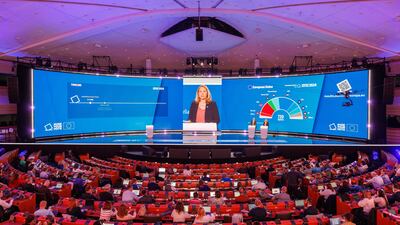
European Parliament representative Delphine Collard presents the election results in Brussels. EPA -
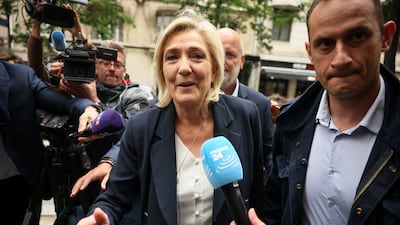
French far-right leader Marine Le Pen arrives at the National Rally party headquarters in Paris. AP -

European Commission President Ursula von der Leyen receives flowers from Christian Democratic Union party leader Friedrich Merz in Berlin. AP -
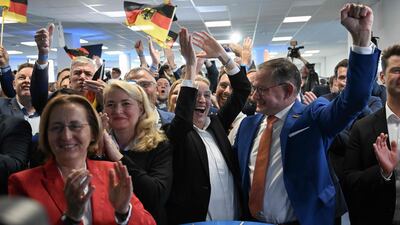
Members of the Alternative for Germany (AfD) party cheer after first exit polls in Berlin. AFP -
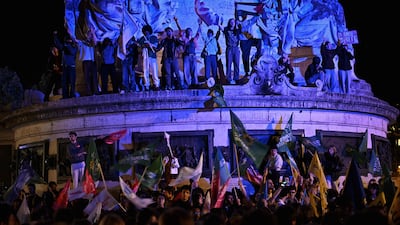
Several hundred people demonstrate on Republique square in central Paris against the victory of French far-right party Rassemblement National (RN) in the European elections, taking a position of strength in the early legislative elections called by French President after the election results, in Paris, on June 9, 2024. (Photo by Arnaud FINISTRE / AFP) -

German Chancellor Olaf Scholz arrives to attend a meeting with the leadership of his social democratic SPD party in Berlin. AFP -

Sigrid Friis and Martin Lidegaard of the Social Liberal Party at an election party in Copenhagen, Denmark. AFP -
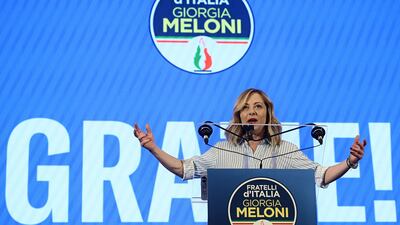
Italy's Prime Minister Giorgia Meloni, leader of the far-right party Brothers of Italy, speaks after the results in Rome. AFP -

Election officials count the votes in the city of Gyor, north-western Hungary. EPA -

This screen shot shows France's President Emmanuel Macron speaking during a televised address to the nation during which he announced he is dissolving the National Assembly, French Parliament lower house, and calls new general elections on June 30, in Paris on June 9, 2024. (Photo by Ludovic MARIN / AFP)



